Reptiles Guide
Copperhead
What Is a Copperhead? The copperhead (Agkistrodon contortrix) is a venomous pit viper native to the central and eastern United States. It is named for the warm copper-to-orange coloring of its head, and it is one of the …
At a glance
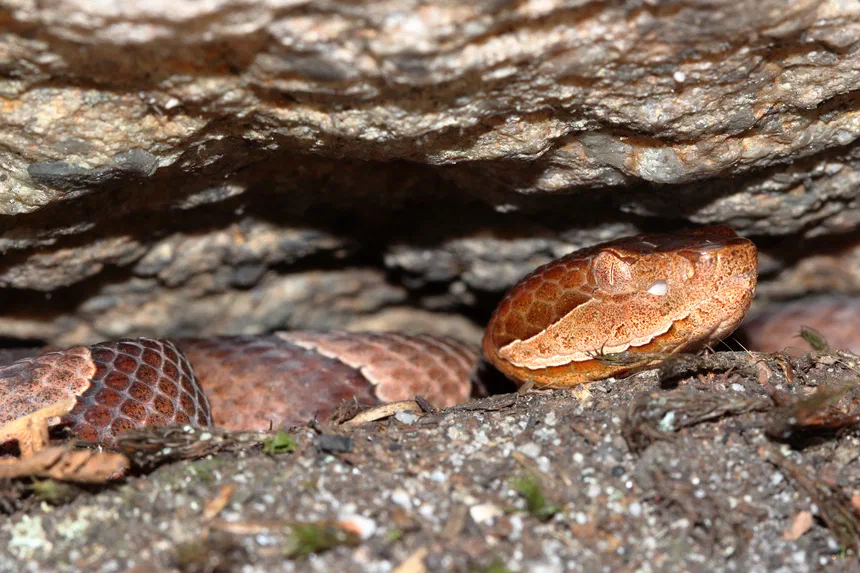
Image: Riley Stanton — CC BY-SA 4.0 · source
What Is a Copperhead?
The copperhead (Agkistrodon contortrix) is a venomous pit viper native to the central and eastern United States. It is named for the warm copper-to-orange coloring of its head, and it is one of the most commonly encountered venomous snakes across much of its range. Despite its fearsome reputation, it is a relatively small, retiring snake that relies far more on camouflage than confrontation.
Appearance and Identification
Copperheads are stout-bodied snakes, typically 60 to 90 cm (2 to 3 feet) long, with a triangular head that is distinctly coppery or rusty in tone. Their most recognizable feature is a series of dark, chestnut-brown crossbands shaped like hourglasses or saddlebags, each pinched narrow along the spine and wider along the sides, set against a lighter tan or pinkish background. Like all pit vipers, they have heat-sensing pits between the eye and nostril and vertically slit pupils. Juveniles look much like adults but have a bright yellow or greenish tail tip, which they wiggle to lure prey.
Habitat and Range
The species occupies a broad swath of the central and eastern United States, from the Gulf Coast north into New England and west toward the southern Great Plains. It favors mixed and deciduous forests, especially areas with rocky outcrops, leaf litter, fallen logs, and brushy edges. Copperheads also thrive along stream corridors, wooded hillsides, and the transitional zones between forest and field, and they tolerate suburban settings such as wood piles, gardens, and overgrown lots surprisingly well.
Diet
Copperheads are ambush carnivores that eat a wide variety of small animals. Adults take mostly rodents such as mice and voles, but the diet also includes frogs, lizards, small birds, and large insects like cicadas and caterpillars. A copperhead typically waits motionless, camouflaged among leaves, and strikes rapidly when prey passes within range. It injects venom, releases larger prey to avoid injury, and then follows the scent trail to the immobilized animal before swallowing it whole.
Behavior
This is a mostly solitary, secretive snake that spends much of the day hidden and becomes more active around dusk and after dark, especially in hot weather. Its camouflage is its first line of defense; a threatened copperhead usually freezes and relies on its pattern to blend into the forest floor. When alarmed, it may vibrate its tail against dry leaves, producing a buzzing sound, and it can release a musky, cucumber-like scent. Bites to humans are common but rarely fatal, as copperhead venom is comparatively mild among North American vipers. In colder regions, copperheads gather to overwinter, or brumate, in communal dens, sometimes alongside other snake species.
Life Cycle and Reproduction
Copperheads mate primarily in spring, with some autumn breeding as well. Females are ovoviviparous, meaning the eggs develop inside the body and the young are born live, usually in late summer or early fall. A litter commonly numbers from about 3 to 10 young, each roughly 18 to 25 cm long and fully venomous at birth. Females do not provide parental care, and the newborns disperse to hunt on their own, using their yellow tail tips to attract prey. Copperheads reach sexual maturity at around four years and may live 15 to 18 years in the wild.
Conservation Status
The copperhead is listed as Least Concern by the IUCN, reflecting a wide distribution and generally stable populations. It remains common across most of its range and adapts reasonably well to human-altered landscapes. Localized declines can occur through habitat loss, road mortality, and deliberate killing by people who fear venomous snakes. As a mid-level predator, the copperhead helps regulate rodent and insect populations, making it a beneficial part of the ecosystems it inhabits.
Frequently Asked Questions
Are copperhead bites dangerous to people? Copperhead bites are painful and require medical attention, but their venom is relatively weak, and deaths are extremely rare. Most bites cause localized swelling and pain rather than life-threatening effects.
How can I recognize a copperhead? Look for a coppery head and dark hourglass-shaped crossbands that are narrow across the back and wide along the sides, set on a tan or pinkish body.
Where are copperheads most likely to be found? They favor wooded, rocky habitats with plenty of leaf litter and cover, and they are often encountered near wood piles, stone walls, and forest edges.