Reptiles Guide
Chinese Water Dragon
What Is a Chinese Water Dragon? The Chinese water dragon (Physignathus cocincinus) is a medium-sized, tree-dwelling lizard in the agamid family, native to the forests and waterways of Southeast Asia. Named for its strong …
At a glance
What Is a Chinese Water Dragon?
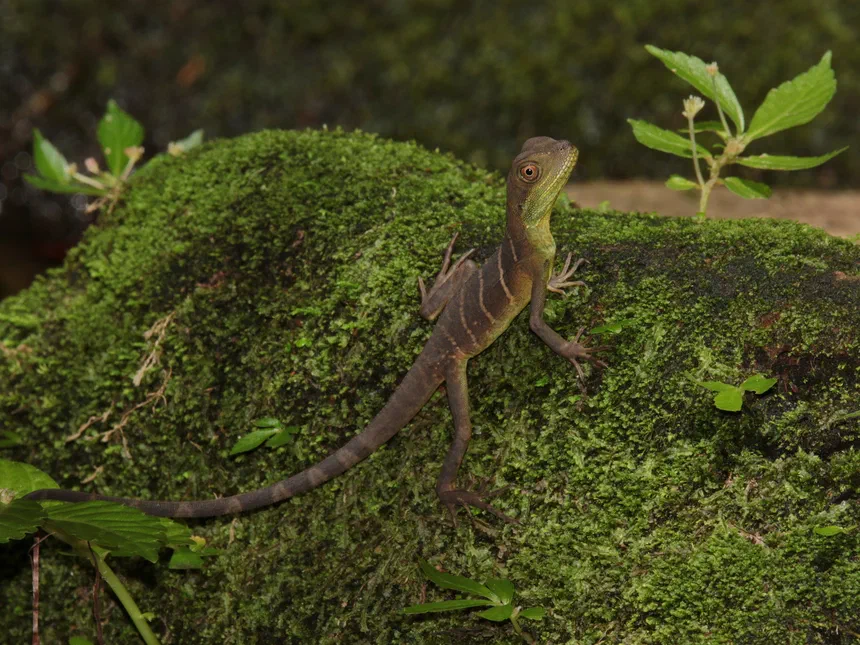
The Chinese water dragon (Physignathus cocincinus) is a medium-sized, tree-dwelling lizard in the agamid family, native to the forests and waterways of Southeast Asia. Named for its strong association with rivers and streams, it is an agile climber and a capable swimmer. Its vivid green coloring and spiny crest have also made it a familiar species in the reptile-keeping hobby.
Appearance and Identification
This lizard is typically bright green to teal, often marked with faint diagonal bands of paler green, turquoise, or cream along the flanks. A row of soft, pointed crest scales runs from the neck down the back and onto the base of the long, laterally flattened tail, which can account for more than half of the animal’s total length. Adults generally reach about 2 to 3 feet (0.6 to 0.9 m) overall. Males grow larger, with a broader head, a more pronounced crest, and heavier jowls than females. The throat is frequently washed with yellow, orange, or pink. Like many agamids, the species has a small pale spot on the top of the head, the parietal or “third” eye, which is sensitive to light.
Habitat and Range
Chinese water dragons live in humid lowland and hill forests across mainland Southeast Asia, including parts of southern China, Vietnam, Laos, Cambodia, Thailand, and Myanmar. They favor densely vegetated banks along rivers, streams, and pools, where overhanging branches give them both basking sites and quick escape routes. Water is central to their lives: when threatened, a dragon will often drop from a branch straight into the water and swim or remain submerged until the danger passes.
Diet
The species is an omnivore that leans heavily toward animal prey. Insects such as crickets, grasshoppers, and beetles make up much of the diet, supplemented by spiders, worms, and other invertebrates. Larger individuals will also take small vertebrates, including fish, amphibians, small reptiles, and the occasional nestling or small mammal. Plant matter, fruit, and flowers round out the diet, particularly for juveniles and in seasons when insects are scarce.
Behavior
Chinese water dragons are diurnal and spend much of the day basking or foraging among branches near water. They are generally shy and rely on camouflage and rapid flight rather than confrontation, though males can be territorial toward one another and use head-bobbing, arm-waving, and crest displays to signal status. Strong limbs and a long tail make them nimble climbers, and their flattened tail doubles as a paddle for swimming. Being ectothermic, they thermoregulate by moving between sunlit perches and shade through the day.
Life Cycle and Reproduction
Breeding is tied to seasonal warmth and rainfall. After mating, a female digs a shallow nest in moist, sandy soil near water and lays a clutch of roughly 6 to 15 eggs, sometimes producing more than one clutch in a favorable year. The eggs are left to incubate in the warmth of the ground for around two to three months, and hatchlings emerge fully independent, already able to climb, swim, and hunt small insects. Sexual maturity is usually reached within the first couple of years. In the wild, individuals commonly live about 10 to 15 years, and well-cared-for captives can live longer.
Conservation Status
The Chinese water dragon is listed as Vulnerable on the IUCN Red List. Populations have declined under pressure from habitat loss as forests and riverside vegetation are cleared, along with heavy collection for the food trade and the international pet market. Because the species depends on intact streamside habitat, protecting forested waterways and regulating wild harvest are key to its long-term survival.
Frequently Asked Questions
Are Chinese water dragons good swimmers? Yes. They are strong swimmers and will readily dive into water to escape predators, using their long, flattened tail to propel themselves and staying submerged for extended periods.
How big do Chinese water dragons get? Most adults reach about 2 to 3 feet in total length, with the tail making up well over half of that. Males tend to be larger and more heavily built than females.
What do Chinese water dragons eat? They are omnivores. The bulk of the diet is insects and other invertebrates, supplemented by small vertebrates such as fish and amphibians, plus some fruit and plant matter.