Reptiles Guide
Burmese Python
What Is a Burmese Python? The Burmese python (Python bivittatus) is one of the largest snake species in the world, a nonvenomous constrictor native to the tropics of South and Southeast Asia. Renowned for its impressive …
At a glance
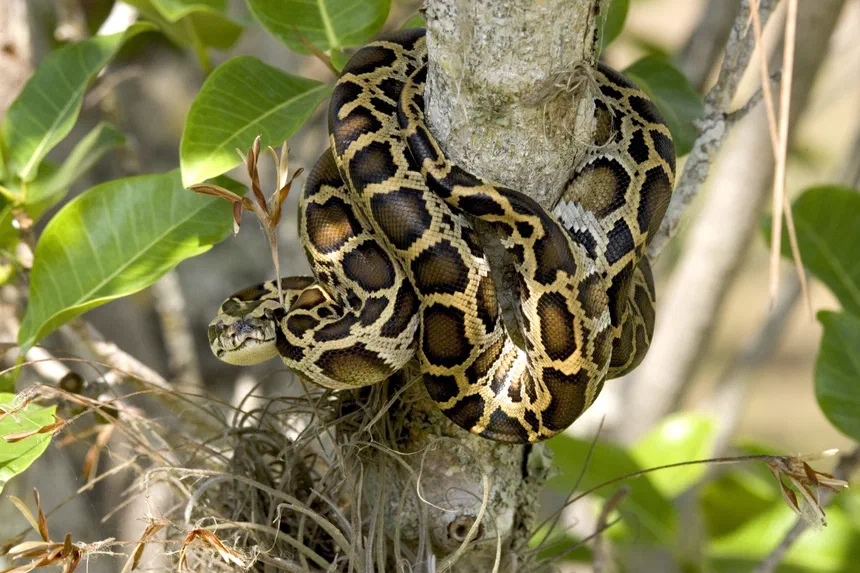
Image: Everglades NPS from Homestead, Florida, United States — Public domain · source
What Is a Burmese Python?
The Burmese python (Python bivittatus) is one of the largest snake species in the world, a nonvenomous constrictor native to the tropics of South and Southeast Asia. Renowned for its impressive length and patterned skin, it is a familiar animal in the exotic pet trade and, more troublingly, an established invasive species in parts of the United States.
Appearance and Identification
Burmese pythons are heavy-bodied snakes with a tan or light-brown base color overlaid by large, dark chocolate-brown blotches edged in black, a pattern often likened to a giraffe’s markings. A distinctive arrowhead-shaped marking typically runs along the top of the head. Adults commonly reach 10 to 16 feet (3 to 5 meters), with exceptional individuals exceeding 18 feet. Females are generally larger and bulkier than males. Like other pythons, they have heat-sensing pits along the jaw that help them detect warm-blooded prey.
Habitat and Range
This species occupies a wide range of habitats, including grasslands, marshes, swamps, rocky foothills, woodlands, and river valleys. Access to permanent water is important, and Burmese pythons are strong swimmers that can remain submerged for extended periods. Their native range spans much of South and Southeast Asia, from eastern India and Nepal through Myanmar, Thailand, and southern China to parts of Indonesia. A large invasive population has become established in the Florida Everglades, likely from released or escaped pets, where the warm, wet environment closely mirrors their native conditions.
Diet
Burmese pythons are ambush predators and strict carnivores. They feed primarily on birds and mammals, seizing prey with their sharp, backward-curving teeth and then coiling around it to constrict, cutting off blood flow until the animal succumbs. Prey is swallowed whole, head first, and their highly elastic jaws and expandable bodies allow them to consume animals much wider than their own heads. In Florida, they have taken prey as large as deer and alligators, and their appetite has contributed to steep declines in native mammal populations.
Behavior
These pythons are largely solitary and most active at dusk and after dark, though they will bask during cooler daylight hours. They are generally slow-moving and rely on camouflage rather than speed, remaining motionless for long stretches while awaiting prey. After a large meal, a python may go weeks or even months before feeding again. Although powerful, they are not aggressive toward humans by nature and typically retreat when possible, striking mainly in defense or when mistaking a hand for food.
Life Cycle and Reproduction
Burmese pythons are egg-layers. Following mating, usually in the cooler early months of the year, a female produces a clutch that can range from a dozen to more than fifty eggs, with very large females capable of laying even more. She coils protectively around the clutch and can generate warmth through muscular shivering to help incubate the eggs, which hatch after roughly two months. Hatchlings are independent from birth, already measuring around 2 feet long, and grow rapidly during their first years. Sexual maturity is typically reached within a few years.
Conservation Status
In its native range, the Burmese python is listed as Vulnerable by the IUCN. Populations have declined due to habitat loss, collection for the skin and pet trades, and hunting for meat and traditional uses. This creates a striking paradox: while the species faces pressure at home, its introduced population in the United States thrives and is managed as a harmful invasive that damages native ecosystems.
Frequently Asked Questions
Are Burmese pythons dangerous to people? They are nonvenomous and rarely attack humans, but very large individuals are powerful enough to be hazardous, so caution and proper handling are always advised.
Why are they a problem in Florida? Escaped and released pets established a breeding population in the Everglades, where they prey heavily on native wildlife and have no natural predators.
How big can they really get? Most adults are 10 to 16 feet long, though the largest recorded individuals have surpassed 18 feet and weighed well over 150 pounds.
References
The conservation status and key facts in this profile are supported by these sources:
- GBIF — Python bivittatus (Burmese python) (accessed 2026-08-06)
- U.S. Fish & Wildlife Service — Burmese python (Python bivittatus) (accessed 2026-08-06)
Found an error, source problem, or image concern? Report this page.