Reptiles Guide
Eastern Box Turtle
What Is a Eastern Box Turtle? The Eastern box turtle (Terrapene carolina) is a small, land-dwelling turtle native to the eastern and central United States. It is best known for the high, dome-shaped shell and the hinged …
At a glance
What Is a Eastern Box Turtle?
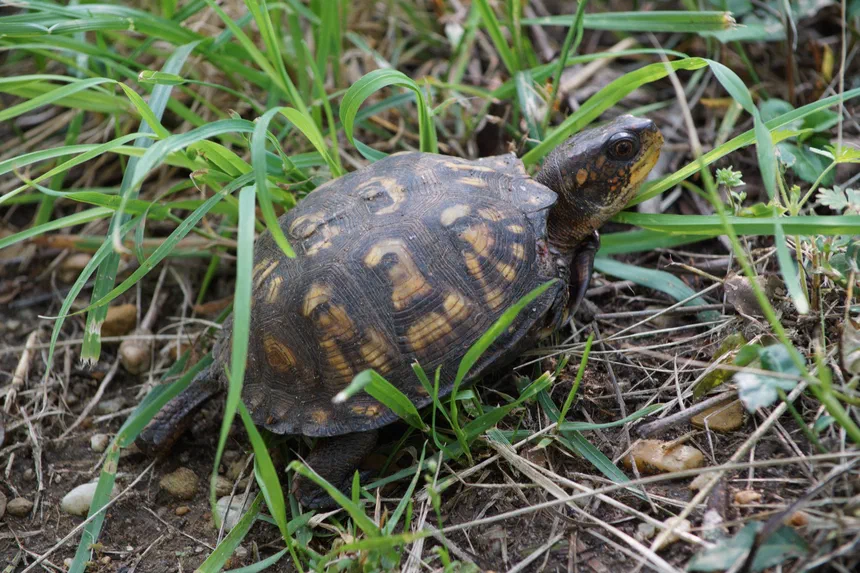
The Eastern box turtle (Terrapene carolina) is a small, land-dwelling turtle native to the eastern and central United States. It is best known for the high, dome-shaped shell and the hinged lower plate that lets the animal close itself completely inside, like a box. Unlike most turtles, it is almost entirely terrestrial and rarely enters deep water.
Appearance and Identification
This turtle has a rounded, dome-like upper shell (carapace) that usually reaches about 4.5 to 6 inches (11 to 15 cm) in length. The shell is dark brown or black and marked with a variable pattern of yellow, orange, or olive blotches and lines, so no two individuals look exactly alike. A flexible hinge across the lower shell (plastron) allows the turtle to seal its head, legs, and tail inside for protection. Males and females can often be told apart by eye color: males frequently have bright red or orange eyes, while females tend to have brown or yellowish eyes. Males also have a slightly concave plastron and a longer, thicker tail.
Habitat and Range
Eastern box turtles occupy moist woodlands, forest edges, meadows, and the margins of wetlands across the eastern and central United States, from Maine and the Great Lakes south to Florida and the Gulf Coast. They favor areas with leaf litter, fallen logs, and soft soil for burrowing. Access to shallow water, damp mud, and shaded cover is important because these turtles need humidity and can overheat in prolonged direct sun. Individuals are strongly tied to a small home range, often living their entire lives within a few acres.
Diet
The Eastern box turtle is an omnivore with a diet that shifts with age and season. Young turtles are more carnivorous, feeding heavily on insects, earthworms, snails, slugs, and other small invertebrates. As they mature, plant matter becomes more important, including berries, fallen fruit, leaves, flowers, and mushrooms. They are known to eat fungi that are toxic to many other animals. Foraging usually takes place in the morning or after rain, when prey is active and the ground is moist.
Behavior
These turtles are diurnal and most active in warm, humid weather. On hot afternoons they retreat into leaf litter, shallow burrows, or muddy hollows to stay cool, and during dry spells they may soak in puddles or shallow water. In colder regions they hibernate through winter, digging into loose soil, mud, or the base of decaying logs below the frost line. Box turtles are slow-moving and rely on their shell rather than speed for defense, withdrawing and sealing themselves shut when threatened. They show remarkable site fidelity and strong homing instincts, often returning to familiar ground if displaced.
Life Cycle and Reproduction
Mating occurs mainly in spring and again in the fall. Females can store sperm for years, sometimes producing fertile eggs long after a single mating. In early summer a female digs a shallow nest in loose, sunny soil and lays a small clutch, typically three to eight elongated eggs. She provides no further care. The eggs hatch after roughly two to three months, and the temperature of the nest can influence the sex of the young. Hatchlings are highly vulnerable to predators and grow slowly, often taking five to ten years to reach breeding maturity. Individuals are exceptionally long-lived, commonly reaching 30 to 50 years and occasionally much older.
Conservation Status
The Eastern box turtle is listed as Vulnerable on the IUCN Red List, and populations have declined across much of its range. Major threats include habitat loss and fragmentation, road mortality, and collection for the pet trade. Their slow reproduction and late maturity make it hard for populations to recover once numbers drop. Many states now restrict or prohibit taking them from the wild. Keeping habitat connected and helping turtles cross roads safely are among the most effective ways to support them.
Frequently Asked Questions
Are Eastern box turtles good pets? They can live for decades and have specific habitat, humidity, and diet needs, so they are a serious long-term commitment. Because wild collection harms populations, wild turtles should be left in place.
Why can they close up completely? A hinge across the lower shell lets the turtle pull the front and back plates tight against the upper shell, sealing itself inside as a defense against predators.
How long do they live? Most wild individuals live 30 to 50 years, and some are documented to survive well beyond that when conditions are favorable.
References
The conservation status and key facts in this profile are supported by these sources:
- Animal Diversity Web — Terrapene carolina (accessed 2026-08-06)
- GBIF — Terrapene carolina (accessed 2026-08-06)
- ITIS — Terrapene carolina (Eastern Box Turtle) (accessed 2026-08-06)
Found an error, source problem, or image concern? Report this page.