Reptiles Guide
Boa Constrictor
What Is a Boa Constrictor? The boa constrictor (Boa constrictor) is a large, non-venomous snake native to tropical and subtropical parts of the Americas. As its name suggests, it subdues prey by constriction rather than …
At a glance
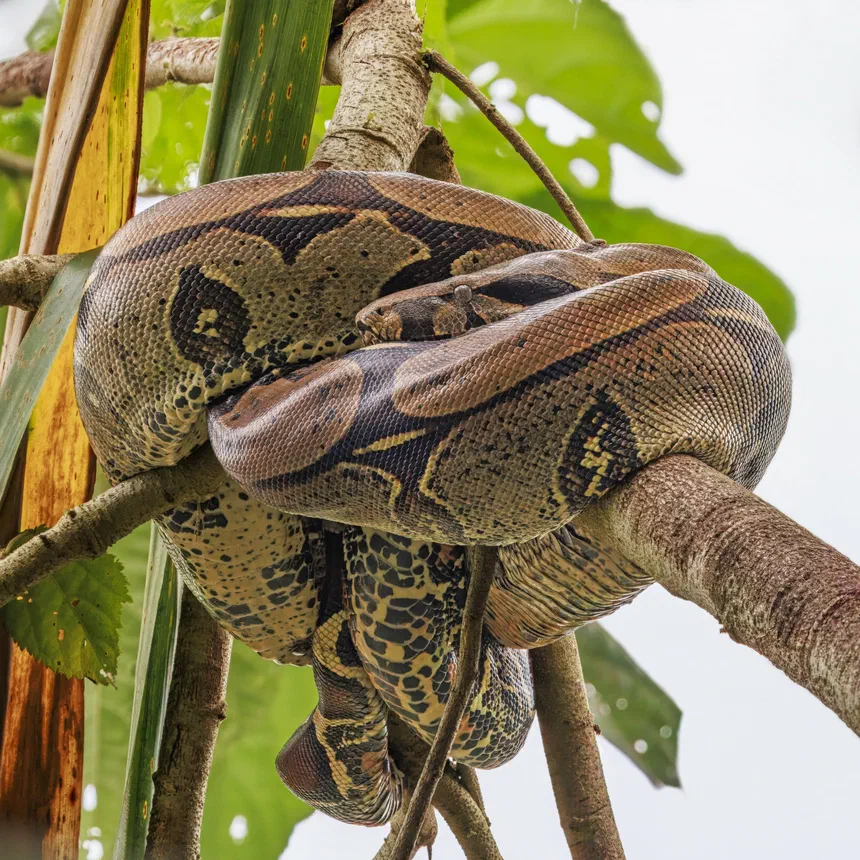
Image: Charles J. Sharp — CC BY-SA 4.0 · source
What Is a Boa Constrictor?
The boa constrictor (Boa constrictor) is a large, non-venomous snake native to tropical and subtropical parts of the Americas. As its name suggests, it subdues prey by constriction rather than venom, wrapping muscular coils around an animal until it can no longer breathe. It is one of the most widely recognized snakes in the world and a popular species in the exotic pet trade.
Appearance and Identification
Boa constrictors are heavy-bodied snakes with a broad, triangular head that is distinctly wider than the neck. Their base color ranges from tan and cream to gray or brown, overlaid with a series of dark, saddle-shaped blotches that become bolder and more reddish toward the tail, giving rise to the nickname “red-tailed boa.” A dark stripe often runs from the snout through each eye. Coloration varies considerably across the species’ large range, and captive breeding has produced many color and pattern morphs. Adults typically measure 6 to 10 feet in length, with females generally larger and heavier than males.
Habitat and Range
This adaptable snake occupies an unusually wide variety of environments. It is found from northern Mexico south through Central America and across much of South America to Argentina, as well as on several offshore islands. Boa constrictors inhabit tropical rainforest, dry forest, savanna, scrubland, and even semi-desert. Young snakes are often arboreal, climbing readily through trees and shrubs, while heavier adults tend to spend more time on the ground. They frequently shelter in hollow logs, rock crevices, or the abandoned burrows of other animals, and are commonly found near water.
Diet
Boa constrictors are ambush predators and strict carnivores. They rely on heat-sensing ability, keen sight, and a well-developed sense of smell to detect warm-blooded prey. Their diet includes rodents, birds, bats, lizards, and other small to medium-sized mammals; larger individuals can take prey as large as a small deer or wild pig on occasion. When hunting, the snake strikes and seizes the animal with its backward-curving teeth, then quickly throws several coils around it. Rather than crushing bones, the coils tighten each time the prey exhales, cutting off circulation and breathing. Prey is swallowed whole, head first, and a large meal can sustain the snake for weeks.
Behavior
Boa constrictors are mostly solitary and nocturnal, resting in cover during the day and becoming active at dusk to hunt. They are generally slow-moving and rely on camouflage to avoid detection rather than on speed. When threatened, a boa may hiss loudly, coil defensively, and strike, but it is not aggressive by nature and lacks venom. These snakes are strong swimmers and capable climbers. Like all reptiles, they are ectothermic and regulate their body temperature by moving between sun and shade.
Life Cycle and Reproduction
Boa constrictors are ovoviviparous, meaning females retain the eggs inside their bodies and give birth to live young. After a gestation of roughly five to seven months, a female produces a litter that can range from a handful to more than fifty offspring, though litters of around 20 to 30 are common. Newborns are fully independent at birth, measuring roughly 15 to 20 inches long, and receive no parental care. They grow quickly during their first years and reach sexual maturity at about two to four years of age. In the wild, boa constrictors commonly live 20 to 30 years, and individuals in captivity have exceeded that.
Conservation Status
The boa constrictor is listed as Least Concern by the IUCN, reflecting its wide distribution and adaptability. The species is included in CITES Appendix II, which regulates international trade, and one subspecies is more strictly protected. Localized populations can be pressured by habitat loss and by collection for the skin and pet trades, but the species as a whole remains widespread and reasonably secure. Introduced populations have also established in a few areas outside the native range.
Frequently Asked Questions
Are boa constrictors venomous? No. Boa constrictors are non-venomous and kill prey by constriction. They pose little danger to humans, though a large individual can deliver a painful bite.
How big do boa constrictors get? Most adults reach 6 to 10 feet, with females typically larger than males. Exceptionally large individuals can approach 12 feet.
Do boa constrictors lay eggs? No. Unlike many snakes, they give birth to live young, producing litters that often number 20 to 30 offspring.
References
The conservation status and key facts in this profile are supported by these sources:
- Animal Diversity Web — Boa constrictor (accessed 2026-08-06)
- GBIF — Boa constrictor Linnaeus, 1758 (accessed 2026-08-06)
Found an error, source problem, or image concern? Report this page.