Reptiles Guide
Black Mamba
What Is a Black Mamba? The black mamba (Dendroaspis polylepis) is a large, fast-moving venomous snake native to sub-Saharan Africa. It is one of the continent’s most feared reptiles, known for its potent neurotoxic …
At a glance
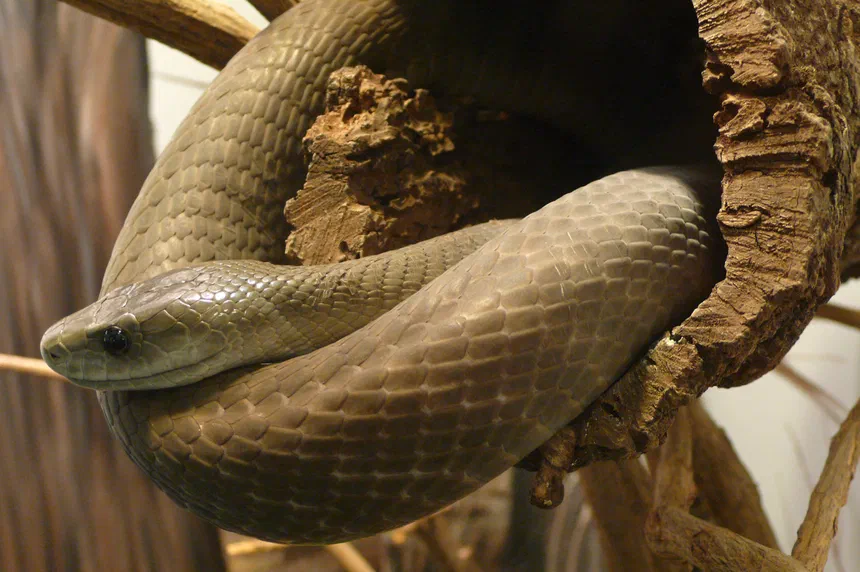
Image: TimVickers — Public domain · source
What Is a Black Mamba?
The black mamba (Dendroaspis polylepis) is a large, fast-moving venomous snake native to sub-Saharan Africa. It is one of the continent’s most feared reptiles, known for its potent neurotoxic venom, alert temperament, and remarkable speed. Despite its name, the snake is not actually black.
Appearance and Identification
The common name refers not to the animal’s skin but to the ink-black lining of its mouth, which it displays as a warning when threatened. The body itself ranges from gunmetal gray to olive, brown, or khaki, often paler on the belly. Adults typically measure about 2 to 3 meters (roughly 6.5 to 10 feet), with exceptional individuals approaching 4 meters, making the black mamba one of the longest venomous snakes in the world. The head is narrow and coffin-shaped, and the eyes are medium-sized with round pupils. Its slender, streamlined build helps it move quickly across the ground.
Habitat and Range
Black mambas are found across much of eastern and southern Africa, from Ethiopia and Somalia down through Kenya, Tanzania, and into South Africa, with populations in parts of West Africa as well. They favor warm, moderately dry environments such as savanna, scrub, open woodland, and rocky outcrops. Unlike the arboreal green mambas, the black mamba is largely terrestrial, though it climbs readily. Individuals often adopt a fixed lair, such as a termite mound, hollow tree, rock crevice, or abandoned burrow, returning to the same shelter over long periods.
Diet
The black mamba is a carnivore that hunts warm-blooded prey. Its diet consists mainly of small mammals, including rodents, hyraxes, and bushbabies, along with birds. It hunts by both ambush and active pursuit, striking quickly and delivering a venomous bite. Rather than holding onto struggling prey, it typically releases the animal after biting and waits for the fast-acting venom to take effect before swallowing it whole. Powerful digestive processes allow the snake to consume relatively large meals.
Behavior
Black mambas are diurnal, doing most of their hunting and basking during daylight. They are famously fast, capable of moving at speeds of around 11 to 19 kilometers per hour (7 to 12 miles per hour) over short distances, though these bursts are used mainly to reach shelter rather than to chase people. The species has a reputation for nervousness and will usually flee when it can. If cornered, it may rear up, spread a narrow hood, gape to show the black mouth, and hiss before striking. Its venom is a mix of potent neurotoxins and cardiotoxins, and an untreated bite can be fatal, though antivenom is effective when administered promptly.
Life Cycle and Reproduction
Breeding generally occurs in the warmer months, when rival males engage in ritualized wrestling contests to compete for females, twisting their bodies together without biting. The black mamba is oviparous, meaning it lays eggs. A female deposits a clutch of roughly 6 to 17 eggs in a warm, humid hidden spot such as a burrow or decaying vegetation. She does not guard the clutch. The eggs incubate for two to three months, and hatchlings emerge fully independent, measuring around 40 to 60 centimeters and already equipped with functional venom. Young snakes grow quickly.
Conservation Status
The black mamba is listed as Least Concern by the IUCN, reflecting its wide distribution and generally stable populations across a large range. It faces no major species-wide threats, though localized declines can result from habitat loss and from persecution by people who fear it. Its ecological role as a predator of rodents makes it a valuable, if unwelcome, neighbor in many rural areas.
Frequently Asked Questions
Why is it called a black mamba if it isn’t black? The name comes from the deep black interior of its mouth, which it displays when threatened, not from the color of its skin, which is usually gray or brown.
How dangerous is a black mamba bite? Its venom is highly toxic and can be lethal without treatment, but bites are relatively rare because the snake prefers to flee. Prompt antivenom greatly improves survival.
How fast can a black mamba actually move? It is one of the fastest snakes, reaching about 11 to 19 kilometers per hour in short bursts, typically used to escape to safety rather than to attack.
References
The conservation status and key facts in this profile are supported by these sources:
- Animal Diversity Web — Dendroaspis polylepis (Black Mamba) (accessed 2026-08-06)
- GBIF — Dendroaspis polylepis Günther, 1864 (accessed 2026-08-06)
Found an error, source problem, or image concern? Report this page.