Reptiles Guide
Bearded Dragon
What Is a Bearded Dragon? The bearded dragon (Pogona vitticeps), often called the central or inland bearded dragon, is a medium-sized lizard native to the dry interior of Australia. It belongs to the agamid family and …
At a glance
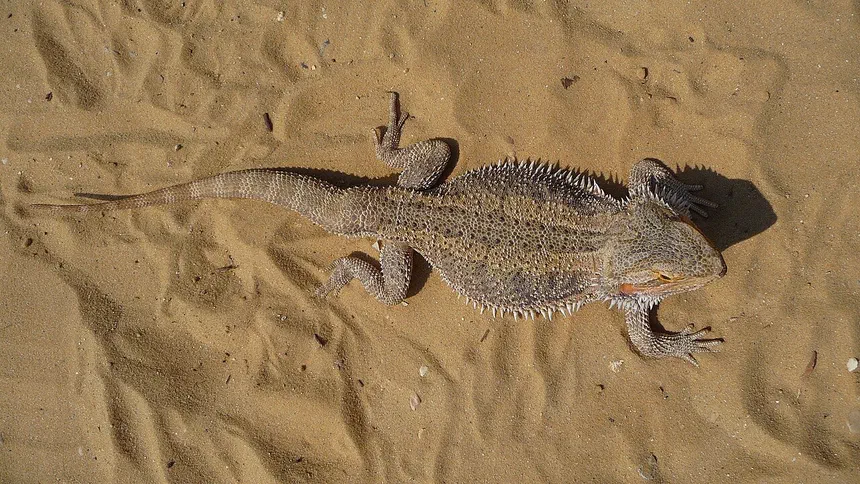
Image: George Chernilevsky — Public domain · source
What Is a Bearded Dragon?
The bearded dragon (Pogona vitticeps), often called the central or inland bearded dragon, is a medium-sized lizard native to the dry interior of Australia. It belongs to the agamid family and takes its name from the spiny pouch of skin beneath its throat, which it can puff out and darken when threatened or displaying. Calm and easily handled, it has become one of the most popular reptiles kept as a pet worldwide.
Appearance and Identification
Bearded dragons are stout, flattened lizards that typically reach 16 to 24 inches (40 to 60 cm) in total length, roughly half of which is tail. Their coloration ranges from sandy tan and gray to brown and reddish, often with subtle banding that helps them blend into arid surroundings. Rows of soft, spiny scales run along the flanks and frame the throat, forming the namesake “beard.” A broad, triangular head, sturdy limbs, and a tapering tail complete the profile. Individuals can lighten or darken their skin somewhat in response to temperature, mood, and light.
Habitat and Range
This species is found across central and eastern Australia, favoring warm, semi-arid environments such as open woodland, rocky scrub, and desert margins. Bearded dragons are semi-arboreal and frequently climb onto fence posts, low branches, and rocks to bask and survey their surroundings. Their range spans habitats where daytime temperatures are high and rainfall is limited, conditions to which their physiology is well suited.
Diet
Bearded dragons are omnivores whose diet shifts with age. Juveniles eat a larger proportion of insects and other invertebrates, which supply the protein needed for rapid growth, while adults consume more plant material such as leaves, flowers, and fruit. Common prey includes beetles, ants, crickets, and other small arthropods. This flexible, opportunistic feeding strategy allows them to thrive in an environment where food availability varies seasonally.
Behavior
Bearded dragons are largely diurnal and spend much of the day basking to regulate their body temperature. They are known for a repertoire of visual signals: an inflated, darkened beard and an open mouth serve as threat displays, while a slow, circular “arm-waving” motion appears to signal submission or awareness of another dragon. Head-bobbing is used in both dominance and courtship. During periods of cold weather, they may enter brumation, a reptilian form of dormancy in which activity and feeding sharply decline.
Life Cycle and Reproduction
Bearded dragons are egg-laying reptiles. Following courtship, which involves head-bobbing by males and arm-waving by females, a female digs a burrow and deposits a clutch that commonly numbers around 15 to 30 eggs, though larger clutches occur. She may produce more than one clutch in a favorable season. The eggs incubate in the warmth of the soil for roughly two to three months before hatching, and the young are independent from birth. Sexual maturity is generally reached within the first one to two years. In the wild, typical lifespans fall around 6 to 10 years, while well-cared-for captive animals often live longer.
Conservation Status
The bearded dragon is listed as Least Concern by the IUCN, reflecting a wide distribution and stable populations across its Australian range. It is not considered threatened, although habitat change and road mortality can affect local numbers. Australia prohibits the export of native wildlife, so animals in the international pet trade are captive-bred rather than wild-caught.
Frequently Asked Questions
Why is it called a bearded dragon? When alarmed or displaying, the lizard puffs out and darkens the spiny skin under its throat, creating the appearance of a dark “beard.”
Are bearded dragons dangerous to people? No. They are docile, non-venomous lizards. Their threat displays are directed at rivals and predators, and they rarely bite unless severely provoked.
What do bearded dragons eat? They are omnivores, eating a mix of insects and plant matter. Younger dragons rely more heavily on insects, while adults eat proportionally more greens, flowers, and fruit.
References
The conservation status and key facts in this profile are supported by these sources:
- Animal Diversity Web — Pogona vitticeps (accessed 2026-08-06)
- GBIF — Pogona vitticeps (Ahl, 1926) (accessed 2026-08-06)
Found an error, source problem, or image concern? Report this page.