Reptiles Guide
Ball Python
What Is a Ball Python? The ball python (Python regius) is a small, nonvenomous constricting snake native to the grasslands and forests of West and Central Africa. It takes its common name from its defensive habit of …
At a glance
What Is a Ball Python?
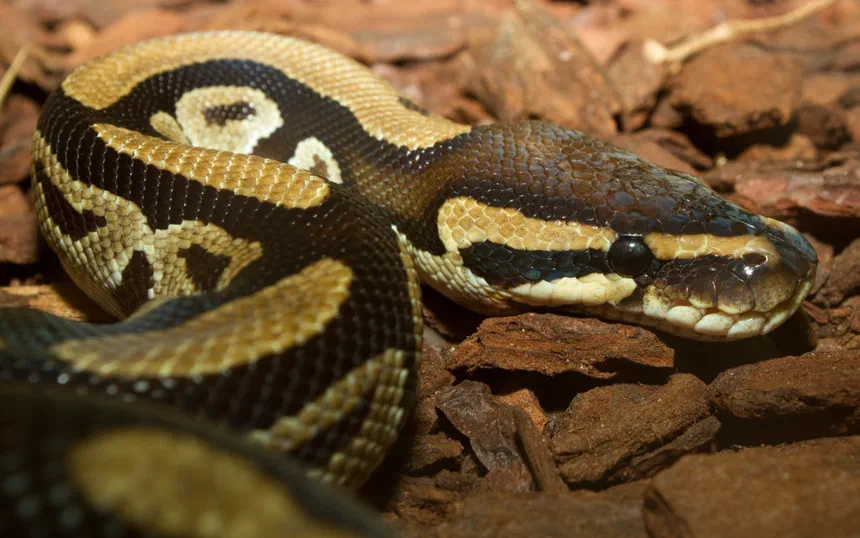
The ball python (Python regius) is a small, nonvenomous constricting snake native to the grasslands and forests of West and Central Africa. It takes its common name from its defensive habit of curling into a tight ball with its head tucked in the center when threatened. Prized for its docile temperament and striking patterns, it is one of the most widely kept pet snakes in the world.
Appearance and Identification
Ball pythons are stocky, muscular snakes with a relatively short, thick body and a small, narrow head. Wild individuals typically display a base color of dark brown to black overlaid with rounded, tan or gold blotches along the back and sides, providing effective camouflage in dry grass and leaf litter. The belly is usually pale cream or white. Adults commonly reach 3 to 5 feet (0.9 to 1.5 meters) in length, with females generally larger and heavier than males. Decades of captive breeding have produced hundreds of color and pattern variations, known as “morphs,” but these do not occur in wild populations.
Habitat and Range
This species occurs across a broad band of sub-Saharan West and Central Africa, from Senegal and Guinea eastward through Nigeria to Sudan and Uganda. Ball pythons favor open habitats such as savanna, grassland, and the edges of forests, often near agricultural land. They are strongly associated with rodent burrows and termite mounds, which offer shelter from heat and predators. Much of their life is spent underground or hidden in these refuges, emerging mainly at dusk and after dark.
Diet
Ball pythons are carnivores that feed almost entirely on small warm-blooded prey. In the wild, their diet centers on rodents such as rats, mice, and gerbils, along with occasional small birds. Juvenile snakes and males tend to take smaller mammals and are more inclined to climb after birds, while larger females hunt bigger ground-dwelling rodents. Like all pythons, they are ambush predators: they seize prey with backward-curving teeth and quickly coil around it, tightening with each exhalation until the animal is subdued, then swallow it whole. An adult may go weeks or even months between meals, particularly during the dry season.
Behavior
Ball pythons are secretive, largely nocturnal, and generally slow-moving. They are non-aggressive by nature and rely on concealment rather than confrontation. When frightened and unable to flee, a ball python coils tightly around its own head, forming the compact ball that gives the species its name. They are solitary for most of the year, coming together only to breed. During the hottest, driest months, individuals may become inactive within burrows to conserve moisture and energy.
Life Cycle and Reproduction
Breeding typically follows the cooler, drier part of the year. Ball pythons are oviparous, meaning females lay eggs rather than giving live birth. A clutch usually contains around 4 to 11 leathery-shelled eggs, which the female coils around and incubates by shivering slightly to generate warmth. Incubation lasts roughly two months. Hatchlings emerge fully independent, measuring around 10 to 17 inches (25 to 43 centimeters), and receive no further parental care. They reach sexual maturity in about three to five years. Ball pythons are long-lived, commonly reaching 10 to 15 years in the wild and often surviving 20 to 30 years or more in captivity.
Conservation Status
The ball python is listed as Near Threatened by the IUCN. While still widespread, populations face pressure from large-scale collection for the international pet trade, hunting for skins and meat, and ongoing loss of habitat to agriculture. The species is listed on CITES Appendix II, which regulates its international commercial trade. Ranching operations in parts of West Africa aim to supply the pet market while reducing the impact on wild snakes, though the sustainability of these practices remains debated.
Frequently Asked Questions
Why is it called a ball python? When it feels threatened, the snake coils into a tight ball with its head protected in the middle, a defensive posture that inspired both its common name and the alternate name “royal python.”
Are ball pythons dangerous to humans? No. They are nonvenomous, relatively small, and have calm dispositions. A bite may occur if the snake feels cornered, but it poses little risk to people.
What do ball pythons eat? In the wild they eat mostly rodents and occasionally small birds, subduing prey by constriction before swallowing it whole.
References
The conservation status and key facts in this profile are supported by these sources:
- Animal Diversity Web — Python regius (accessed 2026-08-06)
- GBIF — Python regius (accessed 2026-08-06)
Found an error, source problem, or image concern? Report this page.