Reptiles Guide
Asian Water Monitor
What Is a Asian Water Monitor? The Asian water monitor (Varanus salvator) is one of the largest lizards in the world and a common sight along waterways across South and Southeast Asia. A powerful swimmer and …
At a glance
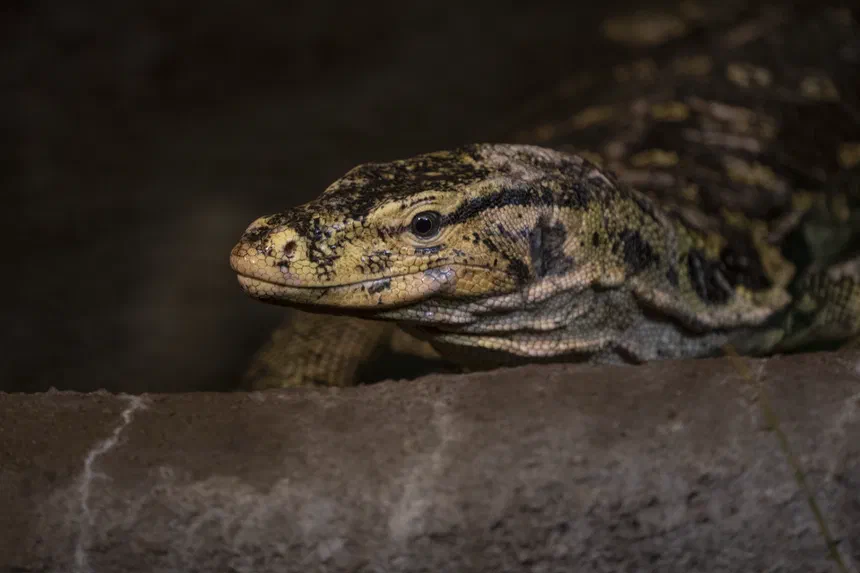
Image: Mira Meijer Burgers' Zoo — CC BY-SA 4.0 · source
What Is a Asian Water Monitor?
The Asian water monitor (Varanus salvator) is one of the largest lizards in the world and a common sight along waterways across South and Southeast Asia. A powerful swimmer and opportunistic feeder, it thrives in wetlands and, increasingly, in the ditches, canals, and parks of towns and cities. Its adaptability and wide range make it one of the most successful of all monitor lizards.
Appearance and Identification
Asian water monitors have a long, muscular body, a deep laterally flattened tail, and strong limbs tipped with sharp, curved claws. Adults commonly measure four to six feet from snout to tail, and unusually large individuals can grow longer and heavier still. The skin is dark brown to nearly black, patterned with rows of pale yellow spots, ocelli, and cross bands that tend to fade with age.
The head is elongated with a distinct snout, and the nostrils sit near the tip, an adaptation for a semiaquatic life. Like other monitors, this species has a long, deeply forked tongue that it flicks out constantly to sample scents in the air and on the ground. The flattened tail works as a paddle, driving the animal smoothly through water.
Habitat and Range
This species ranges from Sri Lanka and eastern India through much of mainland and island Southeast Asia, including Thailand, Malaysia, Indonesia, and the Philippines. Across this broad region it occupies many kinds of wetland, from mangrove forests and coastal swamps to rivers, lakes, and slow-moving streams.
Water monitors are rarely found far from water, though they climb well and often bask in trees overhanging rivers. They are notably tolerant of human activity and readily colonize agricultural canals, drainage ditches, fish ponds, and urban green spaces where food and cover are available.
Diet
The Asian water monitor is a broad carnivore and enthusiastic scavenger that eats almost any animal matter it can catch or find. Its diet includes fish, frogs, crabs, insects, rodents, birds, snakes, and the eggs of reptiles and birds, along with carrion of all kinds.
This willingness to scavenge makes the species an important cleanup agent in many ecosystems, where it consumes dead fish and other carcasses. Near settlements, monitors often forage at rubbish dumps, fish markets, and drainage channels, which helps explain their success in human-altered landscapes.
Behavior
Water monitors are active by day and are strong swimmers, capable of diving and remaining submerged for extended periods when threatened. They also climb and dig well, sheltering in burrows, hollow logs, or dense vegetation. When alarmed, an individual will typically flee to water, but a cornered animal can defend itself with lashing tail blows, scratching claws, and a strong bite.
Although often solitary, monitors may gather in numbers at abundant food sources such as carcasses. Like all reptiles, they rely on external warmth and spend part of the day basking to raise their body temperature before foraging.
Life Cycle and Reproduction
Asian water monitors reproduce by laying eggs. After mating, a female deposits a clutch that may contain roughly ten to thirty or more eggs, often placing them in a riverbank burrow, a rotting log, or even an active termite mound, where stable warmth and humidity aid incubation.
The eggs take several months to hatch, and the timing is often linked to seasonal rains. Hatchlings are brightly patterned, independent from birth, and spend much of their early life near water and in vegetation, where they hunt small prey and avoid the many predators that target young monitors.
Conservation Status
The Asian water monitor is listed as Least Concern on the IUCN Red List, reflecting its wide distribution, large population, and tolerance of disturbed habitats. Even so, it is heavily harvested in parts of its range for its skin, which supplies the leather trade, as well as for meat and the pet trade. International commerce is regulated under CITES, and while the species remains common overall, sustained hunting and wetland loss are pressures worth watching in some areas.
Frequently Asked Questions
Are Asian water monitors dangerous to people? They generally avoid humans and flee to water when disturbed. A cornered animal can bite and lash with its tail, so wild monitors are best observed from a distance, but unprovoked attacks are rare.
How big do they really get? Most adults are four to six feet long, but exceptionally large individuals can exceed that, making the species one of the longest lizards after the Komodo dragon.
Do they live in cities? Yes. Their adaptability lets them thrive in canals, parks, and drainage systems in many Asian cities, where they scavenge and hunt small animals.
References
The conservation status and key facts in this profile are supported by these sources:
- Animal Diversity Web — Varanus salvator (accessed 2026-08-06)
- GBIF — Varanus salvator (Laurenti, 1768) (accessed 2026-08-06)
Found an error, source problem, or image concern? Report this page.