Reptiles Guide
American Alligator
What Is a American Alligator? The American alligator (Alligator mississippiensis) is a large freshwater reptile native to the southeastern United States and one of only two alligator species in the world. A member of the …
At a glance
What Is a American Alligator?
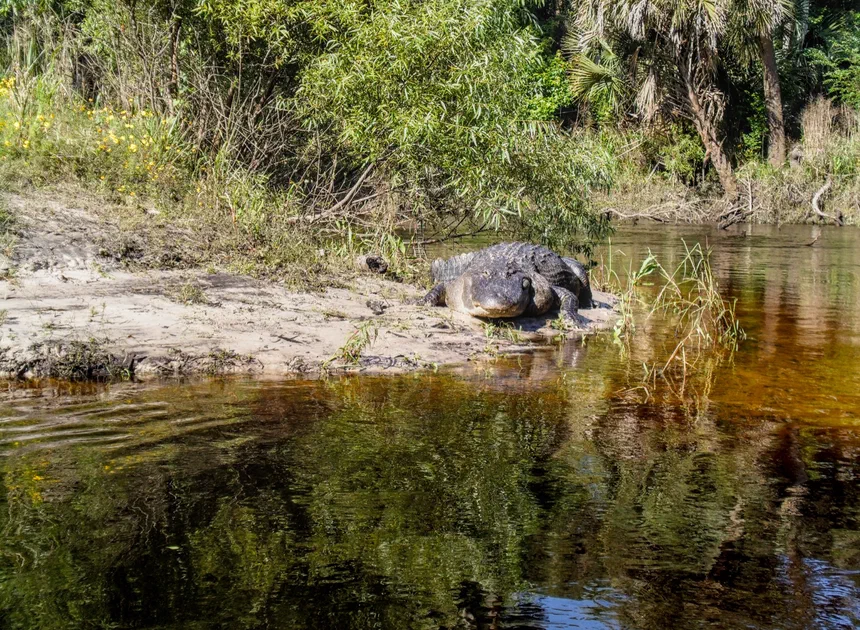
The American alligator (Alligator mississippiensis) is a large freshwater reptile native to the southeastern United States and one of only two alligator species in the world. A member of the crocodilian family, it is a powerful, semiaquatic predator that has changed little in overall form over millions of years. Once pushed to the brink by hunting, it is now a widespread symbol of the region’s wetlands.
Appearance and Identification
The American alligator has a heavy, armored body covered in bony plates called osteoderms, a long muscular tail, and short but sturdy limbs. Adults are typically dark gray to nearly black on top, which helps them blend into murky water, while the belly is pale cream. Young alligators are marked with bright yellow or cream crossbands that fade with age.
One of the easiest ways to tell an alligator from a crocodile is the head. Alligators have a broad, rounded, U-shaped snout, and when the mouth is closed the upper jaw hides most of the lower teeth. Their eyes and nostrils sit high on the head, letting the animal see and breathe while the rest of the body stays submerged. Adult males are generally larger than females, with the biggest individuals reaching well over ten feet.
Habitat and Range
American alligators live in the freshwater wetlands of the southeastern United States, from coastal North Carolina south through Florida and west to eastern Texas. They are most abundant in states such as Florida and Louisiana, where warm temperatures and extensive marshes provide ideal conditions.
Preferred habitats include swamps, marshes, slow rivers, lakes, and ponds. Alligators are tied to fresh water but can tolerate brackish conditions briefly. In dry seasons they dig out depressions known as “gator holes,” which hold water and become vital refuges for fish, turtles, and other wildlife, making the alligator an important engineer of its ecosystem.
Diet
The American alligator is a carnivore and an opportunistic hunter that eats whatever prey it can catch and overpower. Its diet shifts with age: hatchlings and juveniles feed on insects, snails, small fish, frogs, and crustaceans, while larger adults take fish, turtles, snakes, birds, and mammals such as raccoons or nutria.
Alligators are ambush predators, often lying motionless at the surface before lunging with surprising speed. They cannot chew, so they swallow smaller animals whole; with larger prey they may perform a spinning “death roll” to tear off manageable pieces. Because they are cold-blooded and have a slow metabolism, adults can go long stretches between substantial meals.
Behavior
Although they can appear sluggish while basking, alligators are capable of quick bursts on land and are strong, agile swimmers, propelling themselves with sweeps of the tail. They regulate body temperature by moving between sun, shade, and water, basking on banks during cool mornings and retreating to water when it is hot.
Alligators are more social and vocal than many reptiles. During the breeding season, males produce deep bellows and low-frequency vibrations that ripple the water around them to attract mates and warn off rivals. Hatchlings make high-pitched calls, and adults respond to distress sounds from the young, reflecting unusual parental awareness for a reptile.
Life Cycle and Reproduction
Breeding takes place in spring, and in early summer the female builds a large mound nest of vegetation and mud near the water’s edge. She lays a clutch of roughly 20 to 50 eggs, which are covered and left to incubate in the warmth generated by the decaying plant material. As with many reptiles, the temperature of the nest determines the sex of the developing young.
The mother guards the nest through the incubation period of about two months. When the hatchlings begin to call from inside the eggs, she opens the nest and may gently carry the young to the water in her mouth. She continues to protect them for up to a year or more, though survival is still low because small alligators fall prey to birds, fish, and even larger alligators. Individuals grow slowly and can live for several decades in the wild.
Conservation Status
The American alligator is listed as Least Concern on the IUCN Red List, a notable conservation success. By the mid-twentieth century, unregulated hunting for hides and habitat loss had severely reduced its numbers. Legal protection, regulated management, and habitat conservation allowed populations to recover strongly, and the species is now common across much of its range. Ongoing concerns include wetland loss, water pollution, and conflicts with people as human development expands into alligator habitat.
Frequently Asked Questions
How is an alligator different from a crocodile? Alligators have a broader, U-shaped snout and hide their lower teeth when the mouth is closed, while crocodiles have a narrower, V-shaped snout with lower teeth that remain visible. American alligators also live in fresh water and are limited to the southeastern United States.
Are American alligators dangerous to people? Alligators generally avoid humans, and serious attacks are rare. Most incidents involve animals that have been fed by people or encounters near water where alligators are defending themselves or mistaking movement for prey.
How long can an American alligator live? In the wild, American alligators commonly live around 30 to 50 years, and individuals in protected settings can sometimes live even longer.
References
The conservation status and key facts in this profile are supported by these sources:
- Animal Diversity Web — Alligator mississippiensis (accessed 2026-08-06)
- GBIF — Alligator mississippiensis (Daudin, 1801) (accessed 2026-08-06)
Found an error, source problem, or image concern? Report this page.