Reptiles Guide
African Rock Python
What Is a African Rock Python? The African rock python (Python sebae) is Africa’s largest snake and one of the biggest python species in the world. A powerful, non-venomous constrictor, it is found across much of …
At a glance
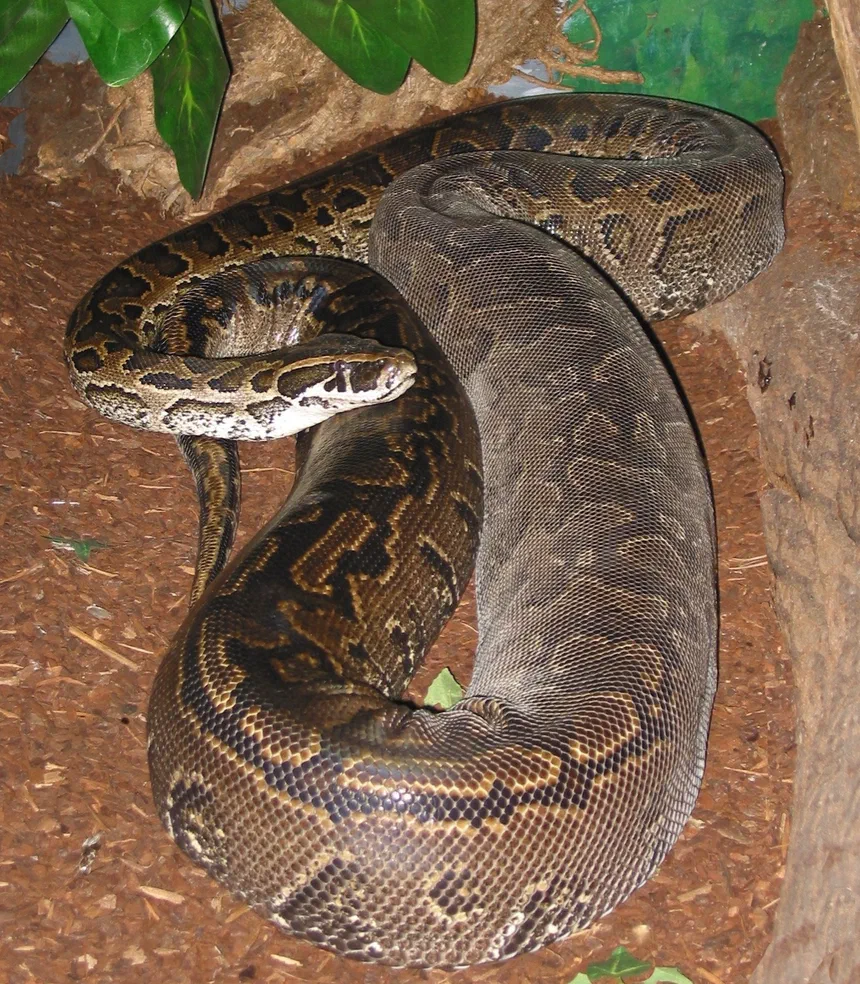
Image: Tigerpython — CC BY-SA 3.0 · source
What Is a African Rock Python?
The African rock python (Python sebae) is Africa’s largest snake and one of the biggest python species in the world. A powerful, non-venomous constrictor, it is found across much of sub-Saharan Africa, where it hunts warm-blooded prey by ambush and overpowers it with muscular coils.
Appearance and Identification
This is a heavy-bodied, thick snake with a broad, somewhat triangular head that is distinct from the neck. The base color ranges through shades of brown, olive, tan, and yellow, overlaid with large irregular blotches and bands that create an effective camouflage against dry grass and leaf litter. A darker stripe often runs from the snout through the eye. The belly is pale, typically whitish or cream. Most adults measure roughly 10 to 16 feet (3 to 5 meters), with exceptional individuals reported longer. Large females can weigh well over 100 pounds (45 kilograms) and are generally bulkier than males. Like other pythons, the species has heat-sensing pits along the lips and retains small vestigial hind-limb spurs near the vent.
Habitat and Range
The African rock python occupies a wide swath of sub-Saharan Africa, from West Africa across the central and eastern regions and into parts of the south. A separate population in southern Africa is sometimes treated as a distinct subspecies or species (Python natalensis). The snake favors savanna, grassland, open woodland, and the edges of forests, and it is rarely found far from water. It readily uses rocky outcrops, abandoned burrows, and dense vegetation for shelter, and it can also turn up around human settlements and agricultural land where prey is plentiful.
Diet
African rock pythons are strict carnivores that feed on a range of warm-blooded animals. Smaller individuals take rodents, birds, bats, and lizards, while large adults are capable of subduing sizable mammals such as antelope, monkeys, monitor lizards, and even young crocodiles. The snake is an ambush predator: it waits in concealment, strikes rapidly to seize prey with its backward-curved teeth, and then wraps its body around the animal, tightening its coils until the prey stops breathing. After a large meal a python may not feed again for weeks or even months.
Behavior
Largely solitary and secretive, the African rock python is most active around dusk and at night, though it will bask in the sun to regulate its body temperature. It is a strong swimmer and a capable climber when young, spending much of its time hidden in burrows, thickets, or rock crevices. Generally shy, it prefers to retreat from disturbance, but a cornered python can defend itself with a powerful bite and constriction. During the dry season or cooler periods, individuals may become inactive for extended stretches.
Life Cycle and Reproduction
Reproduction is tied to seasonal rains in many parts of the range. Females are egg-layers and can produce large clutches, often ranging from around 20 to 50 eggs, sometimes more in very large individuals. The female typically deposits her eggs in a burrow, termite mound, or other sheltered chamber and coils around them to guard and shield them through the roughly two-to-three-month incubation. This maternal attendance is unusual among snakes. Hatchlings emerge fully independent, measuring around 1.5 to 2 feet in length, and must fend for themselves immediately. Growth is rapid when food is abundant.
Conservation Status
At the species level the African rock python has not been formally assessed by the IUCN Red List, though it remains widespread across its range. Localized declines occur where the snake is hunted for its skin, meat, and traditional uses, or killed out of fear near settlements. Habitat conversion and the pet trade add further pressure in some areas. International trade is regulated under CITES Appendix II, which helps monitor and limit commercial exploitation.
Frequently Asked Questions
Is the African rock python venomous? No. It is a non-venomous constrictor that kills prey by wrapping its coils around it, not by injecting venom.
How big can an African rock python get? Most adults reach about 10 to 16 feet (3 to 5 meters), making it Africa’s largest snake, with rare individuals reported longer.
Are they dangerous to people? They generally avoid humans, but very large pythons are powerful animals and bites can be serious, so wild individuals should be given space and never handled.
References
The conservation status and key facts in this profile are supported by these sources:
- Animal Diversity Web — Python sebae (African rock python) (accessed 2026-08-06)
- GBIF — Python sebae (Gmelin, 1789) (accessed 2026-08-06)
Found an error, source problem, or image concern? Report this page.