Reptiles Guide
Ackie Monitor
What Is a Ackie Monitor? The Ackie monitor (Varanus acanthurus), also called the spiny-tailed monitor or ridge-tailed monitor, is a small, ground-dwelling lizard native to the dry regions of Australia. It belongs to the …
At a glance
What Is a Ackie Monitor?
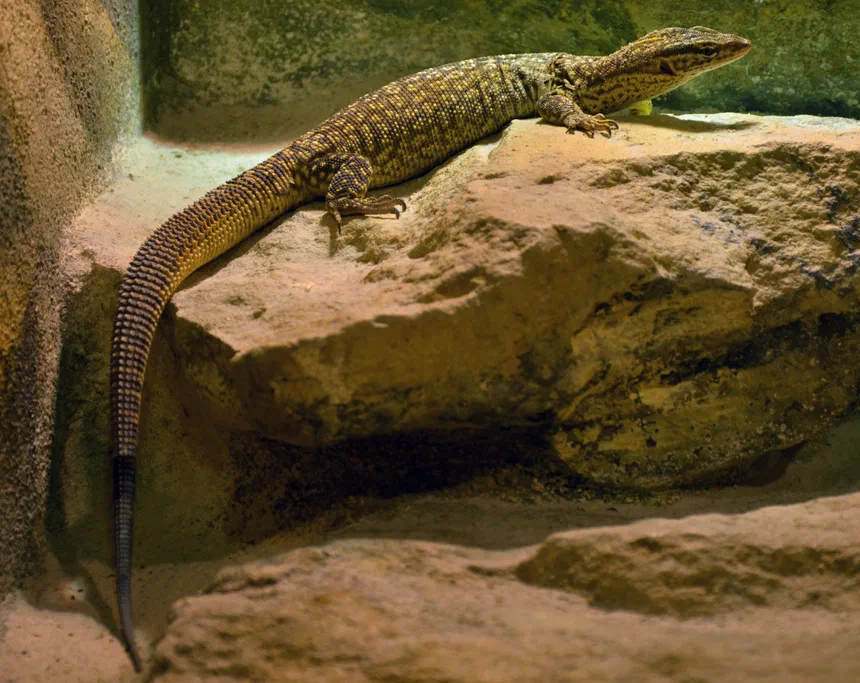
The Ackie monitor (Varanus acanthurus), also called the spiny-tailed monitor or ridge-tailed monitor, is a small, ground-dwelling lizard native to the dry regions of Australia. It belongs to the monitor family, Varanidae, but ranks among the smaller “dwarf” monitors, making it a manageable and popular species among reptile keepers.
Appearance and Identification
The Ackie monitor is a stout, muscular lizard with a broad head, sturdy limbs, and strong claws suited to digging. Its most distinctive feature is the tail, which is covered in rows of enlarged, spiny scales that give the animal both its common names and a measure of protection when it wedges itself into rock crevices.
Body coloration ranges from reddish-brown to a darker brown or nearly black, patterned with clusters of pale cream, yellow, or orange spots arranged in rows along the back. This spotting helps break up the animal’s outline against sun-baked rock and soil. Adults typically reach around 24 to 28 inches in total length, with much of that made up by the long tail. Two regional forms are often recognized, sometimes called the red and yellow ackies, based on differences in background color.
Habitat and Range
Ackie monitors are found across northern and western Australia, including parts of the arid interior. They favor hot, dry landscapes such as rocky outcrops, stony ranges, and open woodland with scattered spinifex grass.
Within these habitats they rely heavily on rock crevices, deep burrows, and cracks in the ground for shelter. These retreats offer protection from predators and, just as importantly, refuge from extreme daytime heat and nighttime cold. A single monitor may use several such hideaways within its home range.
Diet
The Ackie monitor is a carnivore and an active forager. The bulk of its diet consists of insects and other invertebrates, including grasshoppers, beetles, cockroaches, spiders, and scorpions. Larger individuals will also take small vertebrates such as lizards, along with the occasional egg.
Like other monitors, it uses a keen sense of smell, flicking its forked tongue to detect prey hidden beneath sand, leaf litter, or loose rock. Powerful limbs and claws allow it to dig out burrowing insects and pursue prey into tight spaces.
Behavior
Ackie monitors are diurnal, meaning they are active during the day, and they spend much of the morning basking to raise their body temperature before hunting. As cold-blooded reptiles, they shuttle between sun and shade to regulate their warmth. When threatened, a monitor often retreats into a crevice and inflates its body while lodging its spiny tail as a defensive plug, making it very difficult to extract.
For a reptile, the species shows notable curiosity and problem-solving ability, traits shared with larger monitors. Individuals are generally solitary and may defend favored basking and shelter sites, though they are not strongly territorial year-round.
Life Cycle and Reproduction
Ackie monitors reproduce by laying eggs. After mating, the female digs a burrow or uses an existing chamber to deposit a clutch, which commonly numbers from a handful up to a dozen or more eggs. The eggs are then covered and left to incubate underground, where stable temperature and humidity support their development.
Incubation typically lasts on the order of three to four months before the hatchlings emerge fully independent, receiving no parental care. Young monitors grow relatively quickly and reach breeding maturity within a couple of years. In the wild, individuals commonly live around 10 to 15 years, and well-kept animals can live longer.
Conservation Status
The Ackie monitor is listed as Least Concern on the IUCN Red List. It has a wide distribution across Australia and remains locally common in suitable habitat, with no evidence of a rapid decline. Much of the animal supply for the international pet trade now comes from captive breeding, which helps reduce pressure on wild populations. As with many arid-zone reptiles, longer-term concerns center on habitat degradation, altered fire regimes, and introduced predators.
Frequently Asked Questions
Is the Ackie monitor venomous? No. While some monitor lizards are thought to produce mild oral toxins, the Ackie monitor is not considered dangerous to people; its main defenses are its spiny tail and its habit of wedging into crevices.
How big does an Ackie monitor get? Adults usually reach about 24 to 28 inches in total length, with the tail accounting for a large share of that. This compact size makes it one of the smaller monitor species.
Where do Ackie monitors live? They are native to the arid and semi-arid regions of northern and western Australia, where they shelter in rock crevices and burrows among rocky outcrops and open woodland.
References
The conservation status and key facts in this profile are supported by these sources:
- Animal Diversity Web — Varanus acanthurus (accessed 2026-08-06)
- GBIF — Varanus acanthurus Boulenger, 1885 (accessed 2026-08-06)
Found an error, source problem, or image concern? Report this page.