Library Section
Mites
How to identify Mites Similar in appearance to ticks but much smaller, mites have bulbous, round, or pill-shaped bodies. Classified as arachnids, mites have eight jointed legs. Their size varies by species, but most …
At a glance
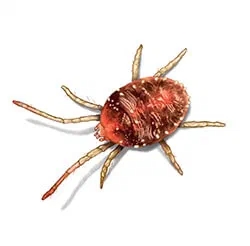
How to identify Mites
Similar in appearance to ticks but much smaller, mites have bulbous, round, or pill-shaped bodies. Classified as arachnids, mites have eight jointed legs. Their size varies by species, but most mites are usually invisible to the naked eye. The largest mites measure about 6 mm long, while the smallest are about 0.1 mm. The colour of mites varies greatly as well; most mites appear tan, brown, or reddish-brown, but some species are bright red, blue, or green in colour.
Signs of an infestation
Canada is home to several thousand species of mites, including clover mites, house dust mites, bird mites, itch mites, and scabies mites, cheese mites, grain mites, flour mites, and mould mites. Most are usually invisible to the naked eye. Mites live in nearly every habitat, including deep soil and aquatic environments. As parasites of birds, mammals, and insects, mites may spread wherever these host animals travel. Mites either live in the host’s nest or on the host itself. Some species such as scabies and chigger mites may bury themselves under human skin. Mites that commonly affect humans often live in carpets, furniture, and mattresses. Common household mites, like dust mites, feed on flakes of dead skin from humans and pets, but others mites do bite animals and in some cases, humans, to suck their blood.
How to prevent Mites from invading
Mow lawn and remove weeds regularly, Keep leaf litter away from the house, Keep pets clean and healthy, Clean the house regularly, Dust surfaces and vacuum carpets, Wash bed linens in hot water, Keep humidity levels low, Use a dust-mite or mite proof mattress encasement
Habitat, Diet, and Life Cycle
Habitat
Mites are ubiquitous and live in nearly every habitat, including deep soil and aquatic environments. As parasites of birds, mammals, and flying insects, mites may spread wherever host animals travel. These arachnids live either in the host’s environment, such as a bird’s nest, or on the host itself. Some species such as scabies and chigger mites can bury themselves under human skin and tissue. Mites that commonly affect humans often live in carpets, furniture, and mattresses.
Diet
Mites thrive by forming parasitic relationships with other organisms. Specific diets vary by species. Mites that are troublesome to humans feed on blood for sustenance. Most biting mites actually prefer to feed on other animals and resort to biting humans when alternative options are scarce. Common household mites, like dust mites, feed on flakes of dead skin from humans and pets.
Life Cycle
The mite lifecycle consists of four stages: egg, larva, nymph, and adult. Eggs hatch into six-legged larvae, which molt several times before entering the eight-legged nymphal stage. As nymphs, mites molt an additional one to three times before maturing into full grown eight-legged adults. Development from an egg to an adult usually takes several weeks; however, under ideal conditions development time can shorten to just a few days. After reaching adulthood, mites may live for several months.
Commonly Asked Questions
How worried should I be about mites?
While some mite bites can go unnoticed, others can be painful. Nearly all result in itchy red marks or rashes. Intense itching may occur, and scratching may lead to infection. Symptoms usually develop within a day and may last as long as a week. Scabies mites can cause persistent, intensely itchy rashes, because the pests burrow into the skin to breed and then emerge to feed on flesh which can result in a severe medical condition. The carcasses of dust mites, which live in carpets and furniture, can cause allergic reactions if inhaled, resulting in stuffy noses, watery eyes, and sneezing. Meanwhile, spider and eriophyid mites can damage crops. It’s difficult to see mites, so you may not be aware of an infestation until it’s too late.
Browse This Section
Every guide in Mites
Use these links to move quickly between closely related pages in the same section.
Bird Mite Facts & Information
What do bird mites look like? Body: Bird mites are small, semitransparent, and ovoid in shape. They have hairs on their …
Bird Mite Removal
Although bird mites rarely cause more than slight skin irritation in humans, they pose great danger to a variety of …
Chicken Mites (Bird Mites)
What Are Chicken Mites? Chicken mites, sometimes called bird mites, get their common name because they live on the skin …
Chigger Mite Facts & Information
What You Can Do When venturing into the woods or other areas where chiggers are located, wear clothing treated with …
Clover Mites
How to identify Clover Mites Smaller than the head of a pin, adult clover mites rarely exceed 1/4 mm in length. They are …
Differences Between Mites vs. Ticks
What Do Mites Look Like? Adult mites are reddish brown to a dark green-brown color, depending on what they are feeding …
Dust Mite Facts & Information
What You Can Do Seeking the assistance of a professional who has experience and success in dust mite control is always …
House Dust Mites
What is a house dust mite? House dust mites have received much attention in the early 1990s and again recently. The …
Scabies Rash
What is scabies? Scabies is an infestation of the skin caused by the human itch mite (Sarcoptes scabiei var. hominis). …
Southern Red Mite Facts & Information
What You Can Do Since inspection is the best first line of defense to reduce or avoid damage from southern red mites, …
Spider Mite Facts & Information
What You Can Do The first step to prevent and control spider mites is to actually see mites on the plant. Key things to …
Treating Bird Mites
Bird mites are parasites that feed on the blood of birds and use their nests as breeding places. These mites can greatly …