Mammals Guide
Water Buffalo
What Is a Water Buffalo? The water buffalo (Bubalus bubalis) is a large, semi-aquatic bovine native to South and Southeast Asia and now kept as livestock across much of the world. Prized for its strength, milk, and meat, …
At a glance
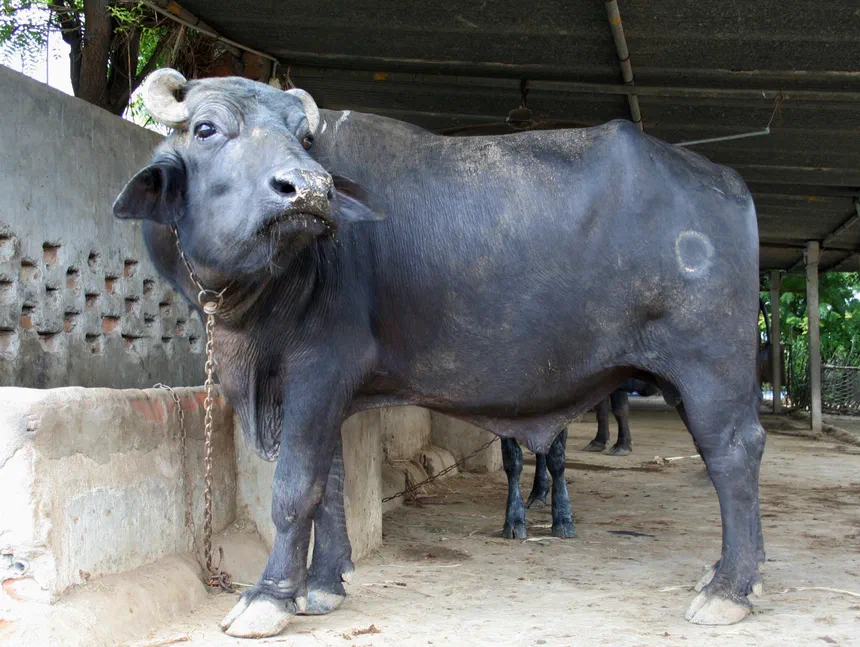
Image: Yann Forget — CC BY-SA 4.0 · source
What Is a Water Buffalo?
The water buffalo (Bubalus bubalis) is a large, semi-aquatic bovine native to South and Southeast Asia and now kept as livestock across much of the world. Prized for its strength, milk, and meat, it is one of the most economically important domestic animals in tropical regions. The domestic form descends from the wild water buffalo, a threatened species still found in scattered parts of Asia.
Appearance and Identification
Water buffalo are massive, powerfully built animals with a broad body, short thick legs, and a large head. Their skin is typically slate-gray to black, covered by a sparse coat of coarse hair. Both sexes carry heavy, backward-curving horns that spread outward in a wide crescent; in some individuals these are among the longest horns of any living bovid. Adults commonly stand around 1.4 to 1.8 meters (4.5 to 6 feet) at the shoulder and weigh from roughly 700 to over 1,200 kilograms, with bulls larger than cows. Two broad types are recognized among domestic animals: the “river” type, favored for milk, and the “swamp” type, used mainly as a draft animal.
Habitat and Range
As the name suggests, this species is closely tied to water. It favors wetlands, marshes, slow rivers, flooded grasslands, and the muddy margins of ponds and lakes. Domestic water buffalo are found throughout South and Southeast Asia and have been introduced to parts of Europe, Africa, Australia, and South America. The wild ancestor now survives only in fragmented populations in India, Nepal, and a few neighboring areas, where it inhabits tall grasslands and riverine forests.
Diet
Water buffalo are grazing herbivores. They feed largely on grasses and sedges but also consume aquatic vegetation, herbs, and leafy plants, often wading into shallow water to reach it. Like cattle, they have a four-chambered stomach and chew cud, allowing them to digest coarse, fibrous plant material that many other grazers cannot use efficiently. This ability lets them thrive on marshland forage of relatively low quality.
Behavior
These are social animals that tend to live in herds, often led by an older cow. They are well known for wallowing: to cope with heat, they submerge in water or coat themselves in mud, which cools the body and helps protect the skin from biting insects and sun. Water buffalo are generally docile when domesticated and have been worked by people for thousands of years, but wild individuals and defensive mothers can be formidable and aggressive. They are strong swimmers and move easily through soft, waterlogged ground where heavier machinery cannot go.
Life Cycle and Reproduction
Cows usually give birth to a single calf after a gestation of roughly 10 to 11 months; twins are rare. Newborn calves can stand and follow the herd within hours and nurse for several months before gradually shifting to grazing. Females typically reach breeding age at around two to three years. Under good conditions, water buffalo may live 15 to 25 years, and working animals are often productive for much of that span.
Conservation Status
The domestic water buffalo is abundant, with well over 100 million animals worldwide, and is not at risk. Its wild ancestor, however, is classified as Endangered by the IUCN, threatened by habitat loss, hunting, disease, and interbreeding with domestic stock. Conservation of the wild population focuses on protecting remaining grassland habitats and keeping wild and domestic herds separate.
Frequently Asked Questions
Are water buffalo the same as American bison or African buffalo? No. Despite the shared name “buffalo,” the water buffalo is a distinct Asian species and is not closely related to the American bison or the African (Cape) buffalo.
Why do water buffalo spend so much time in water and mud? Wallowing helps them regulate body temperature in hot climates and protects their skin from insects and sunburn, since they have relatively little hair.
What are water buffalo used for? They provide milk (the basis of many cheeses, including traditional mozzarella), meat, and hides, and they are widely used as draft animals for plowing and hauling.
References
The conservation status and key facts in this profile are supported by these sources:
- Animal Diversity Web — Bubalus bubalis (accessed 2026-07-29)
- GBIF — Bubalus bubalis (Linnaeus, 1758) (accessed 2026-07-29)
Found an error, source problem, or image concern? Report this page.