Mammals Guide
Common Warthog
What Is a Common Warthog? The common warthog (Phacochoerus africanus) is a wild member of the pig family, Suidae, native to the grasslands and savannas of sub-Saharan Africa. It takes its name from the paired, wart-like …
At a glance
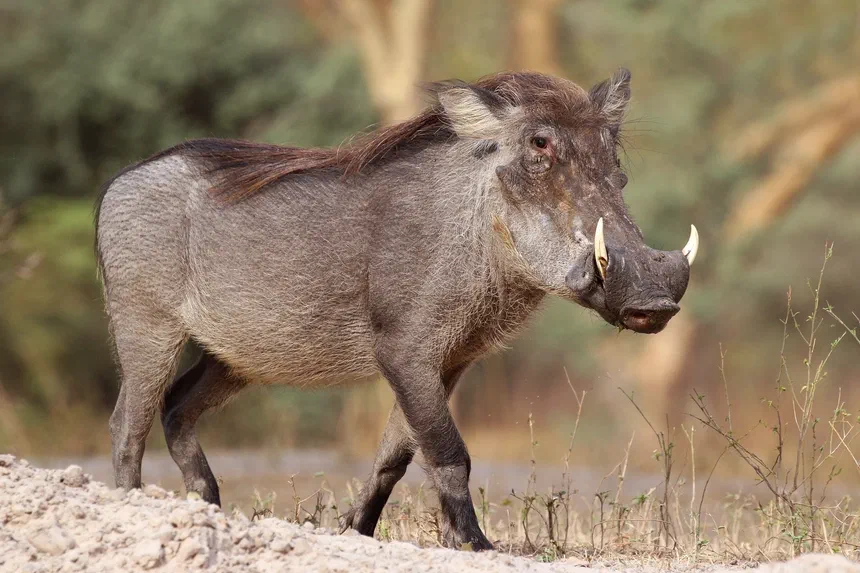
Image: Charles J. Sharp — CC BY-SA 4.0 · source
What Is a Common Warthog?
The common warthog (Phacochoerus africanus) is a wild member of the pig family, Suidae, native to the grasslands and savannas of sub-Saharan Africa. It takes its name from the paired, wart-like protrusions on either side of its face, and it is one of the most familiar and widely distributed wild pigs on the continent.
Appearance and Identification
The warthog has a large, flattened head, a broad snout, and a stocky body set on relatively long, slender legs. Its skin is grayish to brown and mostly hairless, apart from a mane of coarse bristles that runs along the neck and back and a tuft at the end of the tail. When the animal runs, it often holds its thin tail straight up like a flag.
The most striking features are the tusks and facial “warts.” The upper canine teeth curve upward and outward into prominent tusks that can reach well over a foot in length in large males, while the lower tusks are shorter and razor-sharp. The fleshy facial pads, more pronounced in males, help cushion blows during fights. Males are noticeably larger and heavier than females.
Habitat and Range
Common warthogs are found across a wide swath of sub-Saharan Africa, from the semi-arid fringes of the Sahel through the savannas of East and southern Africa. They favor open habitats such as grasslands, floodplains, and lightly wooded savanna, and they generally avoid dense forest and true desert.
Access to water and wallowing sites is important, and warthogs are frequently seen near waterholes. They rely heavily on burrows for shelter, usually taking over holes dug by aardvarks rather than excavating their own. These burrows provide refuge from predators and relief from both midday heat and cold nights.
Diet
The warthog is primarily a grazer, feeding on short grasses, sedges, and herbs. When grass is scarce during the dry season, it uses its tough snout and tusks to dig for roots, bulbs, and rhizomes, and it will also take fruits, berries, and bark.
A distinctive feeding posture sets the species apart: warthogs often shuffle forward on the calloused, padded joints of their front legs, effectively kneeling to crop grass close to the ground. Though mainly herbivorous, they occasionally eat carrion or invertebrates when the opportunity arises.
Behavior
Warthogs are active by day and rest in burrows at night, backing in tail-first so they can face any intruder with their tusks. They live in loose social groups called sounders, typically made up of females and their young, while adult males are more solitary and join groups mainly during the breeding season.
When alarmed, a warthog’s usual strategy is to run for the nearest burrow at a surprising speed, tail raised. If cornered, it can defend itself effectively with its sharp lower tusks and has been known to injure predators. Wallowing in mud helps warthogs cool down and control parasites, and they often share waterholes with other grazing animals.
Life Cycle and Reproduction
Breeding is often timed so that young are born in the wetter months when food is plentiful. After a gestation of roughly five to six months, the female gives birth to a litter of two to four piglets, retreating into a burrow to bear and shelter them.
Piglets remain in the burrow for their first weeks before venturing out to graze with the sounder. They are weaned at a few months of age but may stay with their mother well beyond that. Females typically reach breeding age within about a year and a half, and both sexes continue to grow after reaching maturity.
Conservation Status
The common warthog is listed as Least Concern by the IUCN. It remains widespread and reasonably common across much of its range, helped by its adaptability and high reproductive rate. Localized declines can occur from overhunting for meat and from habitat loss, but the species as a whole is not considered threatened. Warthogs are a common sight in national parks and reserves throughout Africa.
Frequently Asked Questions
Are warthog “warts” really warts? No. The bumps are tough, fleshy pads of skin and tissue, not true warts. They help protect the face during fights between males.
Can warthogs be dangerous? They are not aggressive toward people by nature, but a cornered or wounded warthog can inflict serious wounds with its sharp lower tusks and will defend itself vigorously.
Why do warthogs kneel to eat? Their necks are short relative to their long legs, so they often rest on the padded joints of their front legs to reach and crop short grass near the ground.