Mammals Guide
Snow Leopard
What Is a Snow Leopard? The snow leopard (Panthera uncia) is a large cat native to the rugged mountain ranges of Central and South Asia. Superbly adapted to cold, thin air and steep terrain, it is one of the most elusive …
At a glance
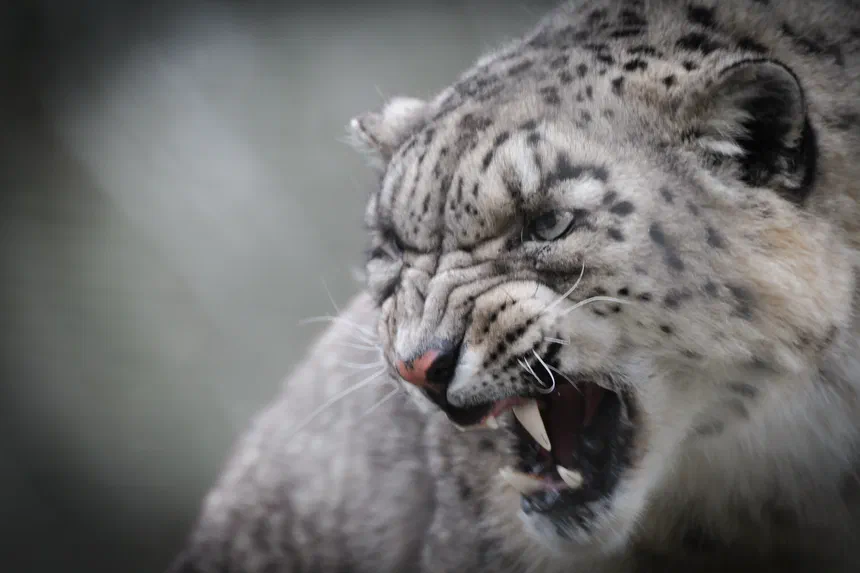
Image: Greg Townsend — CC BY-SA 4.0 · source
What Is a Snow Leopard?
The snow leopard (Panthera uncia) is a large cat native to the rugged mountain ranges of Central and South Asia. Superbly adapted to cold, thin air and steep terrain, it is one of the most elusive of the big cats and is rarely seen in the wild. Its pale, spotted coat provides near-perfect camouflage against snow and bare rock.
Appearance and Identification
Snow leopards have a thick, woolly coat that ranges from pale gray to creamy white, marked with dark gray rosettes and solid spots that help break up their outline. The dense fur, which grows especially long on the belly, insulates them against harsh mountain cold. They are stocky and muscular, with short forelimbs, long hind legs built for leaping, and unusually large paws that act like snowshoes. Their most distinctive feature is an exceptionally long, thick tail, nearly as long as the body, which aids balance on cliffs and can be wrapped around the body for warmth.
Habitat and Range
This cat inhabits the high mountains of a dozen countries, including parts of the Himalayas, the Tibetan Plateau, the Altai and Tian Shan ranges, and the Hindu Kush. It typically lives at elevations of roughly 3,000 to 4,500 meters, though it may descend lower in winter as prey moves downslope. Preferred terrain includes rocky outcrops, ravines, cliffs, and open alpine meadows where broken ground offers cover for stalking.
Diet
Snow leopards are pure carnivores and skilled ambush hunters. Their main prey consists of wild mountain ungulates such as blue sheep (bharal), argali, ibex, and markhor. They also take smaller animals including marmots, pikas, hares, and game birds, and will hunt domestic livestock when wild prey is scarce. A single large kill can sustain a snow leopard for a week or more.
Behavior
Largely solitary and most active at dawn and dusk, snow leopards patrol large home ranges that they mark with scrapes, scent, and scratches. They are famously powerful jumpers, able to clear great distances across rocky ground in a single bound. Unlike the roaring big cats, snow leopards cannot roar; instead they communicate with mews, growls, hisses, and a distinctive non-aggressive puffing sound called a “chuff.”
Life Cycle and Reproduction
Mating generally occurs in late winter, and after a gestation of about three months females give birth in a sheltered rocky den. Litters usually contain two or three cubs, which are born blind and helpless. Cubs open their eyes after about a week, begin following their mother within a few months, and remain with her until they are around 18 to 22 months old before dispersing to establish their own territories.
Conservation Status
The snow leopard is classified as Vulnerable by the IUCN, with a wild population estimated in the low thousands. Major threats include poaching for fur and bones, retaliatory killing by herders protecting livestock, loss of natural prey, and habitat fragmentation. Climate change adds further pressure by shifting the alpine zones these cats depend on. Protected areas, community-based conservation, and anti-poaching efforts are central to ongoing recovery work.
Frequently Asked Questions
Can snow leopards roar? No. Because of the structure of their throat, snow leopards cannot produce a true roar. They make a variety of other sounds, including a friendly puffing “chuff.”
Why do snow leopards have such long tails? The long, thick tail helps them balance while navigating steep cliffs and can also be draped over the body like a scarf for insulation while resting.
Are snow leopards dangerous to people? Attacks on humans are extremely rare. Snow leopards are shy and reclusive, and they generally avoid people whenever possible.