Mammals Guide
Red-Shanked Douc
What Is a Red-Shanked Douc? The red-shanked douc (Pygathrix nemaeus) is a strikingly colored leaf-eating monkey of Southeast Asia, sometimes called the red-shanked douc langur. It belongs to the group of Old World …
At a glance
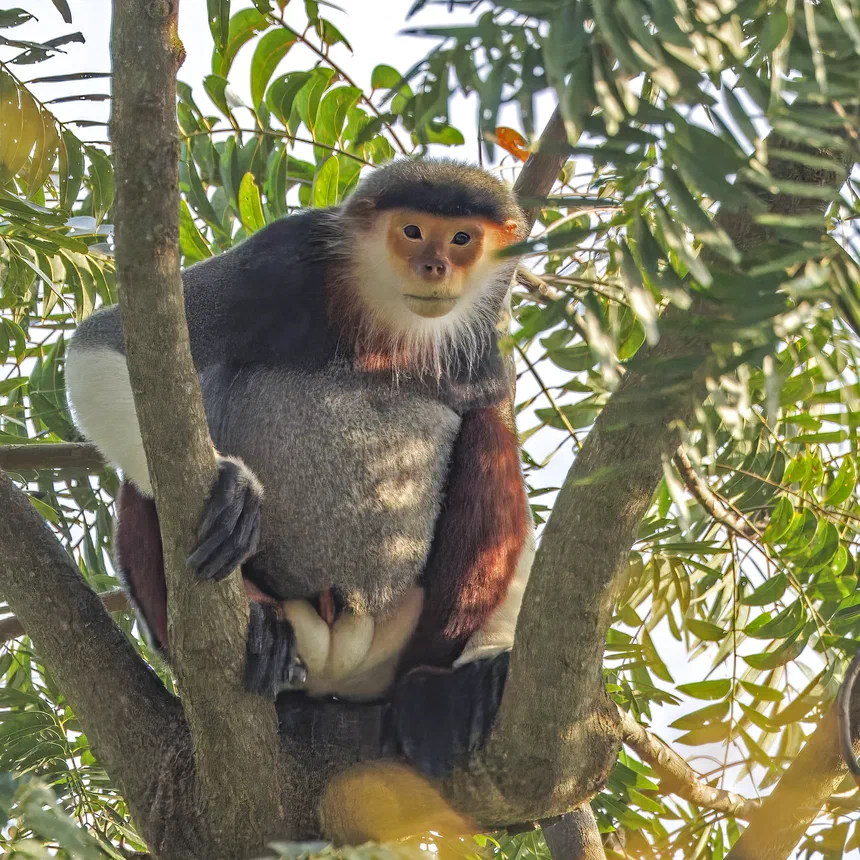
Image: Charles J. Sharp — CC BY-SA 4.0 · source
What Is a Red-Shanked Douc?
The red-shanked douc (Pygathrix nemaeus) is a strikingly colored leaf-eating monkey of Southeast Asia, sometimes called the red-shanked douc langur. It belongs to the group of Old World monkeys known as colobines, and it is often described as one of the most vividly patterned primates in the world.
Appearance and Identification
This medium-sized monkey is best recognized by the deep maroon or brick-red “stockings” that cover its lower legs, a feature that gives the species its common name. The body is a grizzled gray, the forearms and hands are white, and the tail is long and white with a small triangular patch of paler fur at its base. The face is a warm orange-yellow, framed by a white ruff of cheek hair and topped by a dark band above the brow. Adults have a head-and-body length of roughly 55 to 63 centimeters, with a tail of similar length, and typically weigh between about 8 and 11 kilograms. Males tend to be somewhat larger and more boldly marked than females.
Habitat and Range
Red-shanked doucs live in the forests of central Vietnam, southern and central Laos, and parts of northeastern Cambodia. They favor tall, closed-canopy tropical evergreen and semi-evergreen forests, including monsoon forest and hilly terrain, from lowlands up into mid-elevation slopes. As highly arboreal animals, they spend most of their lives in the middle and upper layers of the canopy and rarely descend to the ground.
Diet
The species is primarily folivorous, meaning leaves make up the bulk of its diet. Doucs strongly prefer young, tender leaves, but they also eat unripe fruit, seeds, flowers, and buds depending on the season. Like other colobine monkeys, they have a large, multi-chambered stomach populated by microbes that ferment and break down fibrous plant material, allowing them to extract nutrients from foliage that many other animals cannot digest. Because of this specialized gut, they tend to avoid overly sweet ripe fruit, which can disrupt their digestion.
Behavior
Red-shanked doucs are social and generally live in groups that commonly number from around four to about a dozen individuals, though larger aggregations are sometimes seen where food is plentiful. Groups typically include one or more adult males, several females, and their young. They are agile climbers and impressive leapers, using their long limbs and tail for balance as they move through the canopy. Communication involves a mix of facial expressions, body postures, and soft vocalizations, along with grooming that helps maintain bonds within the group. Activity is concentrated in the daytime, with long midday rest periods used to digest their leafy meals.
Life Cycle and Reproduction
Females usually give birth to a single infant after a gestation of roughly six months. Newborns are born with lighter fur and a distinctive face and darken as they mature, gaining adult coloration over their first year or so. Mothers provide the primary care, though other group members may show interest in infants. Young doucs are weaned during their first year and reach sexual maturity at around four to five years of age. In the wild, individuals may live into their late teens or twenties, and animals in managed care can reach similar or slightly greater ages.
Conservation Status
The red-shanked douc is classified as Critically Endangered by the IUCN. Its populations have declined sharply due to habitat loss from logging and agriculture, along with hunting for meat, traditional medicine, and the illegal pet trade. Because the species depends on undisturbed forest and does not adapt easily to fragmented or degraded habitat, protecting large tracts of intact forest is essential. Reserves such as the Son Tra peninsula in Vietnam have become important strongholds, and conservation programs there combine habitat protection, anti-poaching patrols, and public education.
Frequently Asked Questions
Why is it called the red-shanked douc? The name refers to the rich reddish-maroon fur on the lower legs, or shanks, which looks like a pair of colorful stockings and sets the species apart from its relatives.
Is the red-shanked douc a monkey or a langur? It is a true Old World monkey in the colobine group. It is often called a “langur” informally, but it belongs to the douc genus Pygathrix rather than the true langurs.
What do red-shanked doucs eat? They are leaf specialists, feeding mostly on young leaves and supplementing with fruit, seeds, and flowers, aided by a specialized stomach that ferments tough plant fiber.