Mammals Guide
Red Kangaroo
What Is a Red Kangaroo? The red kangaroo (Osphranter rufus) is the largest living marsupial and the biggest native land mammal in Australia. A powerful, long-legged grazer built for hopping across open country, it is one …
At a glance
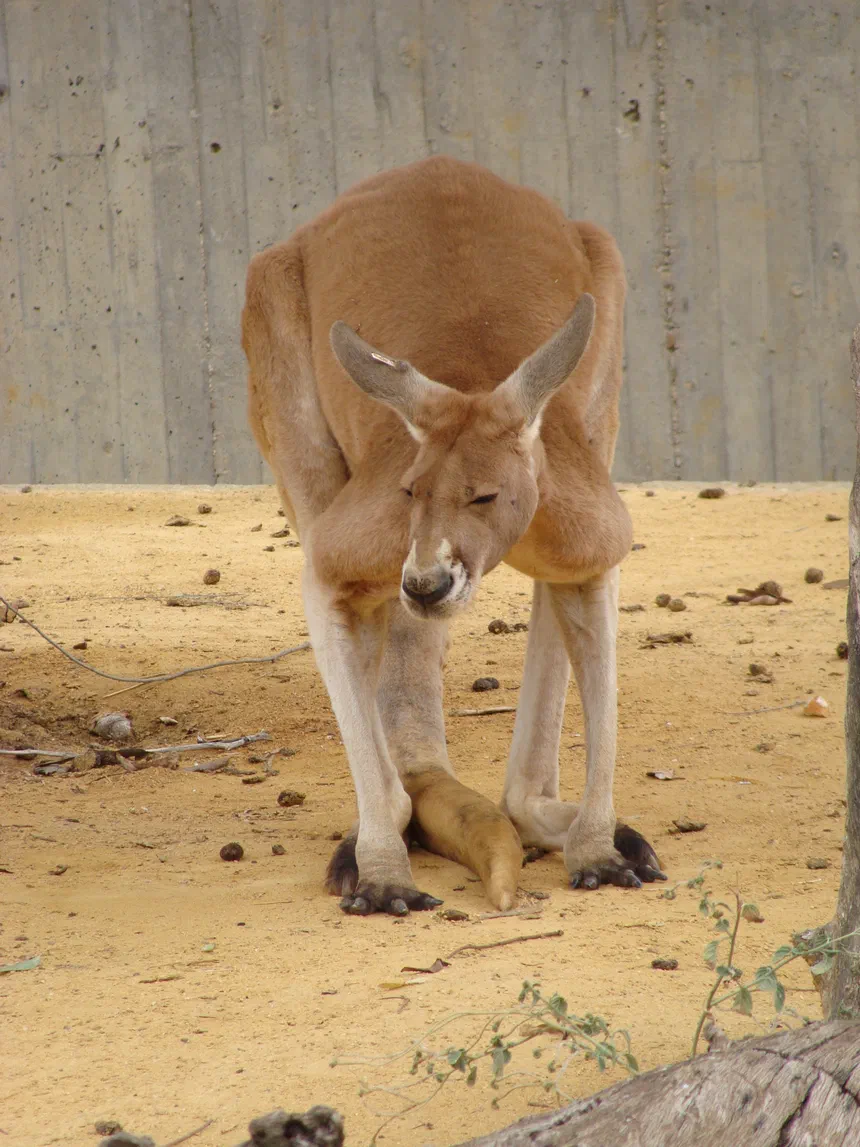
Image: Fernando Losada Rodríguez — CC BY-SA 4.0 · source
What Is a Red Kangaroo?
The red kangaroo (Osphranter rufus) is the largest living marsupial and the biggest native land mammal in Australia. A powerful, long-legged grazer built for hopping across open country, it is one of the most recognizable symbols of the Australian outback. Adult males can stand taller than an average person when they rear up on their hind legs and tail.
Appearance and Identification
Red kangaroos have a compact head, large upright ears, and a muscular body that tapers into enormous hind legs and a thick, tapered tail used as a prop and a counterbalance. Coat color often differs between the sexes: males typically wear a rusty red-brown coat, while females tend to be a smoky blue-gray, which has earned them the nickname “blue fliers.” Both sexes have a paler underside and a distinctive black-and-white patch on the muzzle.
Males are considerably larger than females. Big males may reach roughly 5 feet in head-and-body length with a tail nearly as long again, and can weigh up to around 200 pounds, while females are usually less than half that mass. The forelimbs are short but muscular, and the hind feet are elongated and powerful.
Habitat and Range
This species is spread across most of the arid and semi-arid interior of mainland Australia, favoring open grasslands, shrublands, mulga scrub, and desert plains where trees are scattered and sightlines are long. Red kangaroos generally avoid the wetter coastal fringes, the far north’s tropics, and dense forest. They are well suited to dry country and can travel considerable distances in search of fresh growth after rain.
Diet
Red kangaroos are grazing herbivores that feed mainly on green grasses and soft, low-growing herbaceous plants. Like other grazing marsupials, they have a specialized chambered stomach that ferments plant material, allowing them to extract nutrients from tough, fibrous vegetation. They are highly water-efficient and can go long stretches drawing much of their moisture from the plants they eat, feeding most actively in the cooler hours around dawn and dusk.
Behavior
Red kangaroos are social animals that gather in loose groups known as mobs, which may number from a handful of animals to dozens where food is plentiful. Movement across the landscape is by hopping: at an easy pace it is remarkably energy-efficient, and over short bursts a red kangaroo can reach speeds of roughly 30–35 miles per hour. To cope with desert heat they rest in shade during the hottest part of the day and lick their forearms, where evaporation helps cool the blood.
Males compete for mates through “boxing” matches, balancing on the tail to grapple with the forelimbs and deliver powerful kicks with the hind legs. Dominant, larger males father most of the offspring within a mob.
Life Cycle and Reproduction
As marsupials, red kangaroos give birth to tiny, undeveloped young after a very short gestation of about a month. The newborn, called a joey and no larger than a jellybean, climbs unaided into the mother’s forward-opening pouch, where it latches onto a teat and continues developing for several months. A joey typically first pokes its head out and begins leaving the pouch at around five to six months and is fully weaned near a year of age.
Females have a remarkable reproductive strategy called embryonic diapause, in which a fertilized embryo can be held in a paused state until conditions improve or the current joey vacates the pouch. This lets populations rebound quickly after drought. In the wild, red kangaroos commonly live around 8 to 12 years, with some individuals living longer.
Conservation Status
The red kangaroo is listed as Least Concern by the IUCN. It remains widespread and abundant across its range, and populations fluctuate naturally with rainfall and the availability of forage, rising in good years and falling during prolonged drought. The species is managed under regulated commercial and control harvesting in parts of Australia, but it faces no major threat of extinction at present.
Frequently Asked Questions
How fast can a red kangaroo hop? Over short distances a red kangaroo can reach roughly 30 to 35 miles per hour, and it can cover long distances at a steady, energy-saving pace.
Why are some red kangaroos gray instead of red? Coat color often varies by sex. Males are usually the classic rusty red, while many females are a bluish-gray, though there is some variation in both.
Are red kangaroos dangerous to people? They are wild animals and generally keep their distance, but a cornered or habituated adult male is strong enough to injure a person with its kicks and forelimbs, so they are best observed from a respectful distance.