Mammals Guide
Red Fox
What Is a Red Fox? The red fox (Vulpes vulpes) is a small, dog-like carnivore and the most widely distributed member of the dog family, Canidae. It is instantly recognized by its rich reddish coat, pointed muzzle, …
At a glance
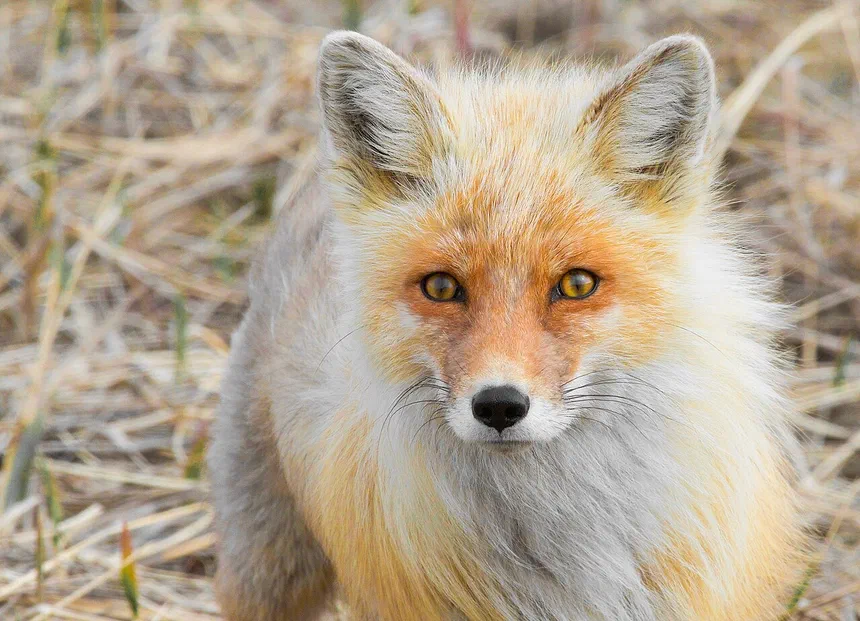
Image: Gregory "Slobirdr" Smith — CC BY-SA 2.0 · source
What Is a Red Fox?
The red fox (Vulpes vulpes) is a small, dog-like carnivore and the most widely distributed member of the dog family, Canidae. It is instantly recognized by its rich reddish coat, pointed muzzle, upright triangular ears, and long, white-tipped bushy tail. Highly adaptable, it thrives across an enormous range of climates and landscapes, from remote wilderness to the centers of large cities.
Appearance and Identification
Despite its name, the red fox varies considerably in color. The typical coat is a warm rusty red to reddish-brown across the back and sides, fading to white or pale gray on the chin, throat, and belly. The lower legs and the backs of the ears are usually black, and the tail nearly always ends in a distinctive white tip. Color morphs such as the darker “cross fox” and the black-and-silver “silver fox” occur naturally within the species. Adults measure roughly 45 to 90 cm in head-and-body length, with the tail adding another 30 to 55 cm, and most weigh between 3 and 7 kilograms. Males, called dogs, tend to be slightly larger than the females, or vixens. The slender build, low-slung posture, and elliptical, cat-like pupils help distinguish the red fox from larger canids.
Habitat and Range
The red fox has one of the widest natural distributions of any land mammal. It is found throughout most of the Northern Hemisphere, including Europe, much of Asia, North Africa, and North America, and it was introduced to Australia in the 1800s. This flexibility reflects the species’ remarkable tolerance for different environments. Red foxes occupy deciduous and mixed forests, open grasslands, agricultural land, mountain slopes, coastal dunes, and Arctic tundra. In recent decades they have become common in towns and cities, where parks, gardens, and human food waste provide reliable resources.
Diet
Red foxes are opportunistic omnivores with a varied diet that shifts with the seasons and local availability. Small mammals such as voles, mice, rabbits, and other rodents form the core of their diet, and they also take birds, eggs, reptiles, amphibians, earthworms, and insects. In late summer and autumn they eat large quantities of fruit and berries. Foxes readily scavenge carrion and, near people, will exploit garbage, pet food, and scraps. A well-known hunting behavior is the “mousing pounce,” in which the fox listens for prey beneath grass or snow and springs upward to pin it with the forepaws. Surplus food is often cached, buried in shallow holes for later.
Behavior
Red foxes are mainly crepuscular and nocturnal, most active around dawn and dusk, though urban individuals are sometimes seen by day. They are generally solitary hunters but maintain family-based social groups within a defended territory. Communication is rich and varied, relying on a repertoire of barks, screams, and whines, along with scent marking and body postures. Their hearing is acute enough to detect small animals moving underground. Foxes are agile, fast runners and capable climbers and diggers, using dens excavated in soil, enlarged from other animals’ burrows, or tucked beneath sheds and buildings.
Life Cycle and Reproduction
Red foxes typically breed once a year, with mating occurring in winter. After a gestation of around 50 to 53 days, the vixen gives birth to a litter of usually four to six pups, or kits, in a den. Newborns are blind, deaf, and dependent, relying entirely on their mother while the male provisions food. The kits open their eyes at about two weeks and begin to emerge from the den at four to five weeks. Both parents, and sometimes older offspring, help raise the young. By autumn the juveniles disperse to establish territories of their own. In the wild many foxes live only two to five years, though individuals in protected settings can live considerably longer.
Conservation Status
The red fox is listed as Least Concern by the IUCN. Its huge range, adaptability, and broad diet make it one of the most successful wild carnivores, and populations are stable or increasing across much of its range. In some regions it is hunted or controlled as a predator of game and livestock or as a rabies vector, and where it has been introduced, notably in Australia, it is a serious threat to native wildlife. Even so, the species faces no significant global conservation concern.
Frequently Asked Questions
Are red foxes dangerous to people? Red foxes are shy and generally avoid humans. Attacks are extremely rare, though foxes can carry diseases such as rabies and mange, so they should not be handled or fed.
Is the red fox the same species as the silver fox? Yes. The silver fox and cross fox are simply color variants of the same species, Vulpes vulpes, not separate animals.
Why do red foxes live in cities? Urban areas offer abundant food, shelter, and few natural predators. The red fox’s flexible diet and behavior let it thrive alongside people in many towns and cities.