Mammals Guide
Jungle Cat
What Is a Jungle Cat? The jungle cat (Felis chaus) is a medium-sized wild cat native to a broad swath of Asia and parts of the Middle East and North Africa. Despite its name, it is not really a rainforest animal; it …
At a glance
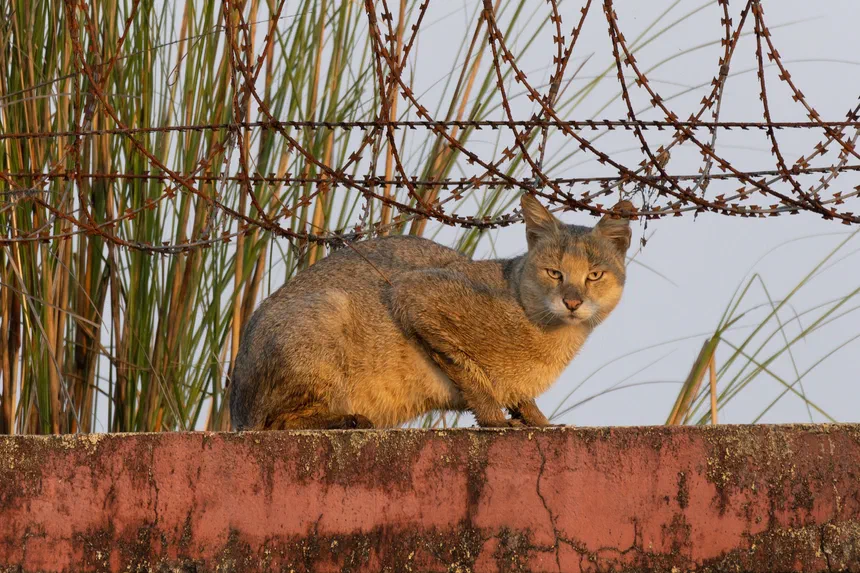
Image: Tisha Mukherjee — CC BY-SA 4.0 · source
What Is a Jungle Cat?
The jungle cat (Felis chaus) is a medium-sized wild cat native to a broad swath of Asia and parts of the Middle East and North Africa. Despite its name, it is not really a rainforest animal; it favors wetlands, reed beds, and other dense vegetation near water. It belongs to the same genus as the domestic cat but is noticeably larger and longer-legged.
Appearance and Identification
The jungle cat has a slender, long-legged build with a relatively short tail, giving it a somewhat lanky, upright appearance. Its coat is typically sandy, tawny, or grayish-brown and largely unmarked in adults, though kittens often show clearer spots and stripes that fade with age. Faint dark bars may remain on the legs, and the tail carries a few dark rings ending in a black tip. Small tufts of dark hair sometimes crown the ears, which are large and reddish on the back. Adults generally measure about 24 to 36 inches (60 to 90 cm) in head-and-body length, with a tail roughly a third of that. Weights commonly range from about 11 to 35 pounds (5 to 16 kg), with males tending to be larger than females.
Habitat and Range
The species occupies one of the widest ranges of any small cat, stretching from Egypt and the Middle East across Central and South Asia into parts of Southeast Asia and southern China. It is strongly associated with water and thrives in wetlands, marshes, riverbanks, reed beds, and the fringes of lakes. It also uses grasslands, scrub, and agricultural land, and is frequently found near rice paddies, irrigation canals, and human settlements where cover and prey are available. It generally avoids dense tropical rainforest and true desert.
Diet
The jungle cat is a versatile carnivore that feeds mainly on small mammals, especially rodents, which can make up the bulk of its diet. It also takes birds, and it is a capable hunter of waterfowl and other wetland species. Fish, frogs, reptiles, and large insects round out the menu, and it will occasionally take hares or young of larger animals. Its long legs suit a hunting style based on stalking and quick pounces through tall grass and reeds, and it is known to make impressive leaps to snatch flushed birds from the air.
Behavior
Jungle cats are largely solitary and territorial, marking and patrolling home ranges that vary with prey availability. They are active by day and night but often shift toward crepuscular and nocturnal habits where they overlap heavily with people. Good swimmers, they readily enter water to pursue prey or cross channels. Vocalizations include a range of calls, and their voice is generally deeper than that of a domestic cat. They rest in dense cover, abandoned burrows, or dens dug by other animals.
Life Cycle and Reproduction
Breeding timing varies across the range but often peaks in late winter and spring. After a gestation of roughly two months, the female gives birth to a litter of about two to four kittens in a sheltered den among reeds, burrows, or dense undergrowth. Kittens are born blind and helpless, open their eyes within the first couple of weeks, and are weaned at around three months. They become independent before their first year and reach sexual maturity at roughly one to two years of age. Males may help provision young in some cases, though the female provides most care.
Conservation Status
The jungle cat is currently listed as Least Concern by the IUCN, reflecting its wide distribution and adaptability. Populations are nonetheless declining in many areas due to the draining and degradation of wetlands, habitat conversion for agriculture, and killing in response to poultry raids. The cats are also lost to snares, poisoning, and road traffic, and hybridization with domestic cats is a localized concern. Legal protection exists across much of the range, but enforcement and wetland conservation remain key to keeping populations stable.
Frequently Asked Questions
Is the jungle cat dangerous to people? No. It is shy and avoids humans, though it may take poultry near villages, which sometimes brings it into conflict with farmers.
Can jungle cats interbreed with domestic cats? Yes. They can hybridize with domestic cats, and such crossbreeding is a conservation concern in some regions where the two overlap.
Do jungle cats really live in jungles? Not typically. The name is misleading; they prefer wetlands, reed beds, grasslands, and scrub, and generally avoid dense rainforest.