Mammals Guide
Juliana's Golden Mole
What Is a Juliana’s Golden Mole? Juliana’s golden mole (Neamblysomus julianae) is a small, burrowing mammal belonging to the golden mole family (Chrysochloridae), a group found only in sub-Saharan Africa. Despite the …
At a glance
What Is a Juliana’s Golden Mole?
Juliana’s golden mole (Neamblysomus julianae) is a small, burrowing mammal belonging to the golden mole family (Chrysochloridae), a group found only in sub-Saharan Africa. Despite the name, it is not a true mole and is only distantly related to the moles of Europe and North America. It is one of southern Africa’s most localized and threatened small mammals.
Appearance and Identification
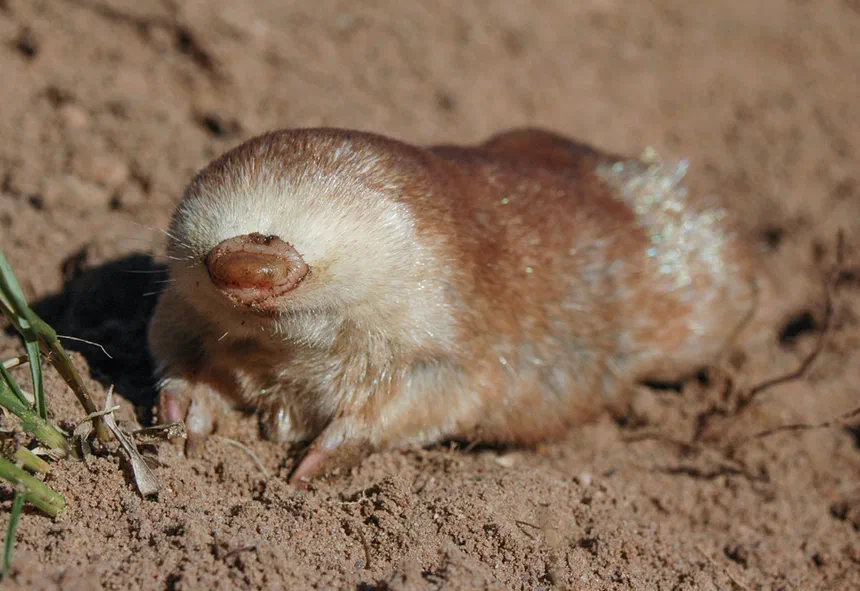
This is a compact, cylindrical animal built for a life spent almost entirely underground. Its dense, water-repellent fur ranges from reddish-brown to grayish, often with a slightly paler belly, and can carry the faint metallic sheen that gives golden moles their name. The eyes are covered by skin and non-functional, and there are no external ears or visible tail. The muzzle ends in a tough, leathery pad used to push through soil, and the forelimbs bear stout claws adapted for digging. Adults typically measure around 9 to 11 centimeters in length.
Habitat and Range
Juliana’s golden mole is restricted to a few isolated areas in northeastern South Africa, historically recorded near Pretoria in Gauteng and in parts of Mpumalanga and Limpopo. It favors sandy, well-drained soils in grassland, savanna, and lightly wooded habitats where it can tunnel easily. Because the species depends on specific soil types, its distribution is patchy and its total range is very small, leaving populations vulnerable to habitat loss.
Diet
The species is insectivorous, feeding on soil-dwelling invertebrates it encounters while burrowing. Earthworms, insect larvae, beetles, and other small arthropods make up the bulk of its diet. It hunts largely by touch and vibration, using its sensitive snout to detect prey moving through loose soil. Like other golden moles, it plays a useful role in aerating soil and controlling invertebrate numbers.
Behavior
Juliana’s golden mole is solitary and spends nearly all of its time below ground, creating shallow foraging tunnels near the surface as well as deeper resting burrows. Surface ridges of pushed-up soil often reveal where the animal has been active. It is thought to be most active during cooler parts of the day and night, and it can enter periods of torpor to conserve energy when conditions are harsh or food is scarce. Golden moles rely heavily on vibration sensitivity to navigate and locate prey in the dark.
Life Cycle and Reproduction
Details of reproduction in this species are poorly known, as its subterranean lifestyle makes it difficult to study. Based on related golden moles, females likely give birth to a small litter of one to two young in a grass-lined nest chamber within the burrow system. The young are cared for underground until they are able to forage independently. Reproductive rates appear to be low, which limits how quickly populations can recover from decline.
Conservation Status
The IUCN lists Juliana’s golden mole as Endangered. Its extremely limited range and dependence on particular sandy soils make it highly sensitive to urban expansion, mining, agriculture, and other forms of habitat disturbance. Some populations occur close to the rapidly growing city of Pretoria, where development has fragmented suitable ground. Protecting the remaining patches of natural habitat, particularly within reserves, is considered essential for the species’ survival.
Frequently Asked Questions
Is Juliana’s golden mole a true mole? No. It belongs to the golden mole family (Chrysochloridae) and is only distantly related to true moles, having evolved a similar digging lifestyle independently.
Why is it endangered? Its range is very small and tied to specific sandy soils, so urban growth, mining, and farming can quickly destroy or fragment the limited habitat it needs.
Can it see? No. Its eyes are covered by skin and it is functionally blind, relying instead on touch and its acute sensitivity to ground vibrations.