Mammals Guide
Jerboa
What Is a Jerboa? Jerboas are small, hopping desert rodents that make up the family Dipodidae, found across the arid lands of North Africa and Asia. With their long hind legs, short forelimbs, and lengthy tufted tails, …
At a glance
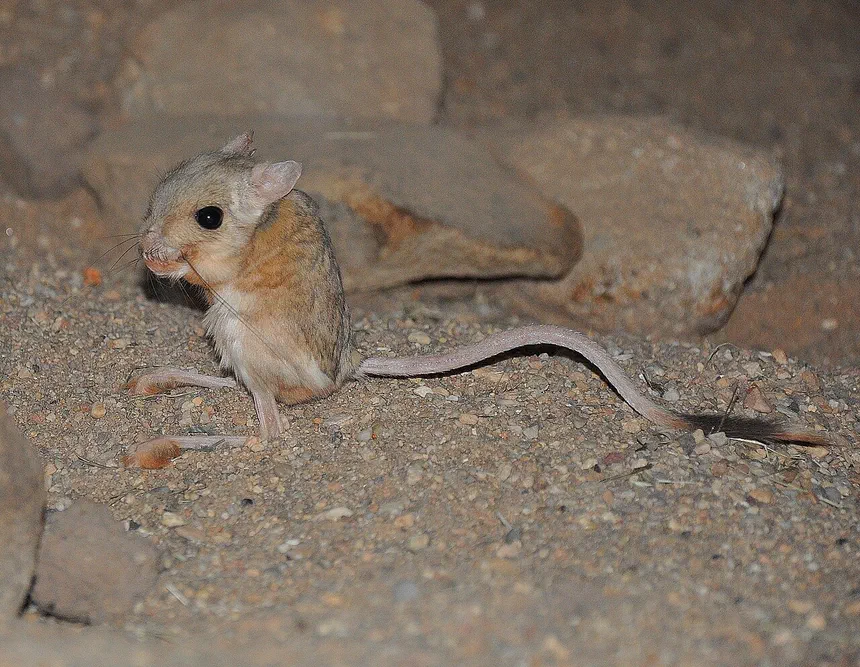
Image: Elias Neideck — CC BY-SA 3.0 · source
What Is a Jerboa?
Jerboas are small, hopping desert rodents that make up the family Dipodidae, found across the arid lands of North Africa and Asia. With their long hind legs, short forelimbs, and lengthy tufted tails, they bear a striking resemblance to miniature kangaroos, though the two are entirely unrelated. The family contains roughly two dozen species adapted to some of the driest environments on Earth.
Appearance and Identification
Jerboas are instantly recognizable by their kangaroo-like body plan. The head and body of most species measure only a few inches, while the slender tail is usually longer than the body and often ends in a small tuft of hair. The hind legs are greatly elongated and powerful, while the front limbs are tiny and used mainly for handling food and digging.
Their fur is typically sandy, buff, or grayish above, blending seamlessly with desert soils, and pale to white on the belly. Large eyes suit a nocturnal life, and many species have notably long ears, most famously the long-eared jerboa, whose ears can be larger than its head. Long hairs on the feet of some species act like snowshoes, spreading weight across loose sand.
Habitat and Range
Jerboas inhabit deserts, semi-deserts, dry steppe, and other sparsely vegetated landscapes. Their combined range stretches from the Sahara and North Africa eastward through the Middle East and Central Asia to Mongolia and northern China.
These are animals of open, exposed country, where daytime temperatures soar and cover is scarce. To survive, jerboas spend the heat of the day underground in burrows they dig themselves, emerging only after dark when the air cools.
Diet
Most jerboas are primarily herbivorous, feeding on seeds, roots, shoots, and other plant matter, though many will also take insects when available. The balance of the diet shifts with the seasons and with what the sparse desert can offer.
Remarkably, jerboas can survive without drinking free water, obtaining nearly all the moisture they need from their food and producing highly concentrated urine to minimize water loss. This physiological thrift is one of the keys to their success in waterless terrain.
Behavior
Jerboas are almost entirely nocturnal, spending the day sealed inside cool, humid burrows and foraging alone at night. Many dig several types of burrow, including temporary daytime shelters and deeper, plugged tunnels used for sleeping through the harshest heat or for hibernating through cold winters.
Their most famous trait is their locomotion. Using their long hind legs, jerboas travel by bipedal hopping, bounding across open ground in a series of leaps that can cover surprising distances relative to their size. This erratic, springing gait, combined with quick changes of direction, helps them evade owls, foxes, snakes, and other desert predators. The long tail acts as a counterbalance and prop.
Life Cycle and Reproduction
Breeding in jerboas is tied to favorable conditions, often occurring after seasonal rains bring a flush of vegetation. Depending on the species and climate, females may raise one or more litters in a year, with each litter generally containing a few young.
The young are born in the safety of the burrow, helpless and hairless at first, and are nursed for several weeks before becoming independent. In many colder parts of their range, jerboas enter a long winter hibernation, sealing themselves underground and surviving on stored body reserves until spring. Lifespans in the wild are typically only a few years.
Conservation Status
Because the family Dipodidae contains many species, conservation status varies widely. A number of widespread jerboas are listed as Least Concern on the IUCN Red List, remaining common across their broad ranges. Others with small or specialized distributions face greater pressure and are considered threatened.
The main risks include habitat degradation from grazing, agriculture, and mining, along with disturbance to the fragile desert and steppe ecosystems they depend on. For most species, large and remote arid habitats currently offer a measure of protection.
Frequently Asked Questions
Are jerboas related to kangaroos? No. Although jerboas hop on long hind legs and use their tail for balance much like a kangaroo, they are rodents, not marsupials. The resemblance is a case of convergent evolution, where unrelated animals develop similar traits to suit similar lifestyles.
How do jerboas survive without water? They extract moisture from the seeds and plants they eat and conserve it with very efficient kidneys, producing concentrated urine. This allows many species to live in true deserts without ever drinking.
Why do jerboas hop instead of run? Bipedal hopping is fast and unpredictable, letting a jerboa change direction sharply to dodge predators across open desert. It is also an energy-efficient way to travel long distances in search of scattered food.