Mammals Guide
Javan Rhinoceros
What Is a Javan Rhinoceros? The Javan rhinoceros (Rhinoceros sondaicus) is one of the rarest large mammals on Earth, a solitary browser that survives today in a single protected reserve on the Indonesian island of Java. …
At a glance
What Is a Javan Rhinoceros?
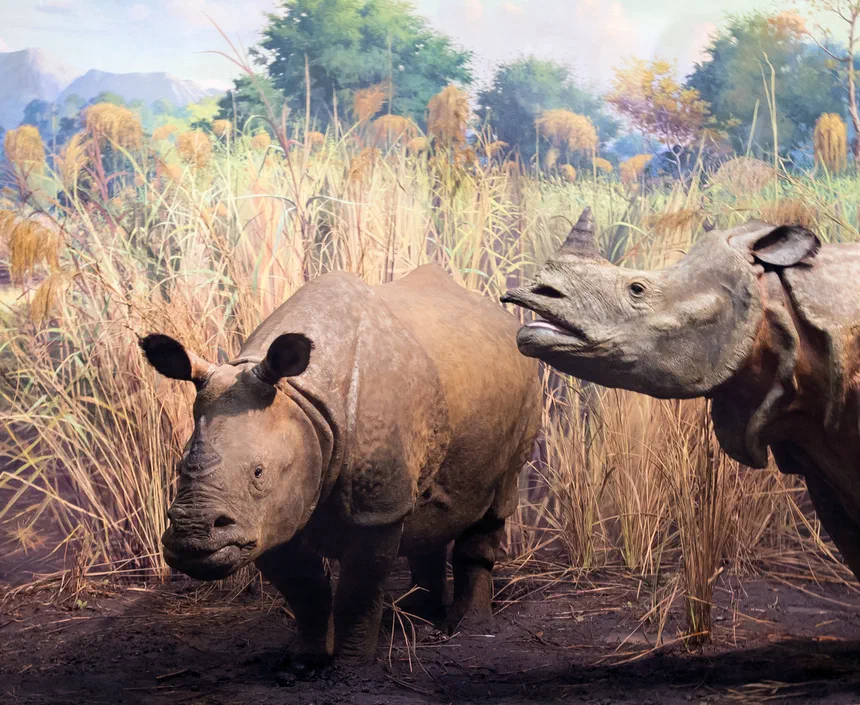
The Javan rhinoceros (Rhinoceros sondaicus) is one of the rarest large mammals on Earth, a solitary browser that survives today in a single protected reserve on the Indonesian island of Java. Closely related to the greater one-horned rhinoceros of South Asia, it is distinguished by its smaller size, mosaic-like skin folds, and a single, often stubby horn.
Appearance and Identification
This is a bulky, gray-skinned animal whose hairless hide is divided into large plates by deep folds at the shoulders, flanks, and rump, giving it an armored, riveted appearance. Adults measure roughly 3 to 3.2 meters in body length and stand about 1.4 to 1.7 meters at the shoulder, with weights generally between 900 and 2,300 kilograms. Unlike African rhinos, the Javan species carries only one horn, which is comparatively short and may be barely present in females. Its upper lip is prehensile and pointed, an adaptation for grasping leaves and twigs.
Habitat and Range
Once ranging widely across Southeast Asia, from northeastern India through mainland Indochina and down into the Sunda Islands, the Javan rhinoceros now clings to existence in Ujung Kulon National Park at the far western tip of Java. It favors dense lowland tropical rainforest, mud wallows, and tangled secondary growth near water. Wallowing in mud is an important daily behavior that helps regulate body temperature and protects the skin from biting insects and parasites.
Diet
The Javan rhinoceros is a dedicated herbivore and, more specifically, a browser rather than a grazer. It feeds on a wide variety of plant material, including young shoots, leaves, twigs, and fallen fruit, using its pointed prehensile lip to pull vegetation into its mouth. An individual may consume tens of kilograms of plant matter each day, often pushing over saplings to reach tender foliage near the tops.
Behavior
Largely solitary and secretive, the Javan rhinoceros keeps to itself except for mating pairs and mothers with calves. It communicates and marks territory through dung piles, urine spraying, and scrapes made with its feet. Individuals maintain overlapping home ranges and follow well-worn trails through the forest. Their eyesight is poor, but they rely on acute senses of smell and hearing to detect disturbance, and they tend to be wary and elusive, which has made them exceptionally difficult to study in the wild.
Life Cycle and Reproduction
Reproduction in this species is slow, a factor that complicates recovery efforts. Females reach sexual maturity at around five to seven years and males somewhat later. After a gestation period estimated at roughly 15 to 16 months, a female gives birth to a single calf, which nurses and remains with its mother for one to two years before becoming independent. Because births are infrequent and litters consist of just one offspring, the population grows only very gradually even under protection.
Conservation Status
The Javan rhinoceros is classified as Critically Endangered by the IUCN and ranks among the most threatened mammals in the world, with a total population estimated at only a few dozen individuals confined to Ujung Kulon. Historic decline was driven by hunting for its horn and by widespread loss of lowland forest to agriculture. Today the surviving population faces additional risks from its small size and single location, including disease, natural disasters such as tsunamis or volcanic activity, and competition from invasive arenga palm. Intensive monitoring, anti-poaching patrols, and habitat management are central to keeping the species alive.
Frequently Asked Questions
How many Javan rhinoceros are left? Estimates place the surviving population at only a few dozen animals, all within Ujung Kulon National Park in Indonesia, making it one of the rarest large mammals alive.
Does the Javan rhinoceros have one horn or two? It has a single horn, which is relatively short in males and may be nearly absent in females, distinguishing it from the two-horned African rhinos.
Why is it so endangered? Centuries of hunting for its horn and the loss of lowland forest reduced it to a single tiny population, which remains vulnerable to disease, natural disasters, and its own slow rate of reproduction.