Mammals Guide
Japanese Serow
What Is a Japanese Serow? The Japanese serow (Capricornis crispus) is a stocky, goat-like mammal native to the mountain forests of Japan. Despite its goat-like build, it belongs to a group of goat-antelopes and is more …
At a glance
What Is a Japanese Serow?
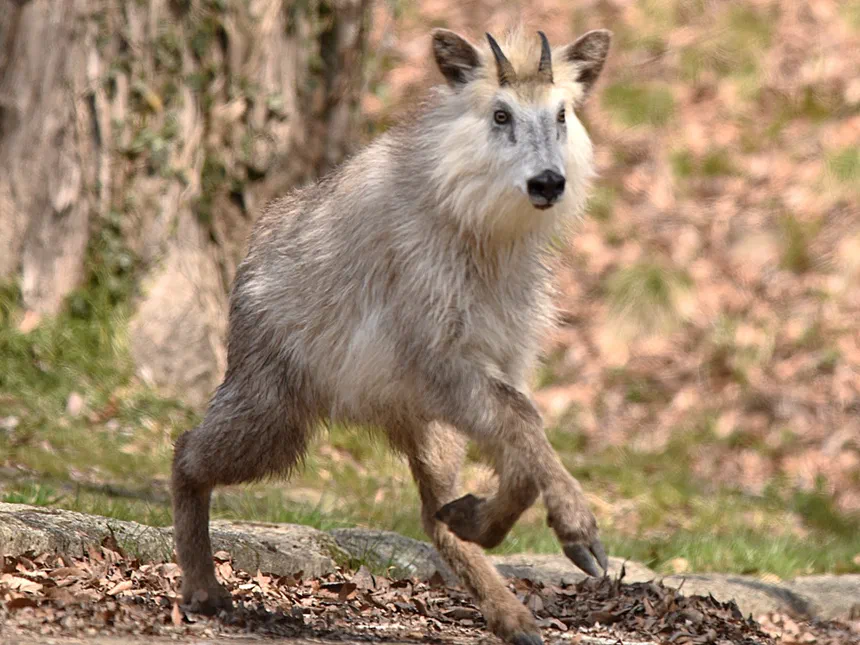
The Japanese serow (Capricornis crispus) is a stocky, goat-like mammal native to the mountain forests of Japan. Despite its goat-like build, it belongs to a group of goat-antelopes and is more closely related to gorals and other serows than to true goats. Known in Japan as kamoshika, it is a celebrated forest dweller and a designated national monument.
Appearance and Identification
The Japanese serow has a compact, muscular body set on sturdy legs, giving it a slightly hunched profile well suited to steep terrain. Its shaggy coat ranges from grizzled gray-brown to a pale, almost whitish tone, often with a lighter throat and cheeks; coat color varies between individuals and regions. Both males and females carry short, backward-curving horns that are usually 10-15 cm long and are never shed. A distinctive feature is the pair of large scent glands below the eyes, which appear as noticeable swellings on the face. The thick, woolly fur helps it endure cold, snowy winters at higher elevations.
Habitat and Range
This species is found across the main Japanese islands of Honshu, Shikoku, and Kyushu, with the largest populations in the mountainous regions of central and northern Honshu. It favors dense broadleaf and mixed forests on steep slopes, from low hills up into subalpine zones. Rocky, forested terrain provides both cover and the browse it depends on. Serows tend to remain within relatively small areas year-round rather than making long seasonal migrations, though they may shift to lower elevations when deep snow blankets the highlands.
Diet
The Japanese serow is a herbivore and a selective browser. Its diet centers on the leaves, buds, and shoots of shrubs and trees, supplemented by acorns, conifer needles, ferns, and grasses. Like other ruminants, it has a multi-chambered stomach that allows it to digest fibrous plant material efficiently. Feeding usually occurs in the early morning and around dusk, with the animal moving slowly and quietly through the understory as it browses.
Behavior
Japanese serows are largely solitary and strongly territorial. Individuals or pairs defend home ranges that they mark using the secretions of their preorbital scent glands, rubbing the glands against twigs, rocks, and branches to leave a signal for other serows. They are most active in the cooler hours of the day and are generally quiet, cautious animals. When alarmed, a serow may freeze and watch an intruder before retreating into thick cover. Their sure-footedness lets them navigate rocky, precipitous slopes with ease.
Life Cycle and Reproduction
Breeding typically takes place in autumn, and after a gestation of roughly seven months a single young, or kid, is usually born in late spring or early summer. Twins are rare. The newborn is well developed and able to follow its mother within a short time, staying close to her during its first months. Young serows are weaned over the summer and gradually become independent, often dispersing to establish their own territories as they approach maturity. Serows generally live around 10 to 15 years in the wild.
Conservation Status
The Japanese serow is listed as Least Concern by the IUCN, and its populations are considered stable. It was once heavily hunted and became scarce, but strict legal protection in the twentieth century, including its status as a Special Natural Monument in Japan, allowed numbers to recover strongly. Today the main management concerns are localized conflicts where serows browse on forestry plantations, along with habitat pressures. Overall the species remains widespread across its forested mountain range.
Frequently Asked Questions
Is the Japanese serow a goat or an antelope? Neither exactly. It is a goat-antelope, part of a group that shares traits with both, and it is most closely related to gorals and other serows.
Do both males and females have horns? Yes. Both sexes grow short, backward-curving horns that are kept for life and are similar in size, which can make the sexes hard to tell apart at a distance.
Why is it important in Japan? Beyond its ecological role as a forest browser, the Japanese serow is protected as a Special Natural Monument and is a well-known symbol of the country’s mountain wildlife.