Mammals Guide
Jaguarundi
What Is a Jaguarundi? The jaguarundi (Herpailurus yagouaroundi) is a small, slender wild cat native to the Americas. With its long body, short legs, and sleek unspotted coat, it looks more like a weasel or otter than a …
At a glance
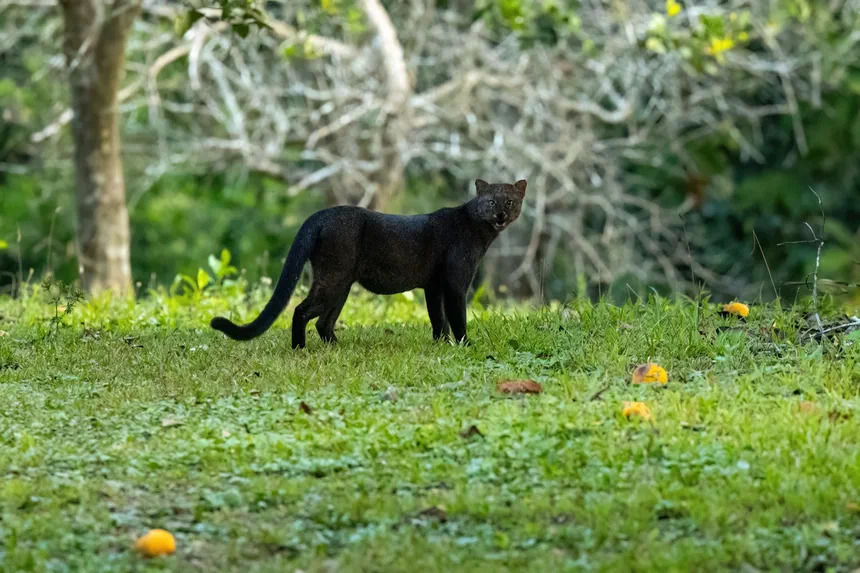
Image: thibaudaronson — CC BY-SA 4.0 · source
What Is a Jaguarundi?
The jaguarundi (Herpailurus yagouaroundi) is a small, slender wild cat native to the Americas. With its long body, short legs, and sleek unspotted coat, it looks more like a weasel or otter than a typical cat, which sets it apart from its spotted neotropical relatives.
Appearance and Identification
Jaguarundis have an unusually elongated body, a small flattened head, short rounded ears, and a long tail that can make up nearly half their total length. Their coat is uniform and unpatterned, coming in two main color phases: a dark gray to blackish morph and a reddish to tawny-brown morph. Kittens may show faint spotting that fades with age. Adults typically weigh between 7 and 20 pounds, standing only about 10 to 14 inches at the shoulder, making them roughly twice the size of a domestic cat but much lower and longer in build.
Habitat and Range
This adaptable cat occupies a wide variety of lowland habitats, including tropical and subtropical forests, dense scrub, savanna grasslands, and the edges of wetlands. It generally favors areas with thick ground cover near water. The jaguarundi’s range stretches from southern Texas and Mexico through Central America and into much of South America as far south as northern Argentina. It tends to avoid high elevations and dense closed-canopy interiors, preferring brushy edges and secondary growth.
Diet
Jaguarundis are opportunistic carnivores that hunt primarily on the ground. Their diet is dominated by small prey such as rodents, rabbits, birds, reptiles, amphibians, and large insects. They will also take fish and occasionally raid for small ground-dwelling birds. Unlike many cats, jaguarundis are frequently active during daylight hours, and they rely on quick pounces and short chases through low vegetation rather than ambush from trees.
Behavior
Jaguarundis are largely solitary and are more diurnal than most wild cats, with peak activity in the morning and midday. They are strong, agile ground hunters but can also climb and swim well when needed. Individuals patrol home ranges that they mark with scent, and encounters between adults are generally brief outside of the breeding season. They produce an unusually wide range of vocalizations for a small cat, including chirps, whistles, purrs, and chatter, which may help them communicate across dense cover.
Life Cycle and Reproduction
Breeding can occur throughout much of the year in tropical parts of the range, with more defined seasons in cooler regions. After a gestation of roughly 70 to 75 days, the female gives birth to a litter of usually one to four kittens in a sheltered den such as a hollow log or dense thicket. The young are born with faint markings and open their eyes within the first couple of weeks. They are weaned at around six weeks and become independent within several months, reaching sexual maturity in about two to three years. Wild jaguarundis typically live around 10 to 15 years.
Conservation Status
The jaguarundi is listed as Least Concern by the IUCN across its broad range, reflecting its wide distribution and adaptability. However, populations at the northern edge, particularly in the United States and northern Mexico, are considered rare and are protected, as the cat has become extremely scarce there. The main threats are habitat loss and fragmentation from agriculture and development, along with road mortality. Because it is naturally elusive and occurs at low densities, reliable population data is limited in much of its range.
Frequently Asked Questions
Is a jaguarundi related to the jaguar? Despite the similar name, the jaguarundi is only distantly related to the jaguar. It is a small cat most closely allied with the cougar, and its name comes from indigenous South American languages rather than from any close kinship with the larger spotted cat.
Are jaguarundis dangerous to people? No. Jaguarundis are small, shy, and avoid humans. They pose no meaningful threat to people and will typically flee if approached.
Why do jaguarundis look so different from other cats? Their long low body, short legs, small head, and unspotted coat give them an otter- or weasel-like appearance. This build suits their ground-based hunting lifestyle in dense, brushy habitats.