Mammals Guide
Jaguar
What Is a Jaguar? The jaguar (Panthera onca) is the largest cat in the Americas and the third-largest in the world, after the tiger and the lion. A powerfully built, spotted predator of tropical forests and wetlands, it …
At a glance
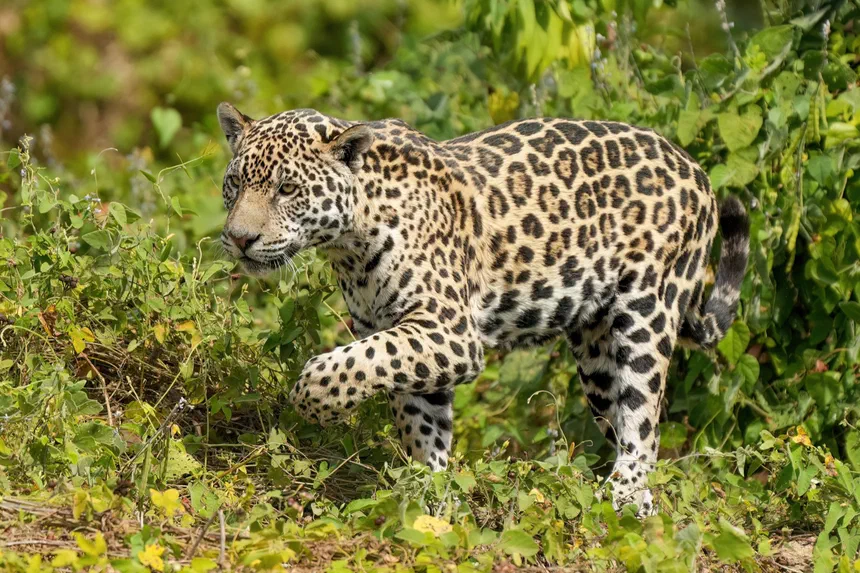
Image: Giles Laurent — CC BY-SA 4.0 · source
What Is a Jaguar?
The jaguar (Panthera onca) is the largest cat in the Americas and the third-largest in the world, after the tiger and the lion. A powerfully built, spotted predator of tropical forests and wetlands, it is the only living member of the genus Panthera native to the New World.
Appearance and Identification
The jaguar is a stocky, muscular cat with a broad head, deep chest, and short, sturdy limbs built for power rather than speed. Its tawny-to-golden coat is patterned with dark rosettes, and unlike the leopard’s simpler rings, a jaguar’s rosettes often enclose one or more small central spots. The belly and inner limbs are pale. Some individuals are melanistic, appearing nearly all black, though their rosettes remain faintly visible in good light; these are the animals often called “black panthers.” Jaguars have exceptionally strong jaws and relatively large canine teeth, giving them one of the most forceful bites of any cat relative to size.
Habitat and Range
Jaguars favor dense, well-watered habitats such as tropical rainforest, seasonally flooded wetlands, swamps, and riverine forest, though they also occur in drier scrub and grassland. They are strongly associated with water and are found in some of their highest densities in the Pantanal, the vast wetland of South America. Historically the species ranged from the southwestern United States through Mexico, Central America, and much of South America to northern Argentina. Today the northern edge of that range is greatly reduced, and the Amazon Basin holds the largest remaining populations.
Diet
The jaguar is a pure carnivore and an opportunistic hunter with an unusually broad prey list, recorded taking dozens of species. Favored prey includes capybara, peccary, deer, and caiman, but jaguars also eat fish, turtles, birds, and smaller mammals. They are strong swimmers and readily hunt in and around water. The jaguar is famous for a distinctive killing method: rather than the throat bite used by most big cats, it often bites directly through the skull between the ears, using its powerful jaws to pierce bone. This same strength lets it crack open turtle shells and armored reptiles.
Behavior
Jaguars are largely solitary and mostly active around dawn, dusk, and at night, resting in cover during the heat of the day. Adults hold home ranges that they mark with scent and scrapes, with male territories typically larger than those of females and often overlapping several. They are excellent climbers and swimmers, comfortable crossing rivers and even hunting aquatic prey. Communication includes a series of grunting, sawing roars, along with growls and scent signals. Encounters between adults are generally avoided outside of mating.
Life Cycle and Reproduction
Jaguars breed at any time of year in tropical parts of their range, with more seasonal timing toward the edges. After a gestation of roughly 90 to 110 days, the female gives birth to a litter of usually one to four cubs in a sheltered den. Cubs are born blind and depend entirely on their mother, who raises them alone. They begin taking solid food within a few months and stay with her for up to two years, learning to hunt before dispersing to establish their own ranges. Females typically reach breeding age earlier than males. Wild jaguars generally live around 12 to 15 years.
Conservation Status
The jaguar is listed as Near Threatened by the IUCN, with an overall declining population trend. The greatest threats are habitat loss and fragmentation from deforestation and agriculture, conflict with ranchers over livestock, loss of prey, and illegal killing and trade in jaguar parts. Because jaguars need large, connected territories, maintaining forest corridors between protected areas is a central conservation priority. Regional efforts such as the Jaguar Corridor Initiative aim to link populations from Mexico to Argentina so that the species can move and breed across its range.
Frequently Asked Questions
What is the difference between a jaguar and a leopard? Jaguars are bulkier with a larger head and stronger bite, and their rosettes usually have small spots inside them. Leopards, native to Africa and Asia, are more slender and their rosettes typically lack central spots.
Are black panthers a separate species? No. A “black panther” in the Americas is simply a melanistic jaguar, and in Africa or Asia a melanistic leopard. The dark coat comes from a pigment variation, not a different species.
Do jaguars attack people? Attacks on humans are very rare. Jaguars tend to avoid people and usually retreat, though conflict can arise where they prey on livestock.