Mammals Guide
Jackrabbit
What Is a Jackrabbit? Despite the name, the jackrabbit is not a rabbit at all but a hare, a member of the genus Lepus. The black-tailed jackrabbit (Lepus californicus) is one of the most familiar species across the arid …
At a glance
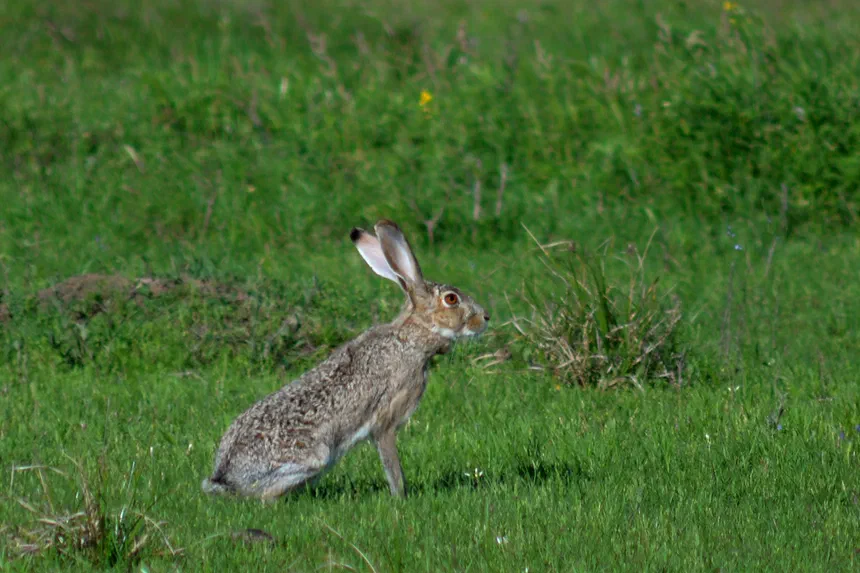
Image: William L. Farr — CC BY-SA 4.0 · source
What Is a Jackrabbit?
Despite the name, the jackrabbit is not a rabbit at all but a hare, a member of the genus Lepus. The black-tailed jackrabbit (Lepus californicus) is one of the most familiar species across the arid open country of western North America, easily recognized by its towering ears and long, powerful hind legs. The name is thought to be a shortening of “jackass rabbit,” a nod to those donkey-like ears.
Appearance and Identification
Jackrabbits are large, lean-bodied hares built for speed. The black-tailed jackrabbit typically measures about 20 to 25 inches (50 to 63 cm) in length and weighs roughly 3 to 7 pounds (1.3 to 3.2 kilograms). Its coat is a mottled grayish-brown that blends well with dry soil and sparse vegetation. The two most distinctive features are the enormous ears, which can reach 4 to 7 inches long and are tipped in black, and the dark stripe running along the top of the tail that gives the species its common name. Those ears are more than sensory organs; their large surface area, laced with blood vessels, helps the animal shed excess heat in hot climates. The hind legs are notably long and muscular, powering explosive leaps.
Habitat and Range
The black-tailed jackrabbit occupies a broad swath of western and central North America, from the interior western United States and the Great Plains south into central Mexico. It favors open, arid, and semiarid landscapes: deserts, grasslands, sagebrush flats, chaparral, and agricultural margins. Unlike many rabbits, jackrabbits do not dig extensive burrows. Instead they rest in shallow depressions called forms, scraped out beneath a shrub or clump of grass, relying on camouflage and speed rather than shelter to avoid danger.
Diet
Jackrabbits are strict herbivores with a flexible, seasonal diet. In spring and summer they graze on green grasses, clover, and other soft, moisture-rich forbs. During dry months, when tender greenery is scarce, they switch to tougher fare including shrubs, twigs, bark, and even cactus pads and mesquite. Like other hares, they practice coprophagy, re-ingesting certain soft fecal pellets to extract additional nutrients from their fibrous plant food. They obtain most of their water from vegetation and can go long stretches without drinking.
Behavior
Jackrabbits are chiefly active from dusk through the night, spending the heat of the day resting in the shade of their forms. When threatened, they rely on remarkable athleticism: they can sprint at speeds around 30 to 40 miles per hour and clear leaps of 10 feet or more, often flashing the white underside of the tail or zigzagging to confuse pursuers. A characteristic behavior is the “lookout” leap, an occasional high bound that may help the animal scan for predators. Though generally solitary or loosely social, jackrabbits may gather in loose groups where food is abundant.
Life Cycle and Reproduction
Jackrabbits are prolific breeders, and in warmer parts of their range they may reproduce nearly year-round. After a gestation of about 40 to 47 days, a female gives birth to a litter of one to six young, with several litters possible in a single year. Unlike helpless newborn rabbits, baby hares, called leverets, are born well developed, fully furred, with open eyes, and able to move about shortly after birth. The mother visits to nurse but otherwise leaves them concealed in vegetation. Young jackrabbits grow quickly and may reach breeding age within their first year.
Conservation Status
The black-tailed jackrabbit is listed as Least Concern by the IUCN. It remains widespread and locally abundant, and its populations can fluctuate dramatically over multi-year cycles. As a major prey species, it supports a wide range of predators including coyotes, bobcats, foxes, hawks, eagles, and owls. In some agricultural areas it is regarded as a pest because it feeds on crops, yet overall the species faces no significant threats to its survival.
Frequently Asked Questions
Is a jackrabbit a rabbit or a hare? It is a hare. Hares are generally larger than rabbits, have longer ears and legs, and give birth to well-developed young rather than blind, hairless newborns.
How fast can a jackrabbit run? Black-tailed jackrabbits can sprint at roughly 30 to 40 miles per hour and make long leaps to escape predators.
Why do jackrabbits have such big ears? The oversized ears sharpen their hearing and, just as importantly, help release body heat, which is a valuable adaptation for life in hot, dry environments.