Mammals Guide
Island Fox
What Is a Island Fox? The island fox (Urocyon littoralis) is a small fox found only on six of the eight Channel Islands off the coast of southern California. Descended from mainland gray foxes that reached the islands …
At a glance
What Is a Island Fox?
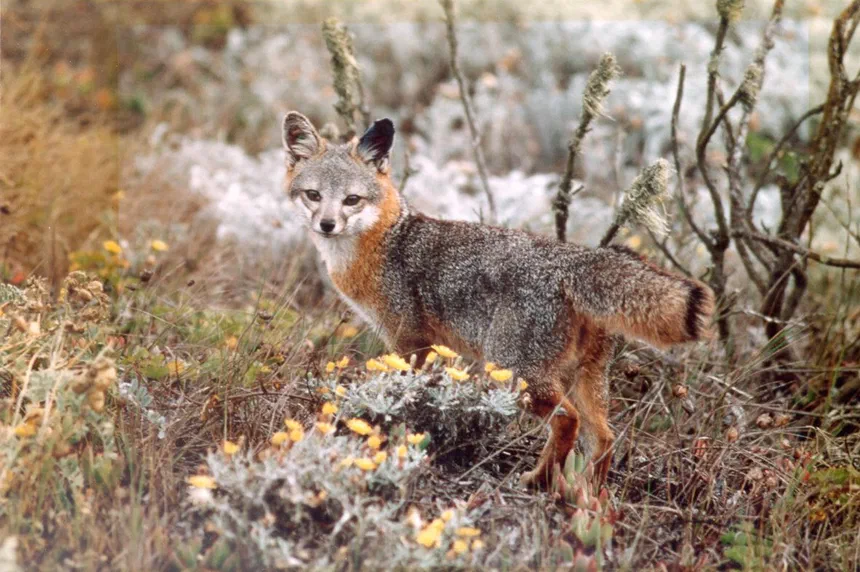
The island fox (Urocyon littoralis) is a small fox found only on six of the eight Channel Islands off the coast of southern California. Descended from mainland gray foxes that reached the islands thousands of years ago, it is one of the smallest wild canids in the world and a striking example of island dwarfism.
Appearance and Identification
The island fox looks like a miniature version of its mainland relative, the gray fox. It has a grizzled gray back, rusty-brown or cinnamon coloring along its sides and legs, and a pale, whitish throat, chest, and belly. The face carries a distinctive pattern of black, white, and reddish markings, and the tail has a dark stripe running along its upper side. Adults are noticeably smaller than a house cat in body mass, standing only about 12 to 15 centimeters at the shoulder and weighing roughly 1.3 to 2.8 kilograms. Males tend to be slightly larger than females. Each island population has developed subtle differences, and biologists recognize six subspecies, one for each inhabited island.
Habitat and Range
This fox occurs naturally nowhere else on Earth. It lives on Santa Catalina, San Clemente, San Nicolas, Santa Cruz, Santa Rosa, and San Miguel islands. Because the islands offer a range of terrain in a compact area, island foxes use nearly every available habitat, including coastal sage scrub, native grassland, oak and pine woodland, sand dunes, and riparian corridors. They tolerate a variety of elevations and are often seen in the open, being less wary of people than many mainland foxes.
Diet
Island foxes are opportunistic omnivores, and their diet shifts with the seasons and with what each island provides. Insects such as beetles, crickets, and caterpillars make up a large share of their food, along with fruits from native plants like manzanita, prickly pear cactus, and toyon. They also hunt deer mice and other small rodents, catch lizards, and take birds, eggs, and land snails. On some islands they forage along the shoreline for crabs and other marine debris left by the tide.
Behavior
Unlike many canids, island foxes are active during both day and night, though they often peak around dawn and dusk. They are generally solitary foragers but form monogamous breeding pairs that share and defend a territory year-round. Foxes mark their ranges with scent using latrine sites and scent glands. They communicate through vocalizations, body posture, and scent, and they are agile climbers, sometimes ascending low trees and shrubs in search of fruit or to escape a threat.
Life Cycle and Reproduction
Breeding pairs mate in late winter, typically from January through March. After a gestation of about 50 to 63 days, the female gives birth in spring to a litter usually numbering one to five pups, with two or three being most common. Pups are born in a den and remain hidden for their first weeks before emerging to explore. Both parents help provision the young, which are weaned by around eight weeks and begin foraging on their own by late summer. Young foxes reach breeding age at about one year. In the wild most island foxes live four to six years, though some survive considerably longer.
Conservation Status
The island fox is one of conservation biology’s notable recovery stories. In the 1990s, populations on several northern islands crashed dramatically, driven largely by golden eagles that had begun preying on the small foxes after native bald eagles declined and feral pigs provided an alternate food source. Canine distemper also devastated the Santa Catalina population. In response, agencies removed golden eagles, restored bald eagles, eradicated feral pigs, vaccinated foxes, and ran captive-breeding programs. These efforts led to a rapid rebound, and several subspecies were removed from the U.S. endangered species list in 2016. The IUCN currently lists the species as Near Threatened, and ongoing monitoring guards against disease and other renewed threats.
Frequently Asked Questions
How big is an island fox? It is about the size of a small house cat, weighing roughly 1.3 to 2.8 kilograms and standing only 12 to 15 centimeters at the shoulder, making it one of the smallest wild canids.
Where do island foxes live? They are found only on six of California’s Channel Islands and occur naturally nowhere else in the world.
Are island foxes endangered? Several populations were once critically endangered but rebounded after intensive recovery efforts. The species is now listed as Near Threatened by the IUCN and remains carefully monitored.