Mammals Guide
Indri
What Is a Indri? The indri (Indri indri) is the largest living lemur and one of the most distinctive primates of Madagascar. Sometimes called the babakoto in Malagasy, it is famous for its haunting, far-carrying songs …
At a glance
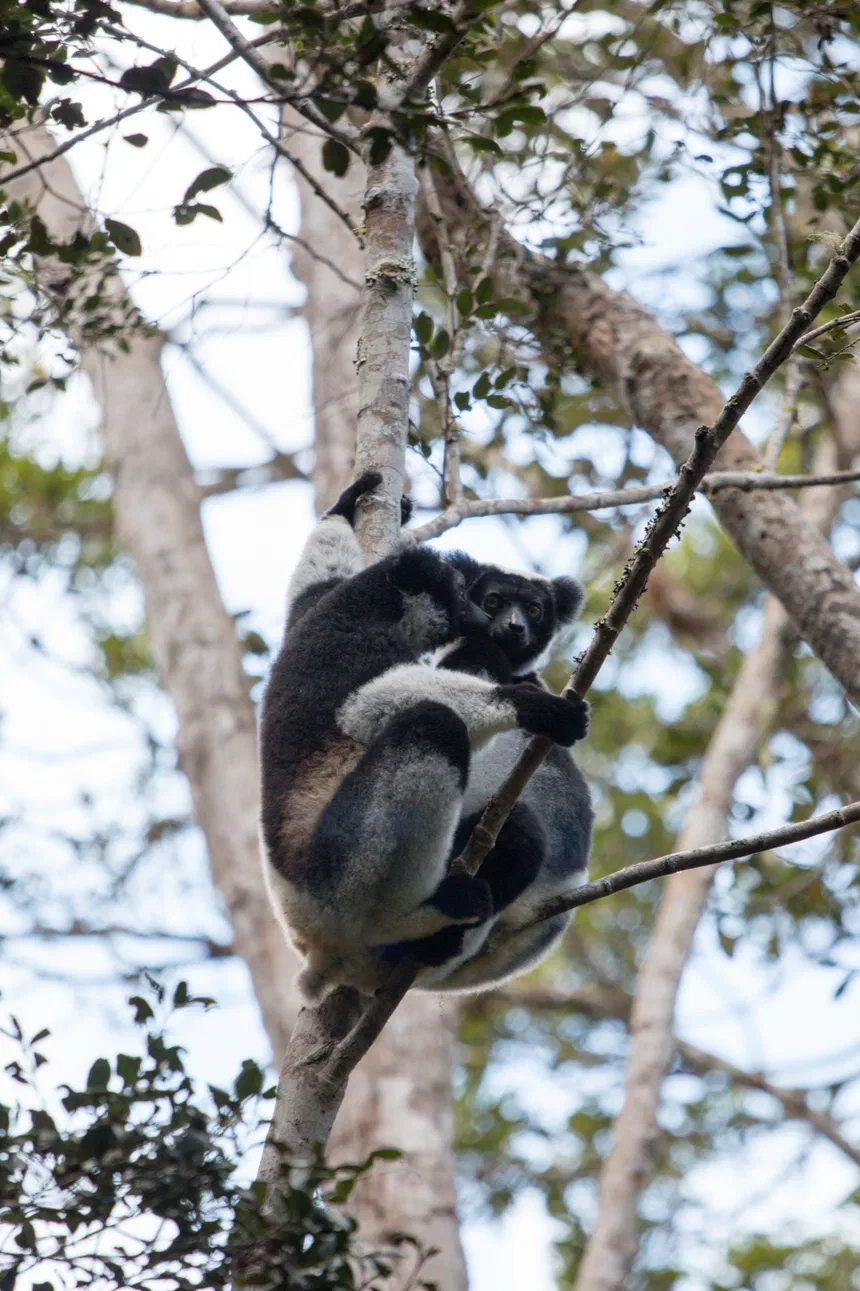
Image: Christophe Germain — CC BY-SA 4.0 · source
What Is a Indri?
The indri (Indri indri) is the largest living lemur and one of the most distinctive primates of Madagascar. Sometimes called the babakoto in Malagasy, it is famous for its haunting, far-carrying songs that echo through the island’s eastern rainforests. Unlike most lemurs, it has only a stub of a tail.
Appearance and Identification
The indri is a large, upright primate with a striking black-and-white coat, though the exact pattern varies between individuals and across its range. The face, hands, feet, and much of the back are typically black, offset by white or pale patches on the limbs, flanks, and crown. Its rounded, teddy-bear-like ears are fringed with fur, and its large forward-facing eyes give it an alert, owlish look. Adults measure roughly 24 to 28 inches (60 to 72 cm) in head-and-body length and weigh about 13 to 21 pounds (6 to 9.5 kilograms). The most unusual feature is the tail, which is reduced to a short vestigial stub rather than the long tail seen in other lemurs. Powerful hind legs, far longer than the arms, equip the indri for a life of vertical clinging and leaping between tree trunks.
Habitat and Range
The indri lives only in the rainforests of eastern Madagascar, a narrow band of humid forest running along the island’s eastern escarpment. It occurs from lowland tropical forest up into cooler montane forest, generally favoring intact, tall-canopy woodland. The species has a limited distribution and does not survive well in heavily degraded or fragmented habitat, which makes it especially vulnerable to deforestation. It has never been successfully kept alive for long in captivity, so wild forest is effectively its only refuge.
Diet
Indris are primarily folivores, meaning leaves form the bulk of their diet. They show a strong preference for young, tender leaves, which are easier to digest and richer in nutrients than mature foliage. Beyond leaves, they eat seeds, fruit, flowers, and occasionally bark, browsing across a wide variety of rainforest tree species through the year. Like other leaf-eating primates, they sometimes visit particular sites to eat soil, a behavior thought to help neutralize plant toxins or supplement minerals. Feeding takes place mainly in the trees, with the animals plucking food using their hands and mouths.
Behavior
The indri is diurnal, active during daylight and resting at night high in the canopy. It is best known for its loud, wailing songs, which can carry for more than a mile through the forest. Family groups sing together in coordinated choruses, most often in the morning, to advertise territory boundaries and keep in contact with neighbors. Locomotion is dominated by spectacular leaps: gripping a vertical trunk, an indri can launch itself many yards to the next tree, staying upright the whole time. On the rare occasions it moves along the ground, it hops on its hind legs with its arms held out for balance. Indris live in small family units, and in local Malagasy tradition they are often regarded with respect and protected by taboo.
Life Cycle and Reproduction
Indris live in small family groups, usually a bonded adult pair together with their offspring, and are generally monogamous. Females typically give birth to a single infant, and breeding is spaced out, with a female often producing young only once every two to three years. This slow reproductive rate means populations recover very gradually from losses. Newborns cling to the mother’s belly at first and later ride on her back as they grow. Young indris depend on their parents for an extended period before reaching independence, and they take several years to mature. In the wild, indris are thought to live for roughly 15 to 20 years.
Conservation Status
The indri is classified as Critically Endangered by the IUCN, and its numbers are declining. The greatest threats are habitat loss from slash-and-burn agriculture, logging, and charcoal production, which steadily shrink and fragment the eastern rainforest. Hunting also occurs in some areas despite traditional taboos that once offered protection. Because the species cannot be bred in captivity, its survival depends entirely on safeguarding wild forest, making protected areas and community conservation efforts essential to its future.
Frequently Asked Questions
Why does the indri sing? Indri families sing loud, coordinated choruses mainly to mark and defend their territory and to stay in contact with other groups across the forest.
Is the indri the biggest lemur? Yes. The indri is the largest of the living lemurs, though several giant lemur species that once lived on Madagascar were larger before going extinct.
Can indris be kept in zoos? No. Indris have never been successfully maintained in captivity for long, so protecting their wild rainforest habitat is the only reliable way to conserve them.