Mammals Guide
Indochinese Tiger
What Is a Indochinese Tiger? The Indochinese tiger (Panthera tigris corbetti) is a mainland Asian population of tiger native to the forests of Southeast Asia. It is one of several recognized tiger groupings, …
At a glance
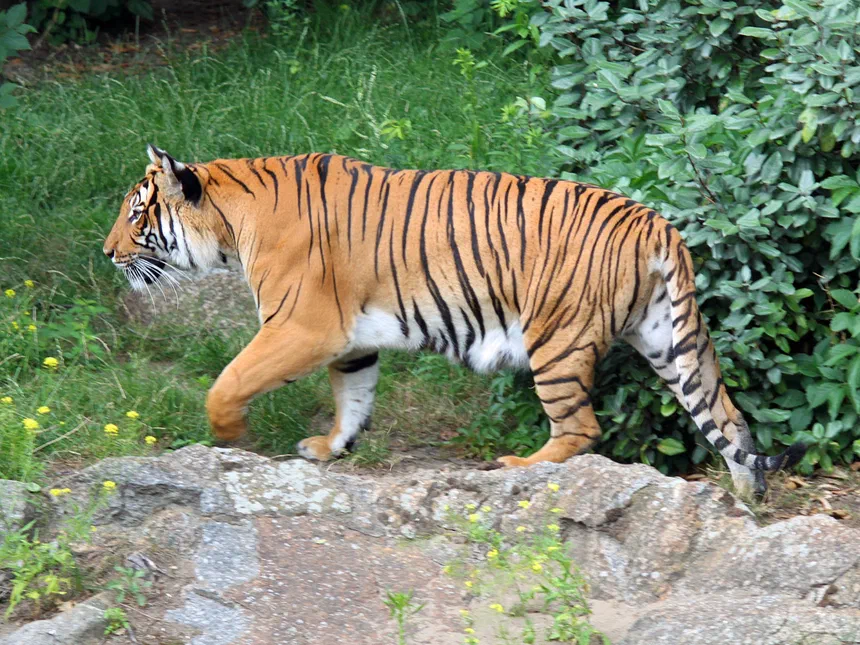
Image: H. Zell — CC BY-SA 3.0 · source
What Is a Indochinese Tiger?
The Indochinese tiger (Panthera tigris corbetti) is a mainland Asian population of tiger native to the forests of Southeast Asia. It is one of several recognized tiger groupings, distinguished mainly by its geographic range and by its somewhat smaller, more slender build compared with the larger tigers of India and the Russian Far East.
Appearance and Identification
Like all tigers, the Indochinese tiger wears a warm orange coat marked with vertical black stripes, paler underparts, and a white belly. Its stripes tend to be narrower and more numerous than those of the Bengal tiger, and the overall body size is generally smaller. Adult males typically weigh between about 330 and 430 pounds (150-195 kg), while females are lighter, in the range of roughly 220 to 290 pounds (100-130 kg). Head-and-body length, including the long tail, spans roughly 8.5 to 9.5 feet (2.6-2.9 m). As with every tiger, the stripe pattern is unique to each individual, functioning much like a fingerprint.
Habitat and Range
This tiger occupies mainland Southeast Asia, historically ranging across Myanmar, Thailand, Laos, Cambodia, Vietnam, and parts of southern China. Today its distribution is far more fragmented, with the most significant surviving populations concentrated in the forest complexes of Thailand and Myanmar. Indochinese tigers favor remote tropical and subtropical forests, hilly and mountainous terrain, and dense cover away from human disturbance, where prey and concealment are both available.
Diet
The Indochinese tiger is a pure carnivore and an apex predator within its range. It hunts medium to large hoofed mammals, including sambar deer, wild boar, muntjac, and banteng, and will take smaller animals when larger prey is scarce. A tiger typically stalks close to its target under cover before launching a short, powerful rush, killing with a bite to the throat or nape. After a successful kill, it may feed over several days and often drags the carcass to a sheltered spot.
Behavior
Tigers are solitary and largely nocturnal or crepuscular, being most active during the cooler hours around dawn and dusk. Each adult maintains a home range that it patrols and scent-marks with urine, scrapes, and claw marks to signal its presence to neighbors. Male ranges are larger and may overlap those of several females. Powerful swimmers, tigers readily enter water to cool off or cross rivers, and they rely on acute hearing and vision rather than sustained running to secure their prey.
Life Cycle and Reproduction
Breeding can occur throughout the year, though it often peaks in cooler months. After a gestation of roughly 3.5 months (about 93-112 days), a female gives birth to a litter that usually numbers two to four cubs in a sheltered den. Cubs are born blind and helpless, depending entirely on their mother for the first weeks of life. They begin accompanying her on hunts at several months old, gradually learning to kill, and typically become independent at around 18 months to 2 years. Females reach breeding age at about 3 to 4 years.
Conservation Status
Tigers as a species are classified as Endangered by the IUCN, and the Indochinese population is considered among the most threatened. Numbers have fallen sharply because of poaching for skins and body parts, depletion of prey, and the loss and fragmentation of forest habitat to agriculture, logging, and development. The subspecies has been lost from much of its former range, including likely extirpation from China, Cambodia, and Vietnam. Conservation efforts center on anti-poaching patrols, protection of core forest complexes in Thailand and Myanmar, and safeguarding prey populations.
Frequently Asked Questions
How is the Indochinese tiger different from the Bengal tiger? It is generally smaller and more slender, with narrower and more closely spaced stripes, and it occupies mainland Southeast Asia rather than the Indian subcontinent.
How many Indochinese tigers remain? Reliable estimates are difficult, but the surviving population is thought to number only in the low hundreds, with strongholds in Thailand and Myanmar.
Are Indochinese tigers dangerous to people? They generally avoid humans and prefer remote habitat, but as large apex predators they can be dangerous, which is one reason their forest strongholds are kept away from dense human settlement.