Mammals Guide
Indian Pangolin
What Is a Indian Pangolin? The Indian pangolin (Manis crassicaudata) is a large, scale-covered mammal native to the Indian subcontinent. It belongs to the order Pholidota, a small group of insect-eating mammals sometimes …
At a glance
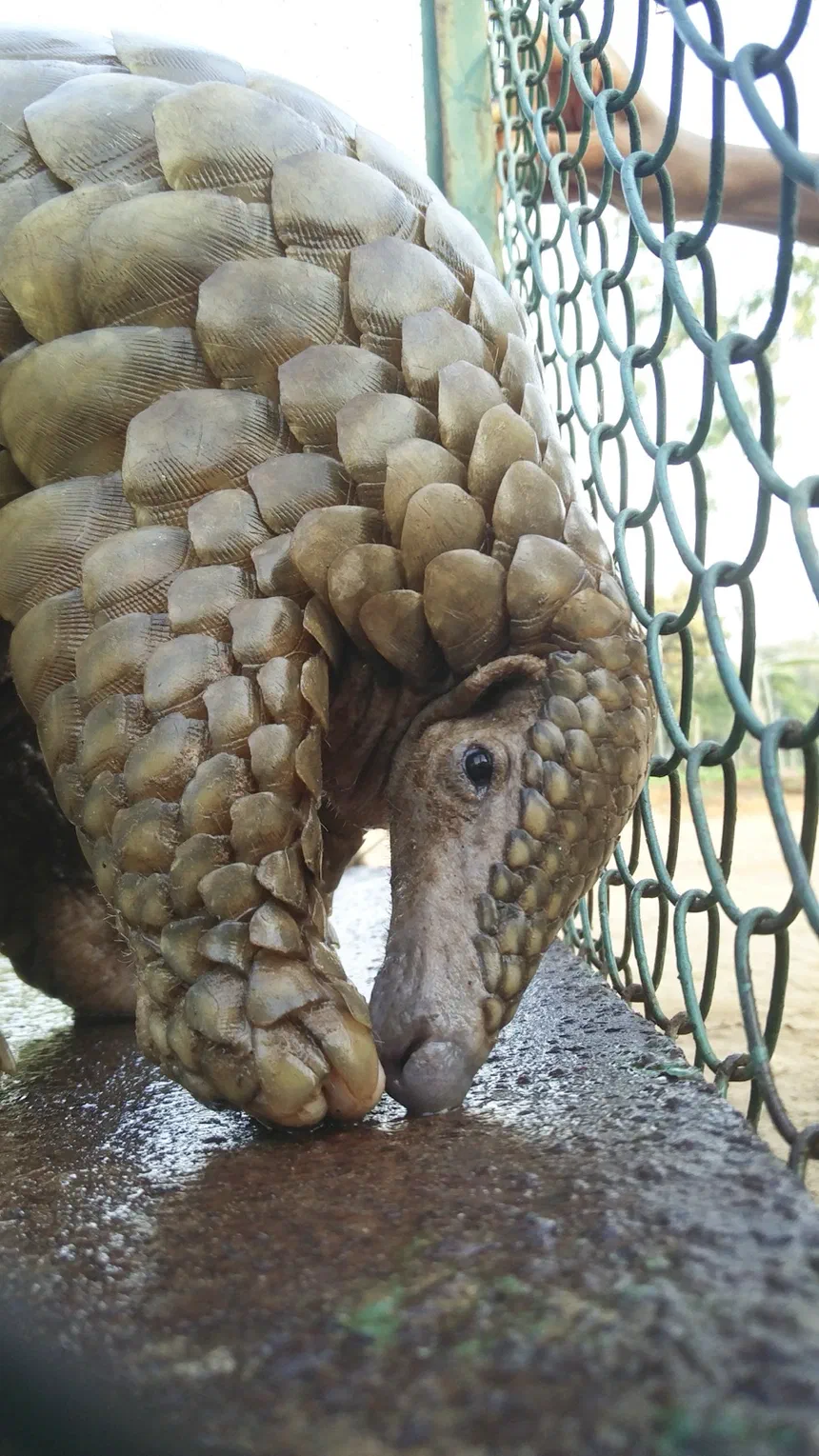
Image: Vickey Chauhan — CC BY-SA 4.0 · source
What Is a Indian Pangolin?
The Indian pangolin (Manis crassicaudata) is a large, scale-covered mammal native to the Indian subcontinent. It belongs to the order Pholidota, a small group of insect-eating mammals sometimes called “scaly anteaters.” Although it looks a little like an anteater or an armadillo, the pangolin is not closely related to either and sits on its own ancient branch of the mammal family tree.
Appearance and Identification
The most distinctive feature of the Indian pangolin is its armor of large, overlapping scales made of keratin, the same protein found in human hair and fingernails. These scales cover the back, sides, limbs, and the thick, heavy tail, and range in color from yellowish-brown to a dull gray. The face, throat, and belly are soft and only sparsely haired. Adults are among the larger Asian pangolins, typically measuring around 60 to 75 centimeters in head-and-body length, with a tail of roughly 45 to 70 centimeters, and weighing somewhere between about 8 and 16 kilograms. The head is small and cone-shaped, the eyes are tiny, and the strong front limbs carry long, curved claws well suited to digging. When alarmed, the animal can curl into a tight ball, hiding its soft underside behind an armored shield.
Habitat and Range
The Indian pangolin is found across much of the Indian subcontinent, including India, Sri Lanka, Nepal, Bangladesh, and Pakistan. It occupies a wide variety of habitats, from tropical and subtropical forests to open grasslands, scrubland, and cultivated areas near villages. Rather than depending on dense forest, it seems most limited by the availability of ants and termites and by soils soft enough for digging. Individuals often make use of deep burrows, which provide shelter and a stable microclimate in both hot and cool conditions.
Diet
This species is a specialized insectivore that feeds almost entirely on ants and termites. It uses a keen sense of smell to locate nests, then rips them open with its powerful claws, tearing into mounds, rotting wood, and soil. A remarkably long, sticky tongue, anchored deep within the chest rather than at the back of the mouth, sweeps up insects and their eggs and larvae. Because it has no teeth, the pangolin swallows its prey whole along with small stones and grit, which help grind the food inside a muscular section of the stomach. In this way a single animal can consume very large numbers of insects and help keep their populations in check.
Behavior
The Indian pangolin is largely solitary and mostly active at night, spending daylight hours resting in burrows it digs itself or takes over from other animals. It is a strong digger and a capable, if slow, climber, using its heavy tail for balance and support. With poor eyesight, it relies heavily on smell to find food and move through its surroundings. When threatened it rarely tries to fight; instead it rolls into a ball, hisses, or releases a pungent secretion from glands near the base of the tail. Its burrowing reshapes soil and provides shelter that other creatures sometimes use.
Life Cycle and Reproduction
Reproduction is slow, which adds to the species’ vulnerability. After a gestation of several months, a female usually gives birth to a single young, though occasionally two. The newborn, sometimes called a pangopup, has soft scales that gradually harden over the following weeks. For its first period of life it stays close to the mother, often riding on the base of her tail as she forages and sheltering in the burrow between trips. The young pangolin is weaned within a few months and becomes independent as it grows. In the wild, individuals are thought to live roughly 12 to 20 years.
Conservation Status
The Indian pangolin is listed as Endangered by the IUCN, and its numbers have declined across much of its range. The greatest threats are poaching and illegal trafficking, fueled by demand for its scales, used in some traditional medicines despite no proven benefit, and for its meat. Habitat loss and its naturally low reproductive rate make recovery difficult. International commercial trade is banned under CITES, and conservation work focuses on stronger enforcement, reducing consumer demand, protecting habitat, and improving the care of rescued animals, which are notoriously hard to keep in captivity.
Frequently Asked Questions
How big is the Indian pangolin compared with other pangolins? It is one of the larger Asian species, with a heavier body and thicker tail than the Chinese pangolin, and adults can weigh well over 10 kilograms.
Why is the Indian pangolin endangered? It is heavily hunted and trafficked for its scales and meat, and because it produces only one offspring at a time, populations recover very slowly.
Does the Indian pangolin have teeth? No. It has no teeth and instead uses a long, sticky tongue to collect ants and termites, swallowing small stones that help grind food in its stomach.