Mammals Guide
Indian Muntjac
What Is a Indian Muntjac? The Indian muntjac (Muntiacus muntjak) is a small deer native to South and Southeast Asia, often called the “barking deer” for the loud, dog-like alarm calls it gives when startled. It is one of …
At a glance
What Is a Indian Muntjac?
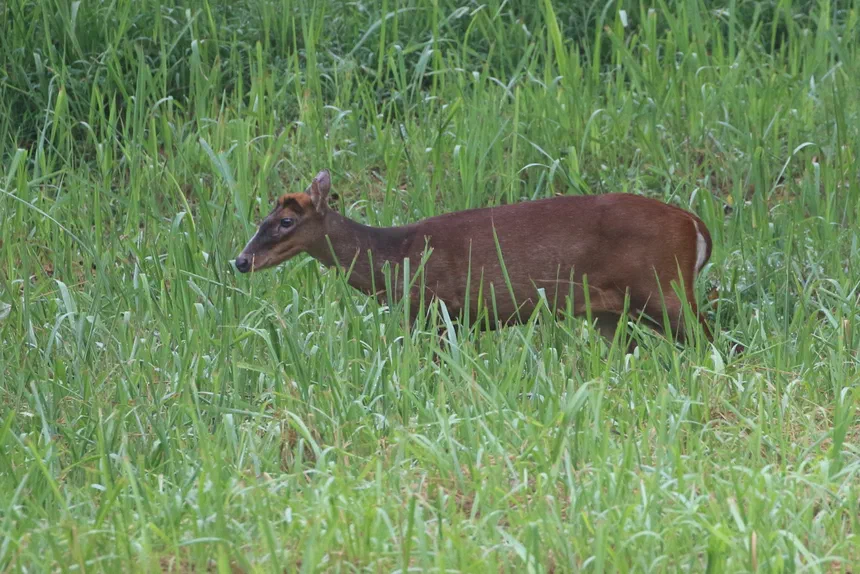
The Indian muntjac (Muntiacus muntjak) is a small deer native to South and Southeast Asia, often called the “barking deer” for the loud, dog-like alarm calls it gives when startled. It is one of the most widely distributed of the muntjac deer and is well known to biologists for having one of the lowest chromosome counts of any mammal.
Appearance and Identification
The Indian muntjac has a compact, rounded body with a coat that ranges from reddish-brown to yellowish-tan, fading to paler or whitish fur on the belly and inner legs. Adults stand roughly 35 to 65 centimeters at the shoulder and typically weigh between 14 and 28 kilograms, with males somewhat larger than females. Males carry short antlers, usually only a few centimeters long, set atop long, skin-covered pedicels that give the head a distinctive profile. These antlers are shed and regrown each year and often have a small backward-pointing brow tine. Both sexes have visible tusk-like upper canines, but these are far more developed in males and are used in fighting. A pair of dark facial ridges runs up the face toward the pedicels, and the underside of the tail flashes bright white when the animal is alarmed.
Habitat and Range
This deer occupies a broad swath of Asia, from India, Nepal, Sri Lanka, and Bangladesh eastward through Myanmar, Thailand, and the forests of southern China, extending into parts of the Malay Peninsula and nearby islands. It favors dense cover, thriving in tropical and subtropical forests, thick scrub, and the brushy margins where woodland meets grassland. Reliable access to water and thick vegetation for hiding are key features of its preferred habitat. The species tolerates a range of elevations, from lowlands up into hill and montane forests, and can persist in secondary growth and areas near human settlement.
Diet
The Indian muntjac is chiefly a browser and forager, feeding on a varied plant diet that includes fruit, tender leaves, young shoots, buds, bark, grasses, and fallen seeds. It has a particular fondness for ripe fallen fruit and often follows fruiting trees through the seasons. Although predominantly herbivorous, it is opportunistic and will occasionally take birds’ eggs, small animals, and carrion, making its diet closer to omnivorous than that of many other deer. Its small size lets it slip through dense undergrowth to reach food that larger grazers cannot.
Behavior
Muntjacs are generally shy, secretive, and most active around dawn and dusk, though they may move at any time of day where undisturbed. They are usually solitary or seen in pairs, rather than in large herds, and males defend loosely held territories. When a muntjac senses a predator such as a leopard, dhole, or python, it may give repeated barking calls that can continue for many minutes, alerting other animals to danger. Males scent-mark their range using preorbital glands near the eyes and glands on the forehead. In disputes, rival males rely more on their sharp canine tusks than on their short antlers, sometimes inflicting real wounds.
Life Cycle and Reproduction
Indian muntjacs can breed throughout the year, without a strongly fixed season, which is unusual among deer and reflects their tropical range. After a gestation of roughly six to seven months, the female usually gives birth to a single fawn, occasionally twins. The newborn is spotted for camouflage and is hidden in dense vegetation while the mother forages, a common strategy among small forest deer. Young are weaned within a few months and reach sexual maturity before their first or second year. In the wild, individuals commonly live around 10 to 16 years, with survival strongly shaped by predation.
Conservation Status
The Indian muntjac is listed as Least Concern by the IUCN, reflecting its wide distribution, adaptable habits, and large overall population. It remains common across much of its range and copes reasonably well with disturbed and secondary habitats. Even so, it faces localized pressures from hunting for meat and hides, habitat loss driven by deforestation, and conflict where it feeds on crops. In most regions these threats have not caused broad declines, and the species is not currently considered at risk of extinction.
Frequently Asked Questions
Why is the Indian muntjac called the “barking deer”? When it detects a predator or is otherwise alarmed, it produces a loud, repetitive call that sounds much like a barking dog, which can carry a long distance through the forest.
Do both males and females have antlers? No. Only males grow antlers, which are short and sit on long bony pedicels. Females lack antlers, though both sexes have enlarged canine teeth, most pronounced in males.
Is the Indian muntjac endangered? No. It is classified as Least Concern by the IUCN thanks to its wide range and adaptability, although local populations can be affected by hunting and habitat loss.