Mammals Guide
Indian Grey Mongoose
What Is a Indian Grey Mongoose? The Indian grey mongoose (Urva edwardsii) is a small, ground-dwelling carnivore of the mongoose family, Herpestidae. Widespread across South and West Asia, it is a familiar sight in …
At a glance
What Is a Indian Grey Mongoose?
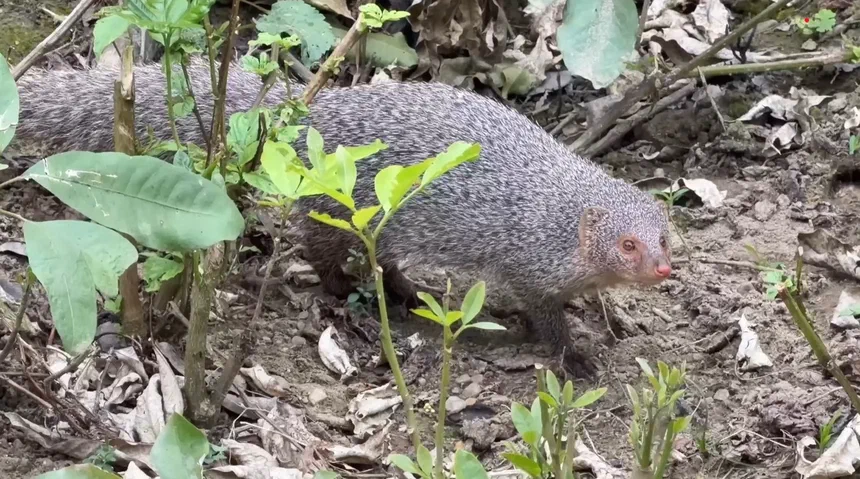
The Indian grey mongoose (Urva edwardsii) is a small, ground-dwelling carnivore of the mongoose family, Herpestidae. Widespread across South and West Asia, it is a familiar sight in farmland and near villages, where it is best known for its bold reputation as a hunter of snakes and other small prey.
Appearance and Identification
This is a slender, low-slung mammal with a pointed muzzle, small rounded ears, and short legs. Its coat has a distinctive grizzled or “salt-and-pepper” look, ranging from iron-grey to a warmer tawny-brown, produced by individual hairs that are banded with light and dark rings. The bushy tail is nearly as long as the head and body and often ends in a paler tip. Adults measure roughly 36 to 45 centimeters in head-and-body length, with the tail adding a similar amount, and typically weigh between about 0.9 and 1.7 kilograms. Males tend to be slightly larger than females.
Habitat and Range
The Indian grey mongoose is highly adaptable and thrives in open and semi-open country. It favors scrubland, thorn forest, grassland, cultivated fields, and the edges of human settlements, and it readily uses gardens, hedgerows, and roadside verges. Its range extends from the Arabian Peninsula and Iran eastward through Pakistan, across much of India and Nepal, and into Sri Lanka and Bangladesh. It has also been introduced to some islands and regions outside its native range. It shelters in burrows, rock crevices, dense vegetation, and drains, often digging its own dens or enlarging those of other animals.
Diet
An opportunistic feeder, the Indian grey mongoose eats a broad mix of animal prey supplemented by some plant matter. Insects and other invertebrates form a large part of the diet, along with rodents, small birds, eggs, lizards, frogs, and snakes. It is famed for taking on venomous snakes such as cobras, relying on speed, agility, and thick fur rather than immunity, though its blood does carry some resistance to snake venom. It will also raid crops for fruit and dig for grubs and roots when animal prey is scarce.
Behavior
The Indian grey mongoose is mainly active during the day and is usually seen alone or in loose pairs rather than in groups. It moves with a quick, darting gait, frequently pausing to sniff and investigate with its keen sense of smell. Agile and quick to react, it is a determined predator that can dispatch prey larger than itself. When threatened it may raise its fur to appear bigger and emits a range of vocalizations, from growls to high-pitched calls. Individuals are known to break open eggs and hard-shelled prey by hurling them backward against a rock or hard surface.
Life Cycle and Reproduction
Breeding can occur more than once a year where conditions are favorable. After a gestation of roughly seven to eight weeks, the female gives birth to a litter of about two to four young in a sheltered den. The pups are born blind and helpless and depend entirely on their mother in the early weeks. They are weaned over the following month or two and gradually learn to forage, reaching independence and sexual maturity within their first year. In the wild, individuals commonly live around six to eight years.
Conservation Status
The Indian grey mongoose is listed as Least Concern by the IUCN, reflecting its wide distribution, large population, and tolerance of human-altered landscapes. It is not considered globally threatened. Localized pressures do exist, however, including road mortality and illegal killing for the hair of its tail, which has been used to make brushes. In several countries it is legally protected, and trade in mongoose hair is banned in India.
Frequently Asked Questions
Is the Indian grey mongoose immune to snake venom? Not fully. It has some resistance thanks to modified receptors that partly block venom, but it relies mostly on speed, agility, and its thick coat to avoid bites when fighting snakes.
Do Indian grey mongooses make good pets? They are wild animals with specialized needs and are protected by law in many places, so keeping them as pets is generally discouraged and often illegal.
What eats the Indian grey mongoose? Larger predators such as birds of prey, big cats, jackals, and large snakes can take mongooses, particularly young or unwary individuals.