Mammals Guide
Indian Giant Squirrel
What Is a Indian Giant Squirrel? The Indian giant squirrel (Ratufa indica), also known as the Malabar giant squirrel, is one of the largest tree squirrels in the world. Native to the forests of India, it is celebrated …
At a glance
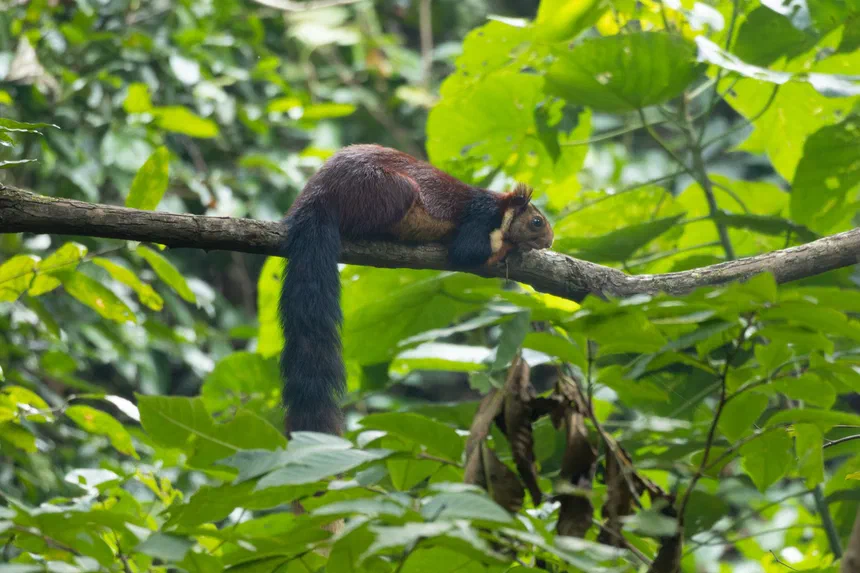
Image: Tisha Mukherjee — CC BY-SA 4.0 · source
What Is a Indian Giant Squirrel?
The Indian giant squirrel (Ratufa indica), also known as the Malabar giant squirrel, is one of the largest tree squirrels in the world. Native to the forests of India, it is celebrated for its striking multicolored coat and its almost entirely arboreal way of life. It is the state animal of Maharashtra.
Appearance and Identification
This is a large, robust squirrel with a body that often measures between 25 and 45 centimeters, plus a bushy tail that is roughly the same length or longer. Adults typically weigh in the range of 1.5 to 2 kilograms. The species is best known for its vivid, patchy coloration, which can combine shades of maroon, deep brown, rust, tan, and creamy white depending on the individual and the region. The underside is usually pale, while the back and tail carry the darker, richer tones. A tuft of fur on the rounded ears and powerful, curved claws help distinguish it from smaller squirrels.
Habitat and Range
The Indian giant squirrel is found across peninsular and central India, with populations concentrated in the moist deciduous, mixed deciduous, and evergreen forests of the region, including parts of the Western and Eastern Ghats. It is a canopy specialist, favoring tall, mature trees with continuous cover that allow it to move without descending to the ground. Because it depends on connected forest, it is sensitive to fragmentation and the loss of large trees.
Diet
Primarily herbivorous, this squirrel feeds mainly on fruit, nuts, seeds, bark, flowers, and other plant material gathered high in the canopy. It may occasionally take insects or bird eggs, but plant foods dominate. Individuals often sit upright on a branch, holding food in their forepaws while balancing with the long tail. By caching and dropping seeds, the species plays a useful role in dispersing the seeds of the trees it feeds on.
Behavior
The Indian giant squirrel is diurnal, most active in the cooler hours of the morning and late afternoon, and tends to rest during the hottest part of the day. It is largely solitary and territorial, though pairs may associate during the breeding season. An agile climber and leaper, it can cross remarkable gaps between trees, using its tail for balance. To sleep and raise young it builds large, globe-shaped nests, called dreys, from twigs and leaves wedged in the upper branches; an individual may maintain several nests within its range.
Life Cycle and Reproduction
Breeding can occur across much of the year, often peaking around seasonal changes in food availability. After a gestation of roughly a month, the female usually gives birth to one or two young, occasionally more, inside a well-hidden drey. The young are born helpless and are cared for by the mother until they are weaned and able to forage on their own. In the wild, individuals may live on the order of 15 to 20 years.
Conservation Status
The Indian giant squirrel is currently listed as Least Concern by the IUCN, reflecting a wide distribution and presence in numerous protected areas. Even so, local populations face pressure from deforestation, forest fragmentation, and, in some areas, hunting. Maintaining large, connected tracts of mature forest is the key to keeping the species secure over the long term.
Frequently Asked Questions
How big is an Indian giant squirrel? It is one of the largest tree squirrels, with a head-and-body length of about 25 to 45 centimeters and a tail roughly as long again, weighing around 1.5 to 2 kilograms.
Why is it so colorful? Its patchy maroon, tan, and cream coat is thought to help break up its outline among the dappled light and shadows of the forest canopy, providing camouflage from predators such as birds of prey.
Does it come down to the ground? Rarely. The Indian giant squirrel spends almost its entire life in the trees, feeding, nesting, and traveling through the canopy, and it depends on continuous forest cover to move safely.