Mammals Guide
Indian Flying Fox
What Is a Indian Flying Fox? The Indian flying fox (Pteropus giganteus, also treated by many taxonomists as Pteropus medius) is one of the largest bats in the world and a familiar sight across the Indian subcontinent. It …
At a glance
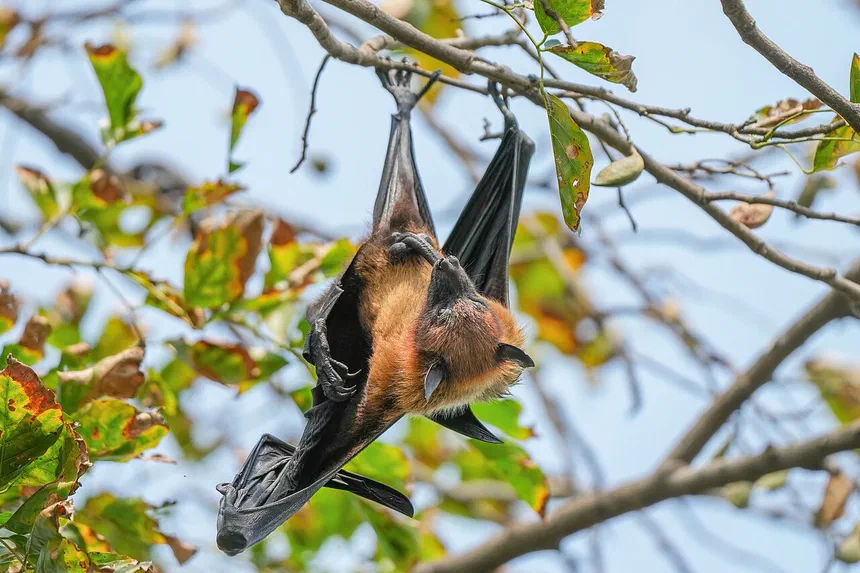
Image: Giles Laurent — CC BY-SA 4.0 · source
What Is a Indian Flying Fox?
The Indian flying fox (Pteropus giganteus, also treated by many taxonomists as Pteropus medius) is one of the largest bats in the world and a familiar sight across the Indian subcontinent. It belongs to the family Pteropodidae, the fruit bats or “megabats,” and despite its size it feeds entirely on plant material rather than insects or blood.
Appearance and Identification
This is a strikingly large bat. Its dark, leathery wings are brown to nearly black, while the head and shoulders carry a warm tawny or rusty-orange mantle, and the crown is often flecked with gray. The face is distinctly fox-like, with a long muzzle, large forward-facing eyes, and simple, pointed ears, giving the animal its common name. Unlike many smaller bats, flying foxes lack a specialized tail membrane and do not use echolocation, relying instead on keen eyesight and a strong sense of smell. With a wingspan that can approach 1.5 meters, an outstretched adult is unmistakable.
Habitat and Range
The Indian flying fox ranges widely across the Indian subcontinent, including India, Pakistan, Nepal, Bangladesh, Sri Lanka, and parts of neighboring South Asia. It favors tropical and subtropical settings but is highly adaptable, occupying forest patches, riverbanks, wetlands, agricultural land, temple groves, and even trees within towns and cities. Colonies typically settle in tall, mature trees near water and human settlement, where they form conspicuous, long-lived roosts.
Diet
As a frugivore, the Indian flying fox eats a variety of ripe fruits, including figs, guavas, mangoes, bananas, and cultivated as well as wild species. It also drinks nectar and consumes flowers and juices, often chewing the pulp and spitting out fibrous remains. Because these bats travel long distances each night in search of food, they are important seed dispersers and pollinators for many tropical trees, playing a valuable role in maintaining forests and orchards.
Behavior
Indian flying foxes are highly social and roost in large, noisy colonies that may number from a few dozen to several thousand individuals. During the day they hang upside down from branches, grooming, squabbling over prime perches, fanning themselves in the heat, and dozing. At dusk the colony sets out to forage, sometimes flying many kilometers to feeding sites. Their loud calls, wing-flapping disputes, and pungent roosts make them one of the most noticeable wildlife gatherings in the region.
Life Cycle and Reproduction
Breeding is seasonal, with mating generally taking place in the cooler months and births following after a gestation of roughly five to six months. Females typically give birth to a single pup, which clings to its mother in the early weeks and is carried on foraging flights before being left at the roost as it grows. Pups are weaned over several months and reach maturity after a year or more. In the wild these bats may live around 15 years, and individuals in captivity have survived considerably longer.
Conservation Status
The IUCN lists the Indian flying fox as Least Concern, reflecting its wide range and large overall population. Even so, colonies face pressures from habitat loss, disturbance and culling at roosts, hunting, and persecution by farmers who regard the bats as orchard pests. Because flying foxes can carry certain viruses, they are sometimes killed out of fear, though such conflict overlooks their considerable ecological value as pollinators and seed dispersers.
Frequently Asked Questions
Are Indian flying foxes dangerous to people? They do not attack humans and feed only on fruit and nectar. As with any wild animal, direct handling is discouraged, but an undisturbed colony poses little risk.
Do they use echolocation like other bats? No. As large fruit bats, they navigate and locate food using excellent vision and smell rather than the echolocation used by many smaller, insect-eating bats.
Why are they important to the environment? By dispersing seeds and pollinating flowers across long distances, Indian flying foxes help regenerate forests and support the reproduction of many tropical plants.