Mammals Guide
Impala
What Is a Impala? The impala (Aepyceros melampus) is a medium-sized antelope native to the savannas and woodlands of eastern and southern Africa. It is one of the continent’s most abundant and recognizable hoofed …
At a glance
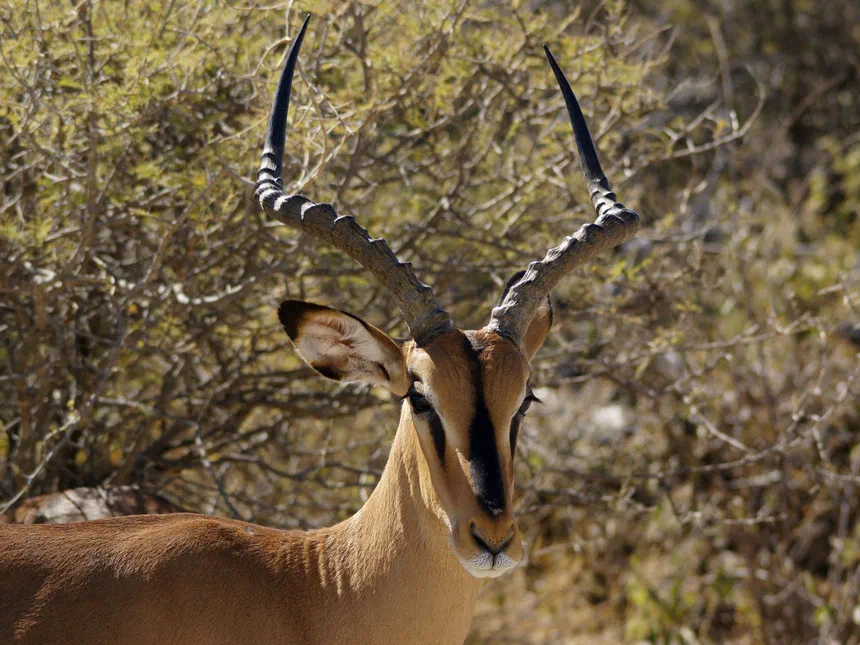
Image: Hans Hillewaert — CC BY-SA 4.0 · source
What Is a Impala?
The impala (Aepyceros melampus) is a medium-sized antelope native to the savannas and woodlands of eastern and southern Africa. It is one of the continent’s most abundant and recognizable hoofed mammals, celebrated for its graceful build and spectacular leaping ability. Impalas occupy a middle rung in the food web, feeding on plants and serving as important prey for many of Africa’s large predators.
Appearance and Identification
Impalas have a sleek, athletic body with a glossy coat marked by three color bands: a reddish-brown saddle across the back, paler tan flanks, and white underparts, chin, and throat. A distinctive black stripe runs down each buttock and along the tail, and a tuft of black hair marks the lower hind leg above the hoof. Only males grow horns, which are slender, ridged, and lyre-shaped, sweeping up and back in a graceful S-curve and reaching roughly 18 to 36 inches (45 to 92 cm) in length. Adults stand about 28 to 36 inches (70 to 92 cm) at the shoulder and typically weigh between 88 and 170 pounds (40 to 76 kg), with males noticeably larger than females.
Habitat and Range
Impalas favor the transitional zones where grassland meets woodland, often called ecotones, where they can graze open ground and browse cover in the same area. They are especially common in acacia and mopane woodland, light savanna, and brushy areas, and they rarely stray far from a source of drinking water. Their range covers much of eastern and southern Africa, including countries such as Kenya, Tanzania, Zambia, Zimbabwe, Botswana, Namibia, and South Africa. A geographically isolated subspecies, the black-faced impala, occurs in northwestern Namibia and southwestern Angola.
Diet
The impala is a herbivore and an unusually flexible feeder, switching between grazing and browsing depending on the season. During the wet months it grazes on fresh, growing grasses, while in the dry season it turns more to leaves, shoots, seedpods, and fruit from shrubs and trees. This mixed-feeding strategy lets impalas thrive in habitats where strict grazers or strict browsers would struggle. Like other ruminants, they chew cud to extract nutrients from tough plant material, and they must drink regularly, which ties their movements to water.
Behavior
Impalas are social animals that live in herds whose structure shifts through the year. Outside the breeding season, females and young gather in loose groups, while bachelor males form separate herds. During the rut, dominant males establish and defend territories, herding females and sparring with rivals in horn-clashing contests. Impalas are famous for their extraordinary jumping: when alarmed they explode into leaps that can clear more than 30 feet (about 10 m) horizontally and rise 8 to 10 feet (roughly 3 m) into the air, scattering in all directions to confuse predators. They also perform a stiff-legged bounding gait called stotting. A curious grooming behavior sees herd members clean one another’s head and neck, an unusual example of mutual grooming among antelopes.
Life Cycle and Reproduction
Breeding is often timed so that most young arrive in the wet season, when food is plentiful. After a gestation of roughly six and a half to seven months, a female gives birth to a single calf, which she may hide in vegetation for the first days of life before it joins a nursery group of other youngsters. Calves are weaned at around four to six months. Females typically reach breeding age in their second year, while males may not secure a territory and mating opportunities until they are several years old. In the wild, impalas commonly live about 10 to 13 years, with predation heavily limiting survival.
Conservation Status
The impala is listed as Least Concern by the IUCN, reflecting a large, widespread, and generally stable population. It remains common across protected areas such as national parks and reserves, and it adapts well to a range of savanna habitats. The black-faced impala subspecies is far less numerous and is considered vulnerable, threatened by habitat loss and historic hybridization with introduced common impalas. Overall, sound protected-area management and the species’ adaptability keep the impala one of Africa’s conservation success stories.
Frequently Asked Questions
Do both male and female impalas have horns? No. Only males grow the long, lyre-shaped horns. Females are hornless, which is one of the easiest ways to tell the sexes apart.
How high and far can an impala jump? Impalas are exceptional leapers, able to spring more than 30 feet (about 10 m) in a single bound and clear obstacles roughly 8 to 10 feet high, an ability they use to escape predators.
What eats impalas? Impalas are a key prey species for many African predators, including lions, leopards, cheetahs, wild dogs, hyenas, and large pythons, while young calves are also taken by eagles and jackals.