Mammals Guide
Alpine Ibex
What Is a Alpine Ibex? The Alpine ibex (Capra ibex) is a wild goat native to the high mountains of the European Alps. Famous for the males’ massive, backward-curving horns, it is a sure-footed climber that thrives on …
At a glance
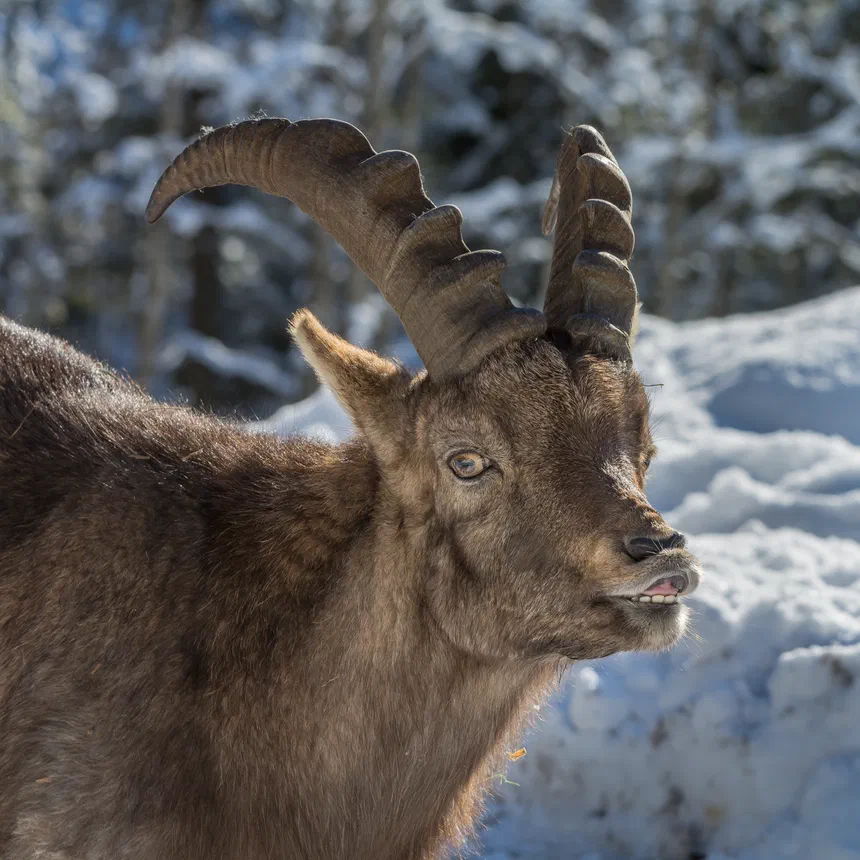
Image: Isiwal — CC BY-SA 4.0 · source
What Is a Alpine Ibex?
The Alpine ibex (Capra ibex) is a wild goat native to the high mountains of the European Alps. Famous for the males’ massive, backward-curving horns, it is a sure-footed climber that thrives on precipitous cliffs and rocky slopes where few large mammals can follow. It is one of several ibex species in the genus Capra.
Appearance and Identification
The Alpine ibex is a stocky, muscular goat with relatively short legs and a compact body built for climbing. Its coat is tawny brown to grayish in summer, turning darker and thicker in winter, with a paler underside. Both sexes carry horns, but they differ dramatically: males grow long, thick, scimitar-shaped horns marked with prominent ridges that can reach roughly 70-100 cm, while females bear short, slender horns usually under 35 cm. Males also develop a dark beard and are noticeably heavier and larger than females, a strong example of sexual dimorphism. The hooves have hard rims and softer, rubbery centers that grip uneven rock, giving the animal remarkable traction on steep terrain.
Habitat and Range
This species is closely tied to the rugged high country of the European Alps, spanning parts of Italy, France, Switzerland, Austria, Germany, and Slovenia. Alpine ibex typically occupy open, rocky habitat above the treeline, from about 1,600 to over 3,000 meters in elevation, favoring steep cliffs, boulder fields, and alpine meadows. They move seasonally with the availability of forage and snow, descending to lower, sunnier slopes in winter and climbing higher as vegetation greens up in summer. The steep, broken terrain offers both grazing and quick escape routes from predators.
Diet
Alpine ibex are herbivores and graze mainly on grasses, sedges, and low-growing alpine herbs, supplementing this with the leaves and shoots of shrubs, and with lichens and mosses when other food is scarce. Their diet shifts through the year: lush green vegetation dominates in the warmer months, while winter forces them onto dry grasses, twigs, and whatever remains exposed on wind-swept slopes. Like other ruminants, they have a multi-chambered stomach that lets them extract nutrients from tough, fibrous plants. Ibex are often seen visiting natural mineral licks to obtain salts and trace elements lacking in their vegetation.
Behavior
Alpine ibex are social and typically live in groups segregated by sex for much of the year. Females and young form nursery herds, while males gather in bachelor bands, the two coming together mainly during the breeding season. They are most active in the early morning and late afternoon, resting on ledges during the heat of midday. Their agility on near-vertical rock is legendary. When threatened, ibex rely on their climbing ability rather than sustained running to reach terrain that predators cannot negotiate.
Life Cycle and Reproduction
Breeding, or the rut, takes place in early winter, roughly December, when dominant males compete for access to females. Rival males engage in dramatic clashes, rearing up and bringing their horns together with a resounding crack; horn size and age largely determine dominance. After a gestation of about five to six months, females give birth in late spring to usually a single kid, occasionally twins. Kids are precocious, standing and following their mother within a day and beginning to nibble vegetation within weeks while continuing to nurse. Females reach breeding condition at around two to three years, while males may not secure mating opportunities until they are considerably older and have grown large horns.
Conservation Status
The Alpine ibex is currently listed as Least Concern by the IUCN, but this status marks a remarkable recovery. By the early 19th century, unregulated hunting had reduced the species to a single surviving population in the Gran Paradiso region of the Italian Alps. Strict protection and decades of reintroduction efforts gradually restored ibex to much of their former range, and populations now number in the tens of thousands. Because the modern population descends from a small number of founders, low genetic diversity remains a long-term concern, and managers continue to monitor herds for disease and the effects of a warming climate.
Frequently Asked Questions
How do Alpine ibex climb such steep cliffs? Their split hooves have hard outer rims and soft, grippy pads that mold to rock, and their strong, compact bodies keep their center of gravity low, letting them balance on tiny ledges.
What is the difference between male and female ibex? Males are larger, bearded, and grow long, ridged, curving horns, while females are smaller with short, thin horns. This makes the sexes easy to tell apart at a distance.
Are Alpine ibex endangered? No. They are listed as Least Concern today, though the species nearly went extinct in the 1800s and was saved through protection and reintroduction from a single remnant population.