Mammals Guide
Humpback Whale
What Is a Humpback Whale? The humpback whale (Megaptera novaeangliae) is a large baleen whale known for its acrobatic breaches and its long, complex songs. It belongs to the rorqual family and is instantly recognizable …
At a glance
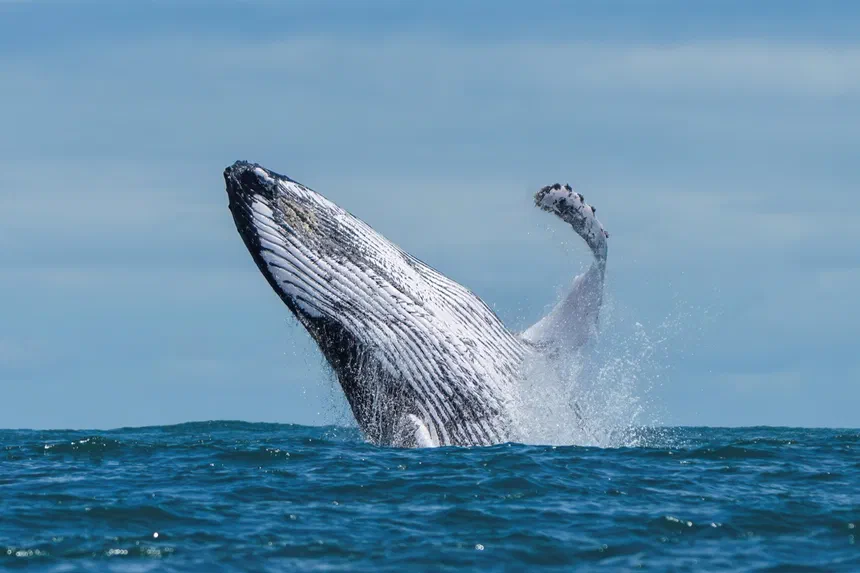
Image: Giles Laurent — CC BY-SA 4.0 · source
What Is a Humpback Whale?
The humpback whale (Megaptera novaeangliae) is a large baleen whale known for its acrobatic breaches and its long, complex songs. It belongs to the rorqual family and is instantly recognizable by its enormous flippers and knobbly head. Humpbacks live in oceans around the globe and undertake some of the longest migrations of any mammal.
Appearance and Identification
Humpbacks are stout-bodied whales that typically reach 39 to 52 feet (12 to 16 meters) in length, with females averaging slightly larger than males. Their most distinctive feature is the pair of extremely long pectoral flippers, which can span nearly a third of the body length. The body is dark gray to black above with variable white patches on the belly and the underside of the flippers and tail flukes. Rounded bumps called tubercles, each containing a hair follicle, stud the head and lower jaw. The trailing edge of the tail fluke is scalloped, and its unique black-and-white pattern lets researchers identify individuals much like a fingerprint.
Habitat and Range
Humpback whales are found in every major ocean, from tropical breeding grounds to cold, productive feeding waters near the poles. During summer they gather in high-latitude regions such as the Gulf of Alaska, the North Atlantic, and the Southern Ocean to feed. In winter they migrate toward warmer subtropical and tropical waters to breed and give birth. These seasonal journeys can exceed 5,000 miles (8,000 km) one way, ranking among the longest migrations known in the animal kingdom.
Diet
Humpbacks are carnivorous filter feeders that eat mainly krill and small schooling fish such as herring, capelin, and sand lance. As baleen whales, they take in huge mouthfuls of water and prey, then push the water out through fringed plates of baleen that trap the food. They often feed cooperatively, and some populations use a remarkable technique called bubble-net feeding, in which whales blow curtains of bubbles to concentrate prey into a tight ball before lunging upward through it. Most feeding occurs during the summer months, when the whales build up fat reserves to sustain them through migration and the fasting winter breeding season.
Behavior
Humpbacks are among the most active and visible of the large whales. They frequently breach, slap their flippers and tails on the surface, and raise their flukes when diving. Male humpbacks produce long, structured songs that can last for many minutes and are repeated for hours, particularly on the breeding grounds; the songs evolve over time and are shared among males in a population. While humpbacks are not strongly social and rarely form lasting groups, they do gather in loose feeding aggregations and cooperate during bubble-net hunts.
Life Cycle and Reproduction
Females generally give birth every two to three years after a gestation of about 11 to 12 months. A single calf is born in warm winter waters, measuring roughly 13 to 16 feet (4 to 5 meters) at birth. The calf nurses on rich, fatty milk for about a year, growing quickly enough to make its first migration to the feeding grounds alongside its mother. Humpbacks reach sexual maturity at around 4 to 10 years of age. Individuals are long-lived, with lifespans commonly estimated between 45 and 90 years.
Conservation Status
Humpback whales were heavily hunted during the era of commercial whaling, which sharply reduced their numbers. Since the international moratorium on commercial whaling took effect, many populations have recovered strongly, and the species is now listed by the IUCN as Least Concern overall, though certain regional subpopulations remain depleted or endangered. Ongoing threats include entanglement in fishing gear, ship strikes, underwater noise, and changes to prey availability driven by a warming ocean.
Frequently Asked Questions
Why do humpback whales sing? Song is produced mainly by males, especially on breeding grounds, and is thought to play a role in mating, though its exact function is still studied.
How far do humpback whales migrate? Many humpbacks travel more than 5,000 miles (8,000 km) each way between polar feeding areas and tropical breeding grounds.
What is bubble-net feeding? It is a cooperative hunting method in which whales release rings of bubbles to herd fish or krill into a dense mass, then lunge through the concentrated prey with open mouths.