Mammals Guide
Mantled Howler Monkey
What Is a Mantled Howler Monkey? The mantled howler monkey (Alouatta palliata) is a large, leaf-eating New World primate famous for the deep, roaring calls that carry for miles through the forest. It takes its name from …
At a glance
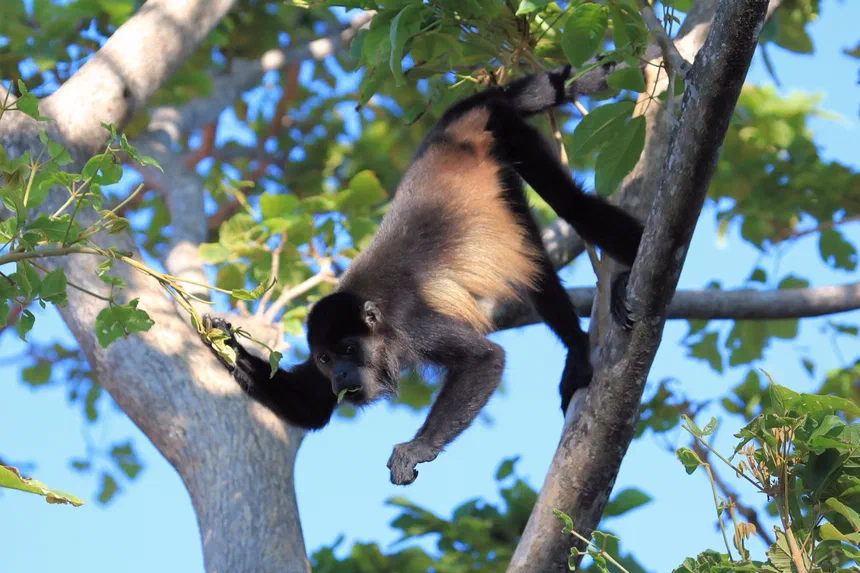
Image: Paul Harrison — CC BY-SA 4.0 · source
What Is a Mantled Howler Monkey?
The mantled howler monkey (Alouatta palliata) is a large, leaf-eating New World primate famous for the deep, roaring calls that carry for miles through the forest. It takes its name from the long golden-brown hairs that drape along its sides like a mantle, contrasting with its otherwise black coat.
Appearance and Identification
Mantled howlers are among the larger monkeys of the Americas. Adults have a predominantly black coat with a fringe of longer, pale golden or tan hair along each flank, giving the “mantled” appearance. The face is bare and dark, framed by a heavy beard, and the head looks bulky because of an enlarged hyoid bone in the throat that amplifies their calls. Males are noticeably larger than females and, at maturity, often develop a white or pale scrotum. A key feature is the long, muscular prehensile tail, which has a bare gripping pad on the underside near the tip and serves as a reliable fifth limb.
Habitat and Range
The species occupies a broad swath of the Neotropics, from southern Mexico through Guatemala, Honduras, Nicaragua, Costa Rica, and Panama, and into parts of Colombia, Ecuador, and Peru. It is highly arboreal and inhabits a range of forest types, including evergreen rainforest, semi-deciduous and dry tropical forest, mangroves, and forest edges. Because they rely heavily on leaves, mantled howlers can persist in relatively small or fragmented patches of forest where more specialized fruit-eating monkeys cannot.
Diet
Mantled howlers are folivores, meaning leaves form the core of their diet, though they also eat fruit, flowers, and young shoots when available. They favor tender new leaves, which are easier to digest and richer in protein than mature foliage. Leaves are abundant but low in energy and can contain toxins and tough fiber, so howlers have an enlarged gut and gut microbes that help ferment plant material. This nutrient-poor diet helps explain their generally slow, deliberate movements and long daily rest periods.
Behavior
These monkeys live in social groups that typically range from a handful to around twenty individuals, usually including several adults of both sexes. They are best known for their roaring choruses, produced most often at dawn and dusk. Rather than fighting over territory, neighboring groups broadcast these calls to advertise their location and spacing, reducing costly physical confrontations. Mantled howlers spend much of the day resting to conserve energy, moving slowly and quadrupedally through the canopy and using the prehensile tail for balance and support while feeding.
Life Cycle and Reproduction
Breeding occurs year-round, without a strict fixed season. Females give birth to a single infant after a gestation of roughly six months. Newborns cling to the mother’s belly at first and later ride on her back as they grow more coordinated. Weaning takes place over the first year to year and a half, and females generally reach maturity somewhat earlier than males. Young males typically leave their birth group as they mature, while dispersal patterns help maintain gene flow among groups. In the wild, mantled howlers commonly live into their mid-teens or beyond.
Conservation Status
The mantled howler monkey is currently listed as Least Concern by the IUCN, reflecting its wide range and tolerance for disturbed and fragmented forest. Even so, populations face ongoing pressure from deforestation, agricultural expansion, hunting, and the pet trade. Habitat fragmentation can isolate groups and raises the risk of electrocution on power lines and vehicle collisions where forest is broken up by roads. Maintaining forest corridors and protected areas remains important for the long-term stability of local populations.
Frequently Asked Questions
Why are howler monkeys so loud? Their enlarged hyoid bone acts as a resonating chamber, letting their calls carry for several kilometers. Groups use these roars to space themselves apart and avoid direct conflict.
What do mantled howler monkeys eat? They are primarily leaf-eaters, favoring tender young leaves, but they also consume fruit, flowers, and buds depending on the season.
Are mantled howler monkeys endangered? The species as a whole is listed as Least Concern, but it still faces threats from habitat loss, hunting, and fragmentation that can harm local populations.