Mammals Guide
House Mouse
What Is a House Mouse? The house mouse (Mus musculus) is a small rodent in the family Muridae and one of the most widespread and familiar mammals on Earth. Originally native to Asia, it has spread across nearly every …
At a glance
What Is a House Mouse?
The house mouse (Mus musculus) is a small rodent in the family Muridae and one of the most widespread and familiar mammals on Earth. Originally native to Asia, it has spread across nearly every part of the globe by traveling alongside humans, thriving in homes, barns, and fields. It is also the ancestor of the laboratory mouse, making it one of the most studied animals in science.
Appearance and Identification
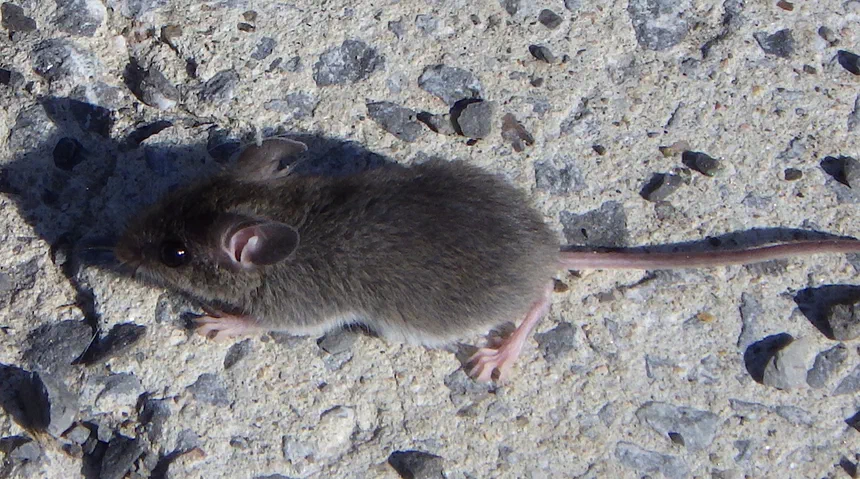
The house mouse is a compact rodent with a rounded body, a pointed snout, large rounded ears, and prominent dark eyes. Its fur is typically grayish-brown on the back and sides, shading to a paler gray or buff on the belly, though color varies with population and habitat. Adults usually measure about 7 to 10 centimeters in head-and-body length, with a nearly hairless, scaly tail roughly as long as the body. Most weigh between 12 and 30 grams. The tail, relatively large ears, and small size help distinguish the house mouse from young rats and from native field mice, which often have larger eyes and a sharper two-toned coat.
Habitat and Range
Few mammals occupy as broad a range as the house mouse. Native to the steppes and grasslands of central Asia, it now lives on every continent except in the harshest polar regions, having colonized new lands as a stowaway in cargo, ships, and stored goods. It is strongly commensal, meaning it lives in close association with people, and is most abundant in and around buildings, granaries, warehouses, and farms. Away from human structures it also inhabits fields, hedgerows, grasslands, and scrub, where it shelters in burrows or dense vegetation.
Diet
The house mouse is an opportunistic omnivore that eats a wide variety of foods. In the wild it favors seeds and grains, along with roots, stems, and other plant material, and it will also take insects and other small invertebrates when available. In and around human dwellings it readily consumes stored cereals, bread, and virtually any accessible food scraps. Mice nibble frequently, feeding many times throughout the day and night rather than in a few large meals, and they can survive on remarkably little water, obtaining much of their moisture from their food.
Behavior
House mice are mainly nocturnal or active around dawn and dusk, though they may be seen by day in quiet, sheltered places. They are agile climbers, capable jumpers, and good swimmers, and they can squeeze through surprisingly small gaps. Communication relies heavily on scent, including urine marks that convey identity and status, as well as high-pitched squeaks and ultrasonic calls beyond the range of human hearing. Social structure is flexible: mice often live in family groups with a dominant male defending a small territory, while in crowded conditions many individuals may share space with frequent conflict.
Life Cycle and Reproduction
The house mouse is famous for its rapid reproduction. Under favorable conditions, especially indoors, females can breed year-round, producing several litters annually. After a gestation of about 19 to 21 days, a female gives birth to a litter that commonly numbers around five to eight pups, born blind, hairless, and helpless. The young grow quickly, opening their eyes at roughly two weeks, and are weaned by about three weeks of age. Females can become sexually mature within a couple of months, allowing populations to expand explosively when food and shelter are plentiful. In the wild, most house mice live less than a year because of predation and harsh conditions, though sheltered individuals may survive considerably longer.
Conservation Status
The house mouse is listed as Least Concern by the IUCN and ranks among the most abundant mammals in the world. Far from being threatened, it is often considered a pest where it damages stored food, gnaws materials, and can carry disease. At the same time, the species has been enormously valuable to humanity as a model organism in biology and medicine, contributing to research on genetics, disease, and behavior. Its adaptability and close ties to human activity ensure that it will remain common wherever people live.
Frequently Asked Questions
How long do house mice live? In the wild most house mice survive less than a year due to predators and harsh conditions, though protected individuals, including pets and lab mice, can live two to three years.
How many babies can a house mouse have? A single female can produce several litters a year, each typically containing around five to eight pups, which is why mouse populations can grow very quickly.
Are house mice the same as pet and laboratory mice? Yes. Domesticated pet mice and the standard laboratory mouse are both derived from the wild house mouse, selectively bred over many generations.