Mammals Guide
Horse
What Is a Horse? The horse (Equus ferus caballus) is a large, single-toed hoofed mammal domesticated by humans thousands of years ago. A member of the family Equidae alongside donkeys and zebras, it is prized for its …
At a glance
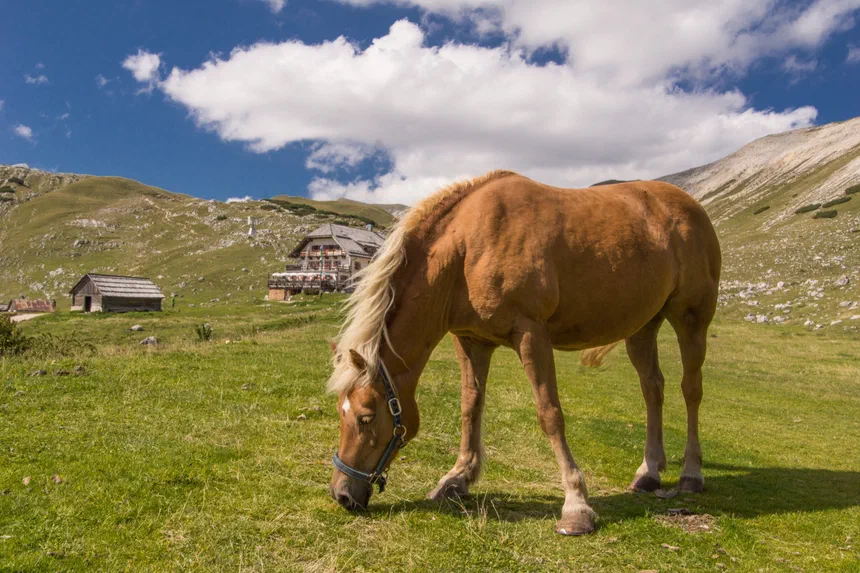
Image: Bramans — CC BY-SA 4.0 · source
What Is a Horse?
The horse (Equus ferus caballus) is a large, single-toed hoofed mammal domesticated by humans thousands of years ago. A member of the family Equidae alongside donkeys and zebras, it is prized for its speed, strength, and long partnership with people in work, transport, and sport.
Appearance and Identification
Horses have a long, muscular body carried on slender legs that each end in a single hardened hoof, an adaptation for running across open ground. The head is elongated with large, side-set eyes that give a wide field of vision, and mobile ears that swivel toward sounds. A mane runs along the neck and a long tail hangs from the rump, both used to shed insects and signal mood. Height is traditionally measured in “hands” (four inches each) at the withers, the ridge between the shoulder blades. Coat colors are varied and include bay, chestnut, black, gray, dun, and spotted or pinto patterns. Breeds range dramatically in build, from compact ponies to towering draft horses bred for heavy pulling.
Habitat and Range
Domestic horses live nearly everywhere people do, from ranches and farms to stables in cities and mountain villages. Their wild ancestors roamed the grasslands and steppes of Eurasia, and horses remain best suited to open country with room to graze and run. Feral populations, descended from escaped or released domestic stock, thrive in many regions, including the American West (mustangs), the Australian outback (brumbies), and various islands and moorlands. The Przewalski’s horse, a separate wild species, is the only truly wild horse never domesticated and survives in the steppes of Mongolia.
Diet
Horses are herbivores with digestive systems built for a steady intake of fibrous plant material. In natural settings they graze for many hours a day on grasses and other low vegetation. Managed horses are fed pasture grass, hay, and sometimes grains or formulated feeds to meet energy needs. Unlike ruminants such as cattle, horses ferment food in an enlarged hindgut, so they do best on frequent small meals rather than a few large ones. Constant access to clean water and roughage helps prevent digestive problems like colic.
Behavior
Horses are highly social herd animals that form strong bonds and rely on group living for safety. Wild and feral herds typically include mares, their young, and a dominant stallion, with bachelor males forming separate groups. As prey animals, horses are alert and quick to flee from danger, and they can doze standing up thanks to a locking mechanism in their legs. They communicate through body posture, ear position, tail movement, and vocalizations such as whinnies, nickers, and snorts. Their strong memories and ability to read human cues underlie the deep working relationships people build with them.
Life Cycle and Reproduction
A mare usually carries a single foal through a gestation of about eleven months. Foals are remarkably precocious, able to stand and nurse within an hour or two of birth and to run alongside the herd soon after, an important defense against predators. Young horses are weaned at several months and reach physical maturity by around four to five years, though many continue growing until then. With good care, domestic horses commonly live 25 to 30 years, and some exceed that. Breeding is often managed carefully by people to preserve or improve traits within a breed.
Conservation Status
As a domesticated animal, the horse is not assessed by the IUCN and is in no danger of extinction, numbering in the tens of millions worldwide. Its truly wild relative, the Przewalski’s horse, tells a different story: once extinct in the wild, it has been reintroduced from captive-bred animals and is now listed as Endangered. Some rare traditional horse breeds are maintained by conservation programs to protect genetic diversity, and feral horse populations are sometimes managed to balance their numbers with the health of the landscapes they occupy.
Frequently Asked Questions
How long do horses live? With good care most horses live around 25 to 30 years, and some ponies and well-kept individuals live even longer.
Can horses really sleep standing up? Yes. A special arrangement of ligaments and tendons lets horses lock their legs and doze upright, though they lie down for deeper sleep.
What is the difference between a horse and a pony? Ponies are simply smaller, typically under about 14.2 hands, and often have stockier builds, thicker coats, and calm temperaments, but both are the same species.