Mammals Guide
Honey Badger
What Is a Honey Badger? The honey badger (Mellivora capensis), also called the ratel, is a stocky member of the weasel family (Mustelidae) known for its boldness and toughness. Despite its name, it is only distantly …
At a glance
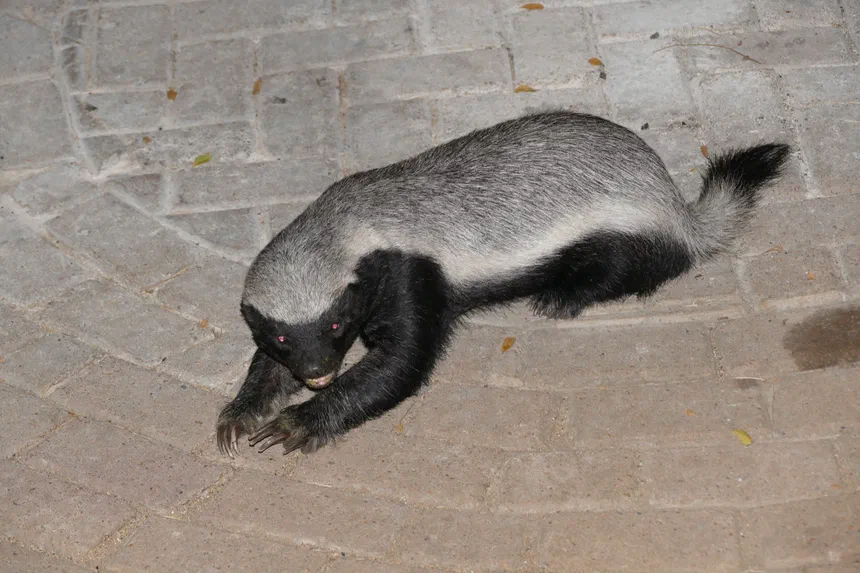
Image: Bernard DUPONT from FRANCE — CC BY-SA 2.0 · source
What Is a Honey Badger?
The honey badger (Mellivora capensis), also called the ratel, is a stocky member of the weasel family (Mustelidae) known for its boldness and toughness. Despite its name, it is only distantly related to true badgers, and it forms its own genus. Widespread across Africa and southern Asia, it has earned a reputation as one of the most fearless small carnivores in the world.
Appearance and Identification
The honey badger has a low, muscular body with short but powerful legs. Its coat is strikingly two-toned: the underside, face, and legs are black, while a broad band of coarse gray-to-white hair runs from the crown along the back to the base of the tail. This mantle is a reliable field mark. Adults typically measure about 55-77 centimeters from head to body, stand roughly 20-30 centimeters at the shoulder, and weigh between 5 and 16 kilograms, with males noticeably larger than females. The skin is famously thick and loose, especially around the neck, allowing the animal to twist and defend itself even when grabbed. The front feet carry long, sturdy claws well suited to digging.
Habitat and Range
Honey badgers are highly adaptable and occupy a wide variety of habitats. They range across most of sub-Saharan Africa, through the Arabian Peninsula and the Middle East, and eastward into Iran, Central Asia, and the Indian subcontinent. Within this range they inhabit open savanna, dry grassland, scrubland, and semi-desert, as well as some forested and mountainous areas. They tolerate arid conditions well and can be found from lowlands up into higher elevations, generally avoiding only the most extreme deserts and dense rainforest interiors.
Diet
The honey badger is an opportunistic omnivore with an exceptionally broad menu. It feeds heavily on insects and their larvae, along with scorpions, spiders, reptiles including snakes, rodents, birds and their eggs, frogs, and carrion. It also eats roots, bulbs, berries, and other plant matter when available. As the name suggests, it raids bee nests for honey and, more importantly, for protein-rich bee larvae, using its claws to tear into hives and its thick skin to endure stings. Powerful digging lets it excavate prey from burrows, and it is known to tackle venomous snakes.
Behavior
Honey badgers are mostly solitary and cover large home ranges in search of food. They are active by day and night depending on temperature and human activity, often becoming more nocturnal where people are common. Intelligent and persistent, they are noted for problem-solving and for escaping enclosures. When threatened, a honey badger is famously aggressive for its size, standing its ground against much larger predators. It can release a strong odor from its anal glands to deter enemies. In some regions it has a well-documented foraging association with the greater honeyguide, a bird thought to help lead it to bee nests.
Life Cycle and Reproduction
Honey badgers do not appear to have a strict breeding season across most of their range. After a gestation of roughly six to eight weeks, the female usually gives birth to one or occasionally two cubs in a burrow she digs herself. The young are born blind and helpless and depend on the mother for an extended period. Cubs may stay with and learn from their mother for well over a year, a long dependency for a small carnivore, and females typically raise only one youngster at a time. In the wild, honey badgers generally live around seven to eight years, though individuals in captivity have lived considerably longer.
Conservation Status
The IUCN lists the honey badger as Least Concern, reflecting its broad distribution and adaptable habits. Populations are not considered globally threatened, but local declines occur. Beekeepers sometimes kill honey badgers that raid hives, and the animals are also affected by trapping, poisoning aimed at other predators, and use in some traditional practices. Habitat loss and persecution can reduce numbers regionally even where the species remains secure overall.
Frequently Asked Questions
Are honey badgers really as fearless as their reputation suggests? They are genuinely bold and will defend themselves against far larger animals, aided by thick, loose skin and strong claws. Much of the fame is exaggerated, but the toughness is real.
Do honey badgers actually eat honey? They raid bee nests mainly for the nutritious larvae, though they consume honey too. Their thick skin helps them withstand stings while breaking into hives.
Can a honey badger survive a venomous snake bite? They regularly hunt snakes and show notable resistance to some venoms, but a serious bite can still incapacitate them temporarily. They are not fully immune.