Mammals Guide
Hog Deer
What Is a Hog Deer? The hog deer (Axis porcinus) is a small, stocky deer of the tall grasslands and floodplains of southern Asia. Its common name comes from its distinctive gait: rather than leaping over obstacles like …
At a glance
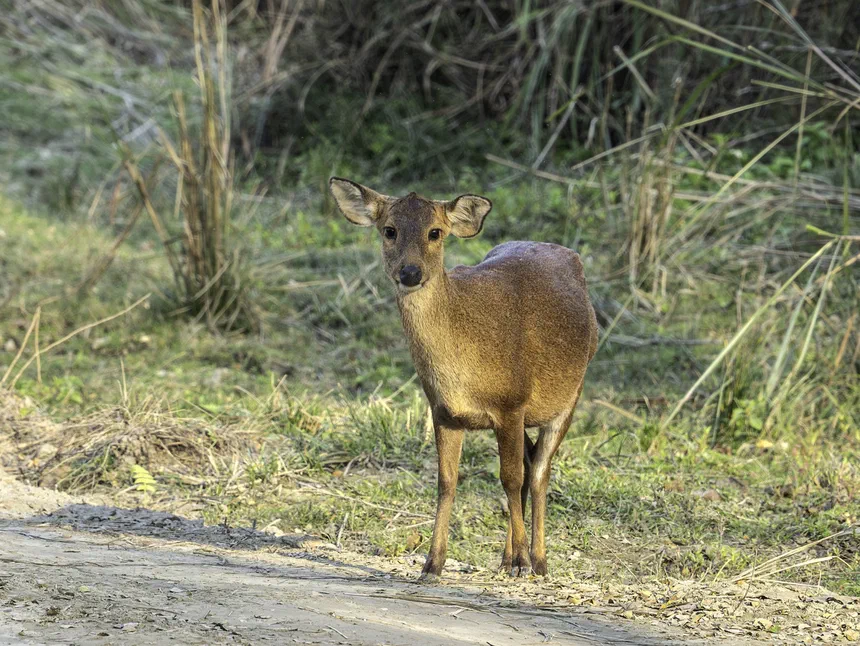
Image: Joydeep Chakraborty — CC BY-SA 4.0 · source
What Is a Hog Deer?
The hog deer (Axis porcinus) is a small, stocky deer of the tall grasslands and floodplains of southern Asia. Its common name comes from its distinctive gait: rather than leaping over obstacles like most deer, it lowers its head and dashes through undergrowth in a manner reminiscent of a running pig. It is closely related to the chital, or spotted deer, though it is smaller and far less social.
Appearance and Identification
Hog deer have a compact, low-slung body set on relatively short legs, giving them a hunched profile with the hindquarters carried higher than the shoulders. The coat is yellowish to reddish brown, fading to paler cream on the belly and inner legs, and darkens somewhat in winter. Fawns are born with faint spotting that generally disappears with age, though some adults retain a scattering of light dots along the back. Adults stand roughly 60 to 75 cm at the shoulder and measure about 100 to 115 cm in body length, weighing in the range of 30 to 50 kg. Only males grow antlers, which are typically three-tined and mounted on tall, bony pedicles; they are modest in size compared with those of larger deer.
Habitat and Range
This species is a specialist of tall, wet grasslands, favoring the alluvial floodplains, riverine meadows, and marshy terai belts where dense stands of grass provide both food and cover. Its historical range stretched across the northern Indian subcontinent, from Pakistan through northern India and Nepal, into Bangladesh, Myanmar, and parts of mainland Southeast Asia. Populations have become fragmented as grasslands have been converted to agriculture, and the animal now persists mainly in protected areas such as Kaziranga and the reserves of the terai. Introduced populations also exist in a few places outside its native range, including parts of Australia and Sri Lanka.
Diet
Hog deer are grazers first and foremost, feeding chiefly on young grasses and the fresh regrowth that follows flooding or fire. They also browse on herbs, forbs, and the tender shoots and leaves of low plants, and will take flowers and fallen fruit when available. Because they depend on nutritious new growth, they tend to concentrate where seasonal flooding or grazing keeps the grassland short and productive.
Behavior
Unlike many of its relatives, the hog deer is largely solitary or found in loose, temporary associations rather than tight herds. It is most active around dawn and dusk, resting in dense cover during the heat of the day. When alarmed it prefers to run low and fast through the grass rather than bound into the open, and it swims readily to cross the channels that thread its floodplain home. Males become more visible and vocal during the rut, when they compete for access to females.
Life Cycle and Reproduction
Breeding can occur across much of the year but often peaks with the seasons of grass growth. After a gestation of roughly seven to eight months, the female typically gives birth to a single fawn, hiding it in tall grass during its first vulnerable weeks. The young grows quickly on rich milk and begins grazing within a couple of months. Sexual maturity is reached at around one to two years of age, and wild hog deer may live on the order of ten to fifteen years, though many fall to predators or hunting well before that.
Conservation Status
The IUCN lists the hog deer as Endangered, reflecting steep declines across much of its former range. The main threats are the loss and drainage of floodplain grasslands, along with hunting and poaching. In some regions local populations have vanished entirely, while strongholds in well-managed reserves remain relatively secure. Grassland protection, anti-poaching patrols, and careful management of flooding and burning regimes are central to keeping the species from slipping further.
Frequently Asked Questions
Why is it called a hog deer? The name refers to the way it flees, running with its head held low and pushing through grass like a hog, instead of leaping over obstacles the way most deer do.
How is a hog deer different from a chital? The hog deer is smaller, stockier, and shorter-legged than the chital, keeps its spotting only faintly if at all as an adult, and tends to live alone rather than in large herds.
Are hog deer endangered? Yes. The species is classified as Endangered by the IUCN, chiefly because the tall wet grasslands it depends on have been widely lost to agriculture and development.