Mammals Guide
Hoary Marmot
What Is a Hoary Marmot? The hoary marmot (Marmota caligata) is a large, ground-dwelling rodent of the squirrel family, native to the mountains of northwestern North America. It is the biggest North American marmot …
At a glance
What Is a Hoary Marmot?
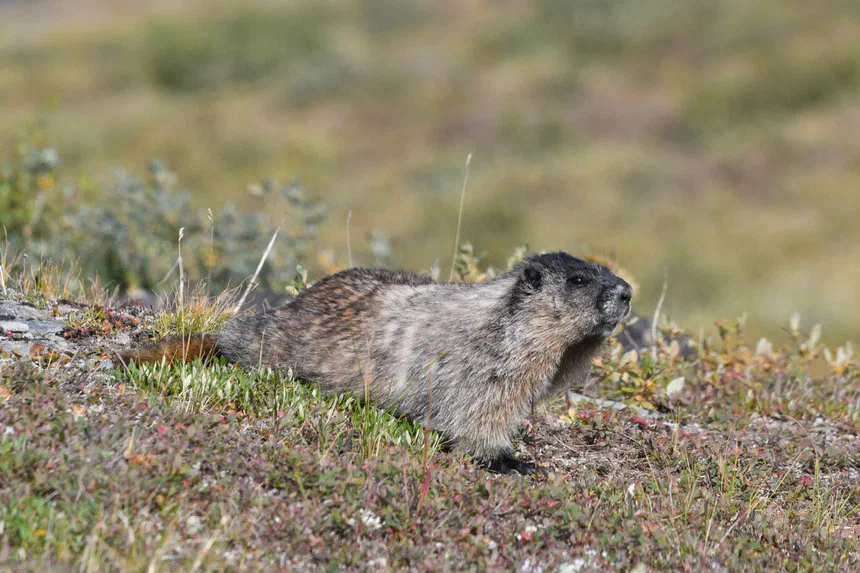
The hoary marmot (Marmota caligata) is a large, ground-dwelling rodent of the squirrel family, native to the mountains of northwestern North America. It is the biggest North American marmot species and takes its name from the frosted, silvery (“hoary”) fur draped across its shoulders and upper back. Like other marmots, it is a social burrower that spends much of the year hibernating.
Appearance and Identification
The hoary marmot is a stocky, heavily built rodent with short, powerful legs and a bushy tail. Its coat is grizzled silver-gray over the head, shoulders, and forequarters, grading into a browner or reddish rump. The face typically shows a black-and-white pattern, and the feet are dark, giving rise to the species name caligata, meaning “booted.” Adults measure roughly 62-82 cm (24-32 in) in total length, including a tail of about 17-25 cm. Weight varies dramatically with the season: individuals may weigh 3.5-4 kg in spring after hibernation but balloon to 7-9 kg by late summer as they store fat. Males tend to be somewhat larger than females.
Habitat and Range
This marmot is a specialist of high country. It lives in alpine and subalpine meadows, often near talus slopes, rockslides, and boulder fields that provide secure denning sites and lookout perches. Its range spans northwestern North America, from Alaska and the Yukon south through British Columbia and Alberta into Washington, Idaho, and Montana. Colonies are usually found above or near treeline, where open meadows supply abundant vegetation and nearby rocks offer shelter from predators and weather.
Diet
The hoary marmot is strictly herbivorous. It grazes on a wide variety of alpine plants, including grasses, sedges, broad-leaved forbs, flowers, berries, roots, and mosses. Feeding is concentrated in the short mountain growing season, when the animals eat intensively to build the thick fat reserves needed to survive many months of hibernation. They obtain most of their water from the plants they consume.
Behavior
Hoary marmots are highly social and typically live in colonies centered on a burrow system. They are diurnal, foraging in the cooler hours of morning and late afternoon and resting during midday heat. The species is famous for its loud, high-pitched alarm whistle, which has earned it the nickname “whistler”; the resort town of Whistler, British Columbia, is named for these calls. When a sentinel spots an eagle, bear, coyote, or wolverine, its whistle sends the colony diving for cover among the rocks. Much of the day is also spent sunbathing, grooming, and engaging in social play.
Life Cycle and Reproduction
Hoary marmots hibernate for a large portion of the year, often seven to eight months, emerging in spring when snow begins to melt. Mating occurs shortly after emergence. After a gestation of about a month, females give birth to a litter of roughly two to five young in an underground den. The pups are weaned within a few weeks and grow quickly through the summer. Because the alpine season is so short, females typically breed only every other year, and young may remain with the colony for a couple of seasons before dispersing to establish their own territories.
Conservation Status
The hoary marmot is listed as Least Concern by the IUCN. It has a broad range across remote mountain terrain, and overall populations are considered stable. The species faces no major immediate threats, though isolated high-elevation colonies could be sensitive to long-term climate change, which may shrink and fragment suitable alpine habitat.
Frequently Asked Questions
Why is it called “hoary”? “Hoary” means grayish or frosted, describing the silvery fur across the animal’s shoulders and back.
Why are hoary marmots called “whistlers”? They give a loud, piercing alarm whistle to warn the colony of predators; the sound is so distinctive that places like Whistler, BC, are named for them.
How do they survive winter in the mountains? They hibernate for roughly seven to eight months in underground burrows, living off fat reserves built up during the brief summer feeding season.