Mammals Guide
Hippopotamus
What Is a Hippopotamus? The hippopotamus (Hippopotamus amphibius) is a large, semiaquatic mammal native to sub-Saharan Africa. Despite its pig-like appearance, it is most closely related to whales and dolphins. It is one …
At a glance
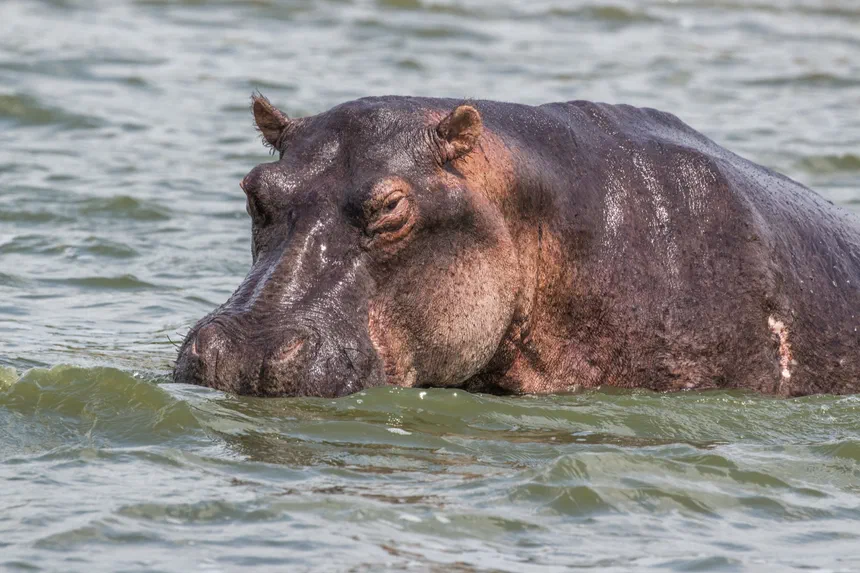
Image: Charles J. Sharp — CC BY-SA 4.0 · source
What Is a Hippopotamus?
The hippopotamus (Hippopotamus amphibius) is a large, semiaquatic mammal native to sub-Saharan Africa. Despite its pig-like appearance, it is most closely related to whales and dolphins. It is one of the heaviest land animals alive today, surpassed among terrestrial mammals only by elephants and some rhinoceroses.
Appearance and Identification
Hippos have a barrel-shaped body, short sturdy legs, and an enormous head that can account for a large share of their weight. Their skin is nearly hairless and ranges from grayish to purplish-brown, tinged pink around the folds and around the eyes and ears. The skin secretes a reddish, oily fluid, sometimes called “blood sweat,” that acts as a natural sunscreen and antibiotic. Their eyes, ears, and nostrils sit high on the head, allowing the animal to see, hear, and breathe while the rest of the body stays submerged. Males are generally larger than females and continue growing throughout life. The jaws open to nearly 150 degrees and hold formidable canine and incisor tusks that can exceed 30 cm.
Habitat and Range
Hippos occupy rivers, lakes, swamps, and slow-moving channels across sub-Saharan Africa, from West Africa through the eastern and southern parts of the continent. They favor deep water where they can stay cool and buoyant during the day, paired with accessible grassland nearby for nighttime grazing. Populations are now fragmented, having disappeared from much of their former range in North Africa and parts of the west.
Diet
The common hippopotamus is a herbivore that feeds almost exclusively on short grasses. At dusk it leaves the water and travels along established trails to grazing areas, sometimes covering several miles in a night. An adult eats roughly 35-45 kg (about 80-100 lb) of vegetation each night, a modest amount relative to body size because its mostly sedentary, water-supported lifestyle conserves energy. Occasionally hippos consume aquatic plants or, rarely, other food sources, but grass forms the core of their diet.
Behavior
Hippos are highly social and gather in groups, often numbering ten to thirty animals but sometimes far more, typically led by a dominant bull that controls a stretch of water. They spend the hot daylight hours resting in water or mud to protect their sensitive skin, becoming active and terrestrial after dark. Although they eat only plants, hippos are among Africa’s most dangerous animals, aggressively defending territory and calves. They are surprisingly agile on land and can run faster than a person over short distances. In water they do not truly swim so much as walk or push off the bottom, and they can hold their breath for around five minutes.
Life Cycle and Reproduction
Females reach breeding age at around five to six years. After a gestation of roughly eight months, a single calf is born, usually in or near the water, weighing between 25 and 50 kg. Calves can nurse underwater and stay close to their mothers, who are fiercely protective. Young are weaned at around six to eight months but may remain with the mother longer. Breeding and birthing often peak in the wet season when grazing is most abundant.
Conservation Status
The common hippopotamus is listed as Vulnerable by the IUCN. The main threats are habitat loss from human expansion and water diversion, and illegal hunting for meat and for the ivory in their teeth. Populations have declined in parts of their range, particularly in areas affected by conflict and unregulated hunting, though some protected populations remain stable.
Frequently Asked Questions
Are hippos really dangerous to people? Yes. Hippos are territorial and easily provoked, and they cause a significant number of human fatalities in Africa each year, especially when people come between them and the water or approach a mother with a calf.
What is a hippo’s closest living relative? Genetic and fossil evidence shows hippos are most closely related to cetaceans, the group that includes whales, dolphins, and porpoises.
Can hippos swim? Not in the usual sense. In deep water they move by pushing off the bottom or walking along it, and they can float and hold their breath for several minutes rather than swimming with strokes.