Mammals Guide
Himalayan Tahr
What Is a Himalayan Tahr? The Himalayan tahr (Hemitragus jemlahicus) is a sturdy, goat-like mammal native to the rugged high country of the Himalayas. A member of the family Bovidae and closely related to wild goats, it …
At a glance
What Is a Himalayan Tahr?
The Himalayan tahr (Hemitragus jemlahicus) is a sturdy, goat-like mammal native to the rugged high country of the Himalayas. A member of the family Bovidae and closely related to wild goats, it is superbly adapted to life on steep, rocky terrain where few large herbivores can thrive.
Appearance and Identification
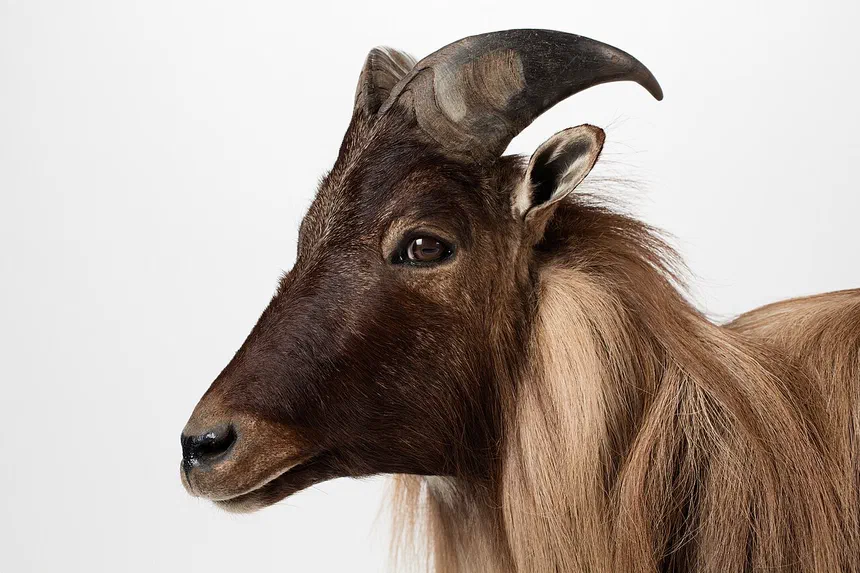
The Himalayan tahr has a compact, muscular body built for climbing rather than speed. Its coat is thick and shaggy, ranging from reddish-brown to dark brown, and males grow a striking mane of long hair over the neck and shoulders that can reach the knees. Both sexes carry curved horns, though the male’s are larger and more robust, typically curving backward and reaching around 30-45 cm. The legs are short and powerful, and the hooves have a flexible, rubbery core surrounded by a hard rim that grips uneven rock. Males are noticeably larger and darker than females, and their coats grow especially dense in winter.
Habitat and Range
This species inhabits the mountainous forests and alpine zones of the Himalayas, generally at elevations between about 2,500 and 5,000 meters. Its native range spans northern India, Nepal, and parts of southern Tibet. Tahr favor steep, broken slopes with a mix of rocky outcrops, grassy ledges, and scattered woodland, terrain that offers both grazing and quick escape from predators. Introduced populations have also established themselves in New Zealand, South Africa, and parts of North America, where they can become locally abundant and even problematic for native vegetation.
Diet
The Himalayan tahr is a herbivore with a broad, adaptable diet. It grazes on grasses and alpine herbs and also browses on the leaves, shoots, and twigs of shrubs and small trees. This flexibility allows it to feed on whatever vegetation the season and elevation provide, shifting between grazing in summer meadows and browsing woody plants when snow limits ground cover. Like other bovids, it is a ruminant, resting on sheltered ledges to chew its cud between feeding bouts, usually in the cooler hours of morning and evening.
Behavior
Tahr are social animals that typically live in herds. Females, young, and juveniles form groups that may number a dozen or more, while adult males often remain solitary or gather in smaller bachelor bands outside the breeding season. They are agile and sure-footed, capable of bounding across near-vertical rock faces to evade threats such as snow leopards. When alarmed, a tahr may give a shrill whistling alarm call. Their days revolve around feeding, resting, and moving between grazing areas and safe resting spots on inaccessible cliffs.
Life Cycle and Reproduction
The breeding season, or rut, occurs mainly in the autumn and early winter. During this period males compete for access to females, engaging in displays and head-to-head clashes to establish dominance. After a gestation of roughly six to seven months, females give birth in late spring or early summer, usually to a single kid. Newborns are remarkably precocious, able to stand and move over rugged ground within a short time. Young tahr are weaned over several months and reach sexual maturity at around two to three years of age. In the wild, individuals commonly live about 10 to 15 years.
Conservation Status
The Himalayan tahr is listed as Near Threatened by the IUCN across its native range. Populations have declined in some areas due to hunting and competition with domestic livestock, as well as habitat disturbance. Ironically, while numbers are pressured in parts of the Himalayas, introduced populations elsewhere are managed as invasive species and subject to control programs. Protected areas in Nepal and India help safeguard native herds, and continued habitat protection is important for the species’ long-term security.
Frequently Asked Questions
Is the Himalayan tahr a goat? It is not a true goat, but it belongs to the same subfamily (Caprinae) and is closely related to wild goats, sharing many of their climbing adaptations and body traits.
Where can Himalayan tahr be found? Their native home is the Himalayas of Nepal, northern India, and southern Tibet. Introduced herds also live in New Zealand, South Africa, and a few other regions.
How do tahr survive on steep cliffs? Their specialized hooves combine a soft, grippy central pad with a hard outer rim, giving them exceptional traction on rock and letting them move confidently across steep, uneven terrain.