Mammals Guide
Hazel Dormouse
What Is a Hazel Dormouse? The hazel dormouse (Muscardinus avellanarius) is a small, nocturnal rodent famous for its long winter sleep and its thick, furry tail. It is the only member of its genus and one of the more …
At a glance
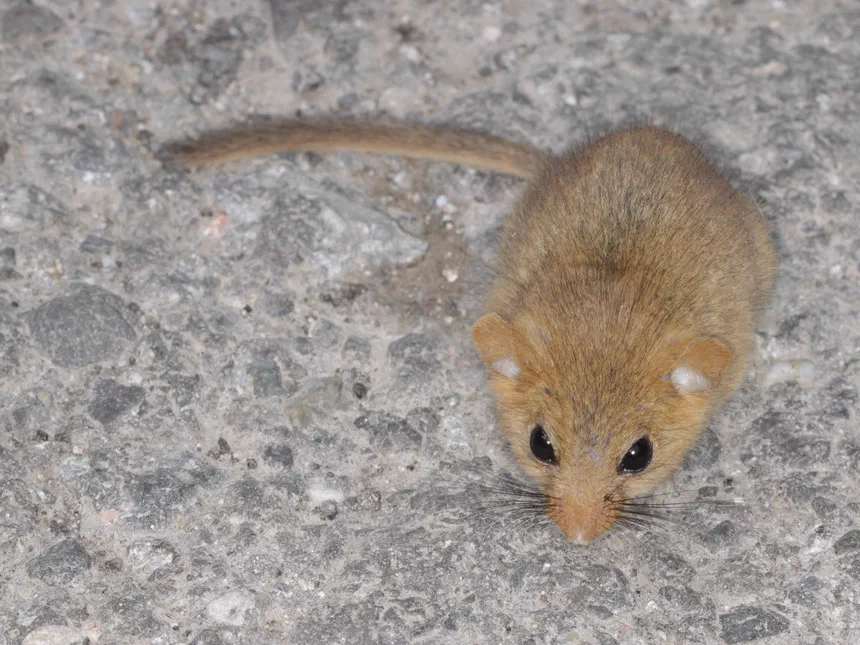
Image: gbohne from Berlin, Germany — CC BY-SA 2.0 · source
What Is a Hazel Dormouse?
The hazel dormouse (Muscardinus avellanarius) is a small, nocturnal rodent famous for its long winter sleep and its thick, furry tail. It is the only member of its genus and one of the more familiar dormice of European woodlands, where its golden coat and large dark eyes make it instantly recognizable when spotted.
Appearance and Identification
This is a diminutive animal, with a head-and-body length of roughly 6 to 9 centimeters and a bushy tail almost as long again. The fur is a warm golden-orange to sandy brown above, fading to a paler cream or buff on the underside, and the throat is often noticeably lighter. Unlike many mice, the hazel dormouse has a fully furred tail rather than a naked, scaly one. Its large black eyes and rounded ears suit a life spent moving through branches after dark. Adults typically weigh somewhere between 15 and 30 grams during the active season, though they can reach 40 grams or more as they fatten up before hibernation.
Habitat and Range
Hazel dormice are strongly associated with deciduous and mixed woodland, especially areas with a dense understory of shrubs such as hazel, bramble, and honeysuckle. Traditional coppiced woodland and thick, species-rich hedgerows are prized habitats because they provide both food and continuous aerial pathways. The species ranges across much of Europe, from Britain and parts of Scandinavia south to the Mediterranean, and eastward into Asia Minor. It tends to be patchy in distribution, favoring warm, structurally diverse woods with a well-developed shrub layer.
Diet
The hazel dormouse is an opportunistic feeder whose menu shifts with the seasons. In spring it eats flowers, buds, and pollen; in summer it turns to insects such as caterpillars and aphids for protein; and in late summer and autumn it feasts on berries, fruit, and energy-rich nuts and seeds, most notably hazelnuts. A neatly gnawed hole in a hazelnut shell, with a smooth inner rim, is a classic sign of dormouse feeding. This autumn bounty is essential, allowing the animal to build up the fat reserves it needs to survive hibernation.
Behavior
Almost entirely nocturnal and arboreal, the hazel dormouse spends most of its active life climbing among branches and rarely descends to the ground, where it is vulnerable to predators. It is an agile, careful climber that uses its tail for balance. During cool or wet weather in the active season it can enter short bouts of torpor to save energy. Individuals build woven nests of shredded bark, leaves, and grass, often tucked into shrubs, tree hollows, or nest boxes. The species is generally solitary and quiet, and its secretive habits mean it often goes unnoticed even where it is present.
Life Cycle and Reproduction
The defining feature of the dormouse year is a long hibernation, typically from around October until April, spent in a tightly woven nest close to or on the ground where temperatures stay stable. During the active months, females usually raise one or sometimes two litters, most often of about four young. The pups are born blind and hairless and develop over several weeks, staying with the mother until they are able to forage independently. Because the breeding season is short and tied to good food availability, reproductive success can vary greatly from year to year. In the wild, hazel dormice commonly live three to five years, which is remarkably long for such a small rodent.
Conservation Status
Globally the hazel dormouse is classified as Least Concern by the IUCN, reflecting its wide range. Regionally, however, it has declined in parts of its range, most notably in Britain, where loss of woodland management, hedgerow removal, and habitat fragmentation have reduced populations. Because it will not readily cross open ground, connected corridors of woodland and hedge are vital. Conservation efforts include coppice restoration, hedgerow planting, nest-box schemes, and legal protection in several countries.
Frequently Asked Questions
Why do dormice sleep so long? Hibernation lets them survive the cold months when their insect and plant foods are scarce; they live off fat reserves built up in autumn.
Do hazel dormice make good pets? No. They are wild animals with specialized needs and are legally protected in many countries, so keeping them is neither practical nor lawful in most places.
How can you tell a dormouse ate a hazelnut? They leave a round hole with a smooth, neatly gnawed inner edge, distinct from the rougher marks left by mice, voles, or squirrels.