Mammals Guide
Hartebeest
What Is a Hartebeest? The hartebeest (Alcelaphus buselaphus) is a large African antelope known for its long, narrow face and steeply sloping back. A member of the family Bovidae, it is one of the swiftest and most …
At a glance
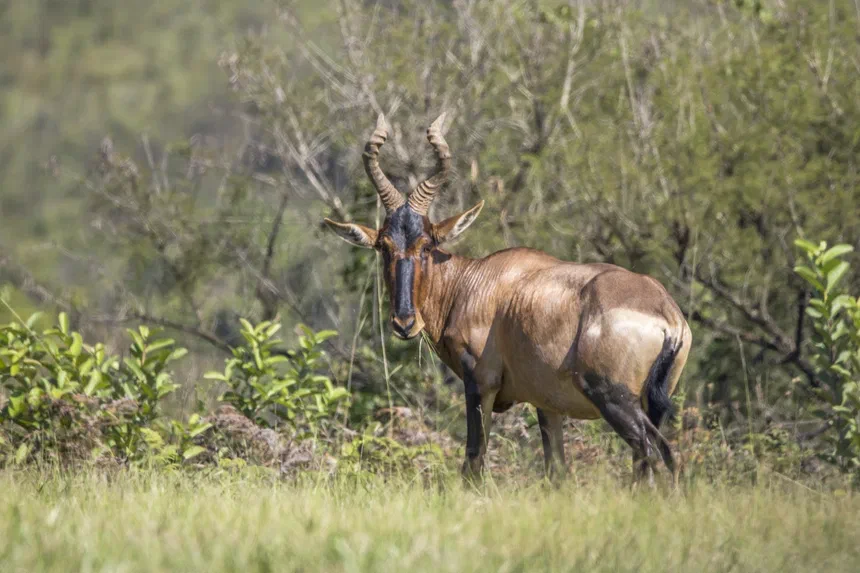
Image: Charles J. Sharp — CC BY-SA 4.0 · source
What Is a Hartebeest?
The hartebeest (Alcelaphus buselaphus) is a large African antelope known for its long, narrow face and steeply sloping back. A member of the family Bovidae, it is one of the swiftest and most enduring runners among the continent’s grazing antelopes, well suited to life on open plains.
Appearance and Identification
Hartebeest have a distinctive body shape: high, muscular shoulders drop away toward lower hindquarters, giving the animal a sloped profile. The head is unusually elongated, ending in a narrow muzzle. Both sexes carry ridged, roughly heart-shaped horns that rise from a bony pedicel on top of the skull, curve outward, and then hook backward; horn shape varies noticeably among the several subspecies. Coat color ranges from sandy tan to deep reddish-brown, often with paler underparts and rump and, in some populations, darker markings on the legs and face. Adults typically stand around 1.1 to 1.5 meters at the shoulder and weigh roughly 100 to 200 kilograms, with males somewhat heavier than females.
Habitat and Range
The species occupies a broad band of sub-Saharan Africa, favoring open savanna, grassland, and lightly wooded country. Historically its range extended across much of the continent and into North Africa, but populations have contracted, and several subspecies are now restricted to smaller pockets. Hartebeest generally avoid dense forest and very arid desert, preferring medium and tall grasslands where they can both graze and watch for predators over long sightlines.
Diet
Hartebeest are grazers, feeding predominantly on grasses, though they will take some leaves and herbs when grasses are scarce, especially in the dry season. They are relatively tolerant of lower-quality forage compared with some antelopes, which allows them to persist in areas that other grazers abandon during dry months. Like most bovids, they depend on regular access to water but can travel considerable distances between grazing grounds and drinking sites.
Behavior
Hartebeest are social animals that form herds, though group size and structure vary with season and habitat. Territorial males defend patches of grazing land and mating access, often using elevated points such as termite mounds as lookouts and marking sites. When alarmed, hartebeest are capable of sustained, bounding gallops and can reach high speeds, relying on stamina to outlast pursuing predators such as lions, hyenas, and wild dogs. Herds frequently mix with other grazers, and their tall stance and alert posture make them useful sentinels for the wider community of plains animals.
Life Cycle and Reproduction
Breeding can occur across much of the year in some regions, though many populations show a peak tied to the rains and the flush of new grass. After a gestation of roughly eight months, a female usually gives birth to a single calf. Unlike some antelopes that hide their young in vegetation for extended periods, hartebeest calves are often kept fairly close to the herd, though a mother may leave a very young calf concealed for short stretches. Calves grow quickly and are weaned within several months, reaching sexual maturity in the second or third year of life. In the wild, hartebeest commonly live around 12 to 15 years.
Conservation Status
As a species, the hartebeest is currently listed as Least Concern by the IUCN, reflecting its wide distribution and presence in numerous protected areas. That broad assessment, however, masks sharp differences among subspecies: some remain reasonably common, while others have become rare or locally extinct, and at least one North African form is considered extinct. Habitat loss, competition with livestock, and hunting are the main pressures, and the persistence of the more vulnerable subspecies depends heavily on well-managed reserves and conservation programs.
Frequently Asked Questions
Why does the hartebeest look so awkward? Its sloping back and long face are adaptations for efficient, enduring running and for grazing while keeping the eyes high enough to scan for danger.
Are male and female hartebeest easy to tell apart? Both sexes have horns, so they can look similar, but males tend to be larger and heavier and have thicker horn bases.
Is the hartebeest endangered? The species overall is Least Concern, but several individual subspecies are threatened or already lost, making local conservation important.