Mammals Guide
Harp Seal
What Is a Harp Seal? The harp seal (Pagophilus groenlandicus) is a medium-sized “true seal” of the northern oceans, named for the dark, harp- or wishbone-shaped marking that spreads across the back of adults. Superbly …
At a glance
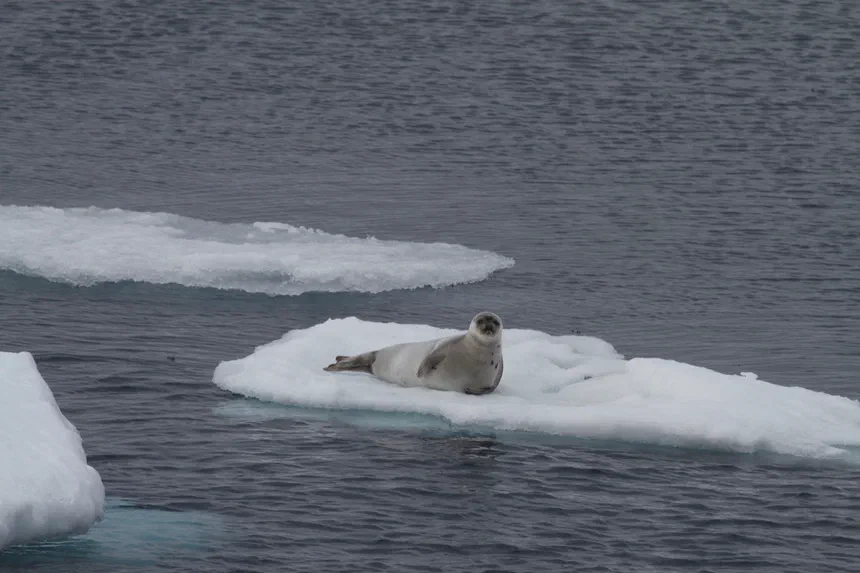
What Is a Harp Seal?
The harp seal (Pagophilus groenlandicus) is a medium-sized “true seal” of the northern oceans, named for the dark, harp- or wishbone-shaped marking that spreads across the back of adults. Superbly adapted to a life spent on drifting sea ice, it is one of the most abundant seals in the North Atlantic and Arctic, and its fluffy white newborns are among the most recognizable young of any marine mammal.
Appearance and Identification
Adult harp seals are streamlined and silvery-gray, with a black face and a distinctive dark band that curves along each flank and across the back to form the “harp” pattern. Males tend to show the boldest markings, while females may have a more broken or spotted version. Newborn pups, called “whitecoats,” are covered in a soft, cream-white lanugo that they molt within a few weeks. Adults typically measure about 5 to 6 feet (1.7-1.9 m) in length and weigh roughly 260 to 300 pounds (120-135 kg), with males and females similar in size. Large dark eyes, sensitive whiskers, and a thick layer of insulating blubber round out the profile of an animal built for frigid water.
Habitat and Range
Harp seals live in the cold waters of the North Atlantic and Arctic Oceans, ranging from the coasts of eastern Canada and Greenland across to Svalbard and the White Sea north of Russia. They are strongly tied to pack ice, which they use as a platform for resting, molting, giving birth, and nursing. For much of the year they are highly migratory, following the advance and retreat of seasonal ice and traveling thousands of miles between breeding grounds and summer feeding areas. Outside the breeding season they spend most of their time at sea, often far from land.
Diet
Harp seals are carnivores that feed on a wide variety of fish and invertebrates. Their diet shifts with season and location but commonly includes capelin, Arctic cod, herring, and other schooling fish, along with crustaceans such as krill and shrimp. They are capable divers, routinely reaching depths of several hundred feet in pursuit of prey and holding their breath for many minutes at a time. Young seals rely heavily on small shrimp-like crustaceans before graduating to fish as they grow.
Behavior
Outside of the breeding and molting seasons, harp seals are largely creatures of the open ocean, spending long periods diving and foraging. They are social animals that gather in enormous numbers on the ice during the pupping and breeding period, forming some of the largest aggregations of marine mammals on Earth. Their long seasonal migrations are among the more impressive of any seal. In the water they are agile and fast, using their hind flippers for propulsion, while on ice they move by hunching and dragging their bodies.
Life Cycle and Reproduction
Harp seals breed on the pack ice in late winter and early spring, with females hauling out in dense colonies to give birth to a single pup. The whitecoat pup nurses for only about 12 days, during which the mother’s extremely rich milk allows it to gain weight rapidly and build a thick blubber layer. The mother then departs and mating occurs, after which the weaned pup is left to fend for itself and eventually take to the water. Females generally reach maturity at around four to six years of age, and delayed implantation ensures pups are born the following spring. In the wild, harp seals may live roughly 20 to 30 years or more.
Conservation Status
The harp seal is listed as Least Concern by the IUCN, reflecting a large and generally stable global population numbering in the millions. Historically the species has been the target of large commercial hunts, and regulated hunting continues in some regions today. The greatest long-term concern is climate change: harp seals depend on stable, seasonal sea ice for breeding, and years with poor or early-melting ice can cause high pup mortality. Continued monitoring of ice conditions and hunt levels is important to keeping populations healthy.
Frequently Asked Questions
Why are baby harp seals white? Newborn pups have a coat of white fur called lanugo that helps camouflage them against the ice and provides insulation. They molt this coat and develop a spotted silvery pattern within a few weeks.
How long do harp seal mothers care for their pups? Nursing lasts only about 12 days. The mother’s fat-rich milk lets the pup gain weight quickly before she leaves it to survive on its own.
Are harp seals endangered? No. They are classified as Least Concern, with a global population in the millions, though loss of sea ice from a warming climate poses a growing threat to their breeding success.