Mammals Guide
Harbor Seal
What Is a Harbor Seal? The harbor seal (Phoca vitulina) is a widespread, medium-sized “true seal” found along the coastlines of the North Atlantic and North Pacific oceans. As an earless (phocid) seal, it lacks external …
At a glance
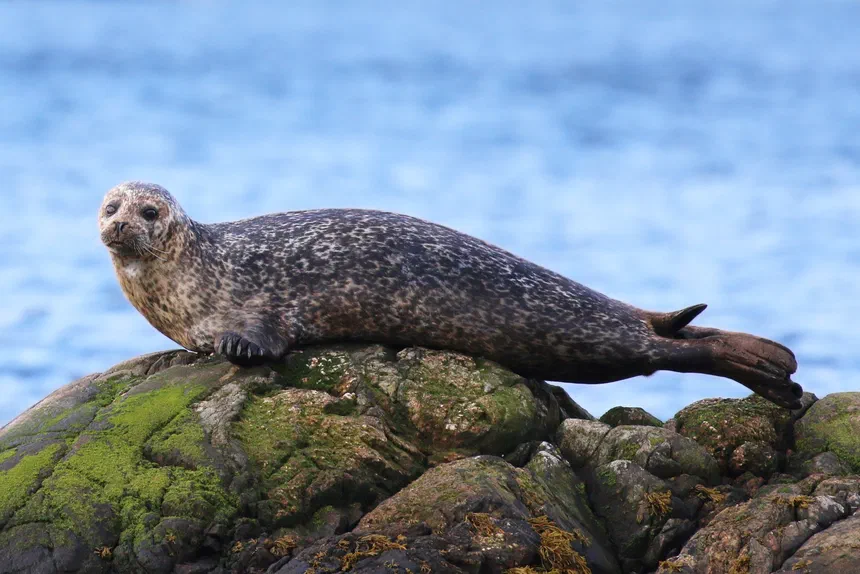
Image: Charles J. Sharp — CC BY-SA 4.0 · source
What Is a Harbor Seal?
The harbor seal (Phoca vitulina) is a widespread, medium-sized “true seal” found along the coastlines of the North Atlantic and North Pacific oceans. As an earless (phocid) seal, it lacks external ear flaps and moves on land with a distinctive caterpillar-like shuffle. It is one of the most commonly encountered marine mammals in coastal waters of the Northern Hemisphere.
Appearance and Identification
Harbor seals have a rounded head, large forward-facing eyes, and a short, dog-like snout with V-shaped nostrils. Their coat ranges from silvery gray to dark brown or tan and is patterned with darker spots, rings, and blotches, so no two individuals look exactly alike. Adults typically measure about 4 to 6 feet in length and weigh anywhere from roughly 100 to 370 pounds, with males generally larger than females. Their streamlined, spindle-shaped bodies and short flippers make them strong swimmers but awkward movers on land, where they cannot rotate their hind flippers forward.
Habitat and Range
Harbor seals occupy temperate and Arctic coastal waters across the Northern Hemisphere. In the Atlantic they range from the eastern United States and Canada across to Europe, while in the Pacific they extend from Baja California north to Alaska and across to eastern Asia. They favor nearshore environments such as bays, estuaries, rocky reefs, sandbars, and sheltered beaches. These seals are strongly tied to “haul-out” sites, exposed rocks, mudflats, or ice, where they rest, warm up, molt, and give birth. They generally stay close to shore rather than undertaking long open-ocean migrations.
Diet
Harbor seals are opportunistic carnivores that feed on a wide variety of prey depending on what is locally abundant. Their diet centers on fish such as herring, flounder, cod, sculpin, and salmon, supplemented by squid, octopus, and crustaceans. They typically hunt alone, diving to depths that commonly reach a few hundred feet and staying submerged for several minutes at a time. Sensitive whiskers (vibrissae) help them detect the movements and vibrations of prey in dark or murky water.
Behavior
Harbor seals are generally solitary in the water but gather in loose groups at haul-out sites, where they may lie in large numbers without forming tight social bonds. They tend to be wary and quick to flee into the water if disturbed. Much of their time ashore is spent resting, digesting, and regulating body temperature. When swimming, they can hold their breath for extended periods and even sleep underwater, surfacing periodically to breathe. Vocalizations are limited on land, but males produce underwater sounds during the breeding season.
Life Cycle and Reproduction
Breeding is seasonal and varies by region. Females usually give birth to a single pup each year after a gestation of roughly eleven months, which includes a period of delayed implantation. Pups are born well developed and can often swim within hours of birth, an adaptation for life in tidal environments. They nurse on rich, fatty milk for about three to six weeks before weaning, gaining weight rapidly during this short period. Females typically reach sexual maturity at around three to five years and males a little later. In the wild, harbor seals may live about 25 to 30 years, with females often outliving males.
Conservation Status
The harbor seal is classified as Least Concern by the IUCN, reflecting its broad distribution and large overall population. Some regional populations are stable or increasing, while others face pressures from entanglement in fishing gear, pollution, disease outbreaks, habitat disturbance, and reduced prey availability. In many countries harbor seals receive legal protection, and human disturbance at haul-out sites, especially during pupping season, remains a management concern.
Frequently Asked Questions
Are harbor seals the same as sea lions? No. Harbor seals are true (earless) seals that lack external ear flaps and move on land by wriggling, while sea lions have visible ear flaps and can turn their hind flippers forward to “walk.”
Are harbor seals dangerous to people? They are generally shy and avoid humans. Like any wild animal they can bite if cornered or handled, so people are advised to keep their distance, especially from resting seals and pups.
Why do harbor seal pups sometimes appear alone on beaches? Mothers routinely leave pups on shore while foraging, so a lone pup is often not abandoned. It is best to observe from a distance and contact local wildlife authorities rather than intervene.